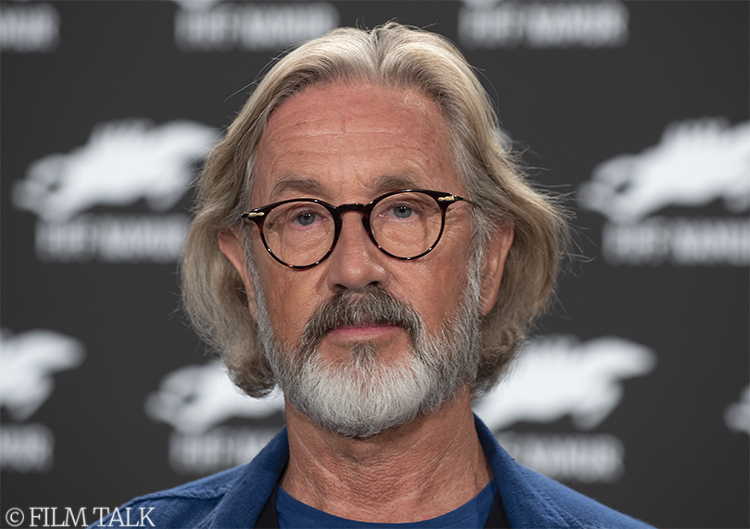
French screenwriter and film director Martin Provost (b. 1957) started his career in his native country as a stage and screen actor, and he was a member of the Comédie française. He turned to screenwriting and filmmaking more than twenty years ago when he made his directorial film debut “Totilla y cinéma” (1997, a.k.a. “Tortilla and Cinema”). Still, only after “Séraphine” (2008), based on the life of French painter Séraphine de Senlis, played by Yolande Moreau, he got recognized and became one of France’s leading filmmakers who—first and foremost as a writer—still prefers to script his own work.
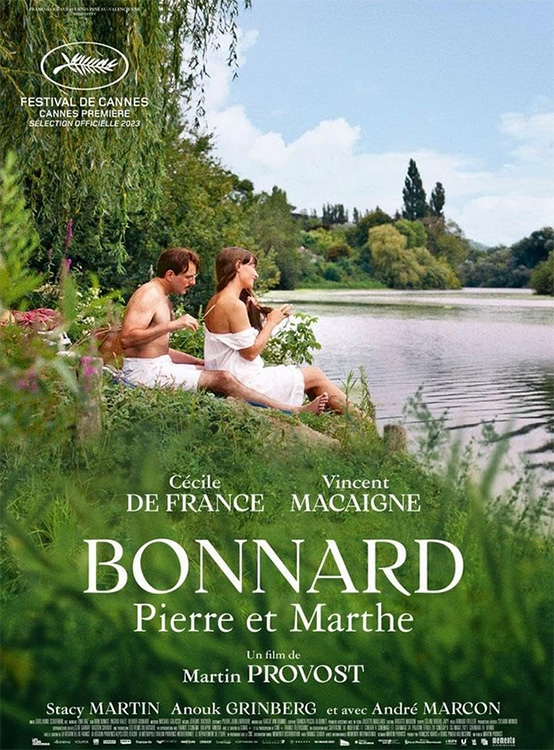
His latest film is “Bonnard, Pierre et Marthe” which premiered at last year’s Cannes Film Festival. In this beautifully crafted film, Vincent Macaigne plays French painter Pierre Bonnard (1867-1947), and Cécile de France is his muse, model, mistress and later his wife Marthe (1869-1942). They lived together since 1893, got married in 1925, and she became a productive painter as well.
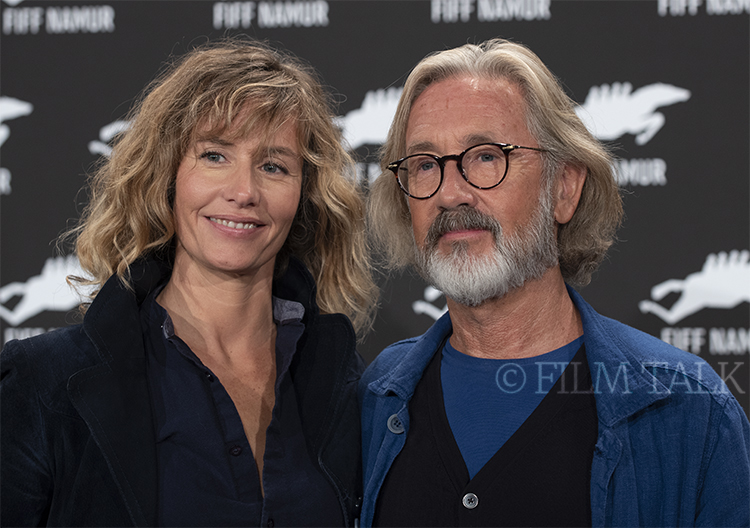
Last October, Martin Provost was a guest at the Festival International du Film Francophone de Namur, where the film was screened and where this interview was conducted. In Belgium, the film will be playing in theaters from January 10 and is released through Imagine Film Distribution.
Mr. Provost, how did you get involved in this project and life story of Pierre Bonnard and his wife Marthe?
It happened gradually. After I had finished “Séraphine” [2008], Marthe Bonnard’s great-niece contacted me. She had seen the film and wanted to meet me, and she asked if I was interested in doing a film about her great-aunt Marthe. She showed me some of her work, but I was not convinced, also because “Séraphine” was already about Séraphine Louis, a French painter. So I talked to Françoise Cloarec who had written “Séraphine: La vie rêvée de Séraphine de Senlis” [2008]. She had been my primary source for the film. As a result of our meeting, she wrote another book, “L’indolente: Le mystère Marthe Bonnard” [2016], telling the story of Marthe. In between, I made other films such as “Sage femme” [2017, a.k.a. “The Midwife”] and “La bonne épouse” [2020, a.k.a. “How to Be a Good Wife”]. During the lockdown, I was at home and realized I live only three miles from Giverny, close to where I shot the film. When I open my window, I see my garden and the forest—it almost looks like a Bonnard painting. During the first lockdown, the weather was great. Spring was great. There was no sound, no planes, no cars, no people. You could hear and feel that nature was coming alive. I took a book on Bonnard that I have, opened it, and saw his painting “Le déjeuner” where you see Marthe, and it’s a piece that he also paints in the film. I remembered that my mother, when I was about seven or eight, came home from Paris one day and had a poster of a Bonnard exhibition that she had gone to. She also painted, but like all women from her generation, she got married, had children, and stopped working. But she went to Paris frequently to visit her parents, and there were always exhibitions that never made it to Bretagne. So I had this Bonnet poster on my bedroom wall; I saw it every evening when I went to sleep. And when I was going through that book during the lockdown, it all came back to me. Especially Marthe’s eyes were fascinating. When I looked at his other paintings, I thought, Il ya a quelque chose à faire. It wasn’t only Marthe; it was the couple. Marthe’s relationship with Pierre and Pierre’s relationship with Marthe fascinated me. If it were only Marthe, that wouldn’t have been interesting enough. It’s both of them.
When telling their life story, was it necessary for you to focus on the different stages in their lives as presented in the film, like the end of the nineteenth century, 1914, 1918, etc.?
Yes, because I didn’t only want to tell their story, but also what it’s like to spend your whole life with somebody. I began with them as young people, then the stage that all couples go through avec le désir qui s’en va et l’amour sans désir, how they deal with it, introducing the character of Renée, the marriage of Pierre and Marthe, and then old age. I wanted to show what it leads up to.
“Bonnard, Pierre et Marthe” (2023, trailer)
How did you construct their story when you wrote the screenplay?
I have one rule: there are no rules. When I began this journey, I had read everything that I could find on Bonnard, the letters he wrote to [painter] Edouard Vuillard, everything he wrote on Marthe and that can be found in Guy Gofette’s “Elle, par bonheur, et toujours nue” [2002]… In the meantime, I was taking notes extensively, and very slowly, you are creating the story you are telling. But it takes time: when I write a screenplay, I can work for several days on one scene that I write over and over again until one day, I get it right. And then move on to the next scene. I always imagine that the characters are writing it for me, and I listen to what they are saying. Very often, I have cast my actors already, but for “Bonnard,” I hadn’t. This film is very different from my other films; I had another approach, and it gave me more freedom. When I wrote “Séraphine,” I heard the voice of Yolande [Moreau]; when I wrote “Violette” [2013], I heard Emmanuelle [Devos]; when I wrote “La bonne épouse” [2020], I heard the voice of Juliette [Binoche]. I live with them and see them playing their characters as if I am already directing them. With the first draft, I go to meet my producers who tell me, ‘No, you need to work more on this or that,’ or ‘You got it, this looks good.’
Several film directors say that writing a screenplay is more complicated than shooting a film. Would you agree with that?
Writing a screenplay is very difficult because you must keep so many things in mind: the camera, lighting, technical details, etc. But I make sure that my screenplays are easy to read so that you can imagine what’s happening when you read them. That’s how the British do it. Alec Guinness once played Macbeth with Simone Signoret [in 1966]; he was at the center of the stage, and when he spoke, you could see the words. In France we’d rather think in terms of the images, because le mot n’est pas l’image mais il est la pensée. So for me, it was essential to collaborate with two people: Isabelle Fauvel was my consultant—we spoke over the phone almost every day—and Mark Abdelnour, with whom I have written most of my screenplays. It’s interesting to have those people that you can rely on. And when I finish the script, I spend a lot of time preparing the technical details for each scene. That’s something I do with my first assistant and cinematographer. Then, when we’re shooting, it’s an entirely different approach; we shoot a scene, and I always think, ‘It will never be what I am looking for, but it will definitely be something interesting,’ because the actors bring other things to the table. If that input is enthralling, I adjust right away; it’s so interesting when actors enter the world you’re creating, but you can only achieve that with the entire cast and crew that surround you as they all invest their time, energy, experience, and talent in your project. In the end, we all have the same common goal.
What about your cameraman, Guillaume Schiffman?
His contribution is humongous. After “La bonne épouse” [2020], “Bonnard” is our second film together, and he created this softness. Very often, images can be cruel, and since I’m not a macho man, I prefer his vision. He also instinctively knew what I was looking for, so we worked quickly. We talked a lot before we began shooting, and he also liked the work of Pierre Bonnard, so this film was a gift for him. He knew precisely how to get the job done. When you look at a film d’époque, they often use the same filters and colors, while we wanted to create a different kind of reality.
 How did the chemistry between your leading actors, Vincent Macaigne and Cécile de France, come about?
I was an actor many years ago and have been able to work with several great actors and directors. At the Comédie française, I had great opportunities—I even played in “Macbeth” with Philippe Clévenot. Most actors of that era like Philippe Clévenot or Dominique Sanda are totally forgotten now, but I cherish them all because they meant so much to me. To observe them at work all the time, that was my basic training and best learning school. Watching them taught me a lot about directing, about how to open another door for your actors as if you’re a father who guides his children and takes care of them by giving them love and energy. That’s what I basically do as a director when I work with my actors.
You always give the impression that making a film is very easy. What is your secret, if any?
[Laughs]. I don’t know. I work very hard because it’s not easy to make a film. It’s very difficult. But it’s a very nice compliment. It’s like telling an actor that he makes you think his portrayal must have been very easy while it may have taken him months and months of preparation, or like a painter who makes a beautiful painting. So there’s no secret, it’s just hard work.
If you weren’t a filmmaker, what other profession would you have chosen? Painting?
Absolutely. I began painting at a young age, and I painted a lot, but it was too lonely a job for me.
Festival International du Film Francophone de Namur
October 3, 2023
FILMS
NEA, a.k.a. NEA: A YOUNG EMMANUELLE (1976) DIR Nelly Kaplan PROD André Génovès, Yvon Guézel SCR Nelly Kaplan, Jean Chapot (book by Emanuelle Arsan) CAM Andréas Winding ED Hélène Plemiannikov MUS Michel Magne CAST Sami Frey, Ann Zacharias, Françoise Brion, Micheline Presle, Heinz Bennent, Ingrid Caven, Robert Freitag, Martin Provost (Raphaël)
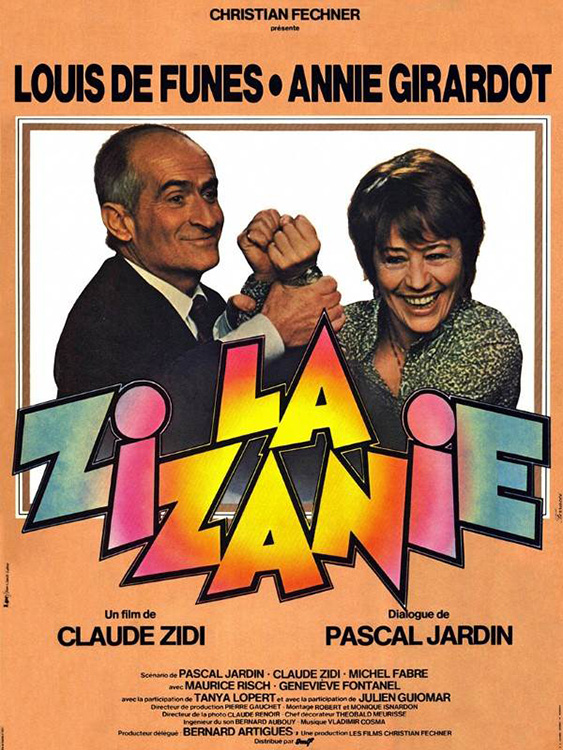
LA ZIZANIE, a.k.a. THE DISCORD (1978) DIR Claude Zidi PROD Marcel Berbert, Christian Fechner SCR Claude Zidi, Pascal Jardin, Michel Fabre CAM Claude Renoir ED Robert Isnardon, Monique Isnardon MUS Vladimir Cosma CAST Louis de Funès, Annie Girardot, Maurice Risch, Jean-Jacques Moreau, Geneviève Fontanel, Jacques François, Martin Provost
ALICE (1988) DIR – SCR Gabriel Benattar CAM Jean-Louis Sonzogni ED Gabriel Benattar, Christian Dior CAST Anne Consigny, Alain Fromager, Denis Manuel, Nadia Mourouzi, Martin Provost
PENTIMENTO (1989) DIR Tonie Marshall PROD Charles Gassot SCR Tonie Marshall, Sylvie Granotier CAM Pascal Lebègue ED Luc Barnier MUS Steve Beresford CAST Patricia Dinev, Antoine de Caunes, Magali Noël, Laurence César, Etienne Bierry, Jean-Pierre Jorris, Martin Provost (Frédéric)
 TORTILLA Y CINÉMA, a.k.a. TORTILLA AND CINEMA (1997) DIR – SCR Martin Provost PROD Yannick Bernard, Chantal Perrin, Ramón Pilacés CAM Éric Guichard ED Monica Coleman MUS Bruno Bertoli CAST Carmen Maura, Marc Duret, Michel Aumont, Marina Tomé, Marianne Groves, Mouss Diouf, José Otero
20, AVENUE PARMENTIER (2002) DIR – SCR Christophe Jeauffroy PROD Eric Mahé CAM Dominique De Wever ED Agnes Contensou MUS Daniel Barba CAST Barbara Schulz, Sagamore Stévenin, Julien Jeauffroy, Violetta Sanchez, Christian Krezel, Christophe Garnot, Martin Provost (Manu), Valérie Daradjian
LA VENTRE DE JULIETTE (2003) DIR Martin Provost PROD Didier Boujard, Jean Michel Savy, François Marquis SCR Martin Provost, Marc Abdelnour, Philippe Lasry CAM Jean-Claude Larrieu ED Christophe Pinel CAST Julie-Marie Parmentier, Stéphane Rideau, Carmen Maura, Nathalie Richard, Patrick Chesnais, Tom Novembre, Ariane Ascaride
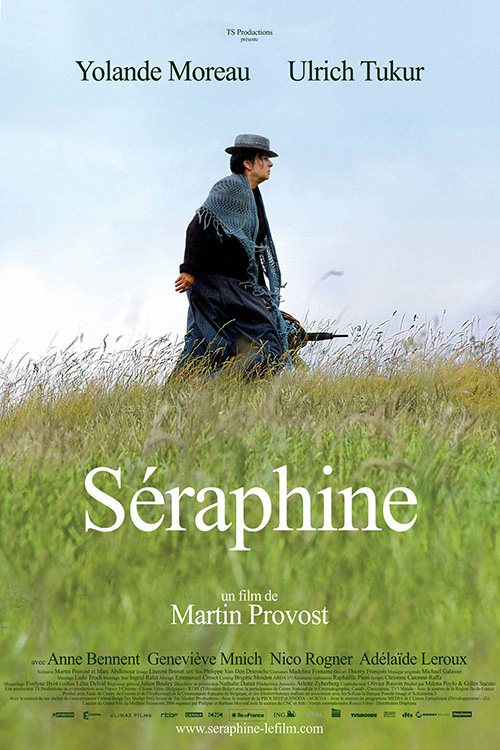 SÉRAPHINE (2008) DIR Martin Provost PROD Miléna Poylo, Gilles Sacuto SCR Martin Provost, Marc Abdelnour CAM Laurent Brunet ED Ludo Troch MUS Michel Galasso CAST Yolande Moreau, Ulrich Tukur, Anne Bennent, Geneviève Mnich, Adélaïde Leroux, Nico Rogner, Françoise Lebrun
OÙ VA LA NUIT, a.k.a. THE LONG FALLING (2011) DIR Martin Provost PROD Julie Salvador, Christophe Jeauffroy SCR Marc Abdelnour (novel by Keith Ridgway; adaptation by Martin Provost) CAM Agnès Godard ED Ludo Troch CAST Yolande Moreau, Pierre Moure, Edith Scob, Jan Hammenecker, Laurent Capelutto, Loïc Pichon, Servane Ducorps
VIOLETTE (2013) DIR Martin Provost PROD Gilles Sacuto, Miléna Poylo SCR Martin Provost, Marc Adbelnour, René de Ceccatty CAM Yves Cape ED Ludo Troch MUS Hugues Tabar-Nouval CAST Emmanuelle Devos, Sandrine Kiberlain, Olivier Gourmet, Catherine Hiegel, Jacques Bonnaffé, Olivier Py, Nathalie Richard, Stanley Weber
SAGE FEMME, a.k.a. THE MIDWIFE (2017) DIR – SCR Martin Provost PROD Olivier Delbosc CAM Yves Cape ED Albertine Lastera MUS Grégoire Hetzel CAST Catherine Frot, Catherine Deneuve, Olivier Gourmet, Quentin Dolmaire, Mylène Demongeot, Pauline Etienne, Pauline Parigot, Marie Gil-Pierre
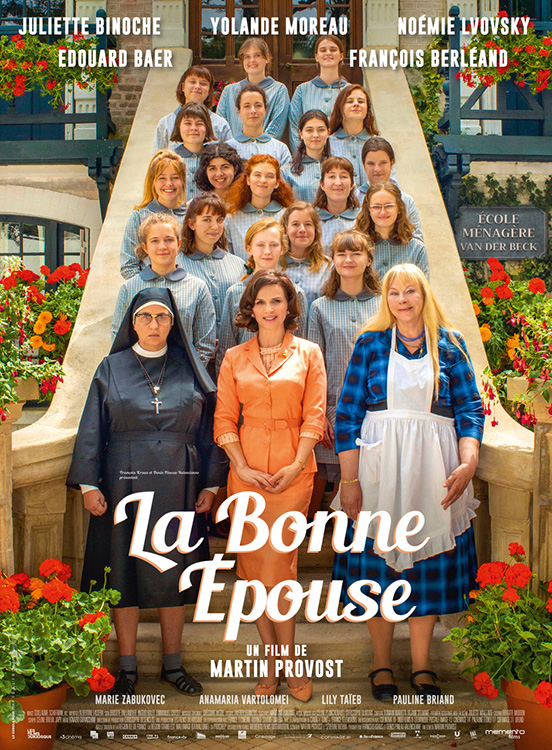 LA BONNE ÉPOUSE, a.k.a. HOW TO BE A GOOD WIFE (2020) DIR Martin Provost PROD Serge Hayat, François Kraus, Denis Pineau-Valencienne SCR Martin Provost, Séverine Werba CAM Guillaume Schiffman ED Albertine Lastera MUS Grégoire Hetzel CAST Juliette Binoche, Yolande Moreau, Noémi Lvovsky, Edouard Baer, François Berléand, Marie Zabukovec, Anamaria Vartolomei, Lily Taieb, Pauline Briand, Armelle, Marine Berlanger, Clémence Blondeau
BONNARD, PIERRE ET MARTHE (2023) DIR – SCR Martin Provost PROD Denis Pineau-Valencienne, François Kraus CAM Guillaume Schiffman ED Tina Baz MUS Michael Galasso CAST Cécile de France, Vincent Macaigne, Stacy Martin, Anouk Grinberg, André Marcon, Hélène Alexandridis, Grégoire Leprince-Ringuet, Peter Van den Begin, Yveline Hamon
TV MOVIES
LE DEVOIR DE FRANÇAIS (1978) DIR Jean-Pierre Blanc SCR Denis Lalanne (also novel) MUS Jacques Loussier CAST Frédéric Andréi, Martin Provost, Clémentine Amouroux, Gisèle Casadesus, Michèle André, Catherine Miltry
MESSIEURS LES RONDS-DE-CUIR (1978) DIR Daniel Ceccaldi SCR Daniel Ceccaldi (novel by Georges Courteline) CAM Alain Levent MUS Georges Delerue CAST Claude Dauphin, Raymond Pellegrin, Daniel Ceccaldi, Evelyne Buyle, Roger Carel, Roland Armontel, Bernard Le Coq, Martin Provost (Medare)
TARENDOL (1980) DIR Louis Grospierre SCR (novel by René Barjavel; adaptation by Louis Grospierre) CAST Jacques Penot, Florence Pernel, Michel Duchaussoy, Daniel Gélin, Nathalie Keryan, Françoise Brion, Martin Provost (Fiston)
HISTOIRES DE VOYOUS: OPÉRATION PRIMEVÈRE (1981) SCR (novel by Pierre Boileau, Thomas Nercejac; adaptation by Dorothée Dhan) CAST François-Eric Gendron, Wolfgang Höper, Pierre Londiche, Germain Muller, Martin Provost, Johannes Schaaf, Michel Such
L’HISTOIRE EN MARCHE: LES PRISONNIÈRES (1985) DIR Jean-Louis Lorenzi SCR Jean-Louis Lorenzi, Stellio Lorenzi, Guy Vassal CAST Sophie Duez, Hélène Vauquois, Martin Provost (Mathieu Seguin), Blandine Métayer, Robert Bazil, Fabienne Tricottet, Violette Malglaive
TV MINI-SERIES
LES FOLLIES OFFENBACH (1977) DIR Michel Boisrond SCR Marcel Jullian, André Roussin, Shervan Sidery, Georges Neveux, Daniel Ceccaldi CAST Michel Serrault, Catherine Samie, André Thorent, Philippe Ariotti, Marco Perrin, Martin Provost
AU PLAISIR DE DIEU (1977) DIR Robert Mazoyer SCR Paul Savatier (novel by Jean d’Ormesson) CAM Jean Badal ED Maryse Siclier MUS Antoine Duhamel CAST Jacques Dumesnil, Paul Barge, Heidi Stroh, Pino Colizzi, Alain Floret, Yves Beneyton, Sylvie Granotier, Martin Provost (Philippe, jeune)
BANLIEUE SUD-EST (1977) DIR Gilles Grangier SCR (adaptation by Jean Herman; novel by René Fallet) CAST Paul Le Person, Maurice Biraud, Odette Laure, Christopher Beaunay, Philippe Mathieu, Valérie Pascale, Martin Provost
 FILM TALK
You must be logged in to post a comment.