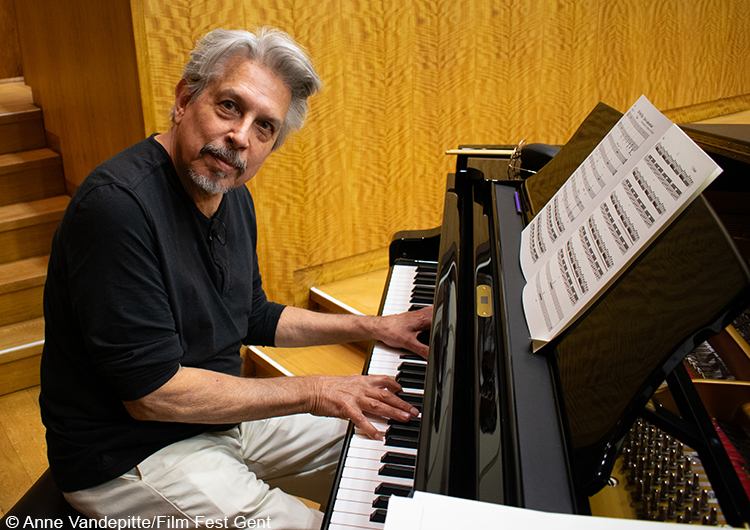
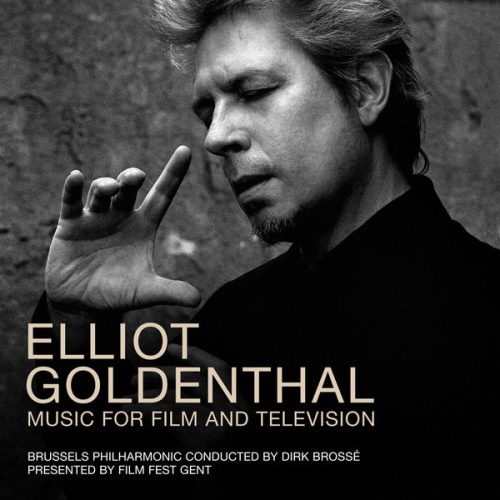
Last month, American film composer and Academy Award winner Elliot Goldenthal (b. 1954) was in Belgium to compile an album, “Elliot Goldenthal: Music for Film and Television,” with brand-new recordings of film scores he did over the years. At the 51st edition of Film Fest Gent in Belgium (from October 9 to October 20), the highly acclaimed film composer will receive the World Soundtrack Award Lifetime Achievement Award for his tremendous contribution to the art of film music.
Music has been Mr. Goldenthal’s lifelong passion. Influenced from an early age by music from all cultures and genres, he studied at the Manhattan School of Music in the 1970s. His principal (and private) teacher in Musical Composition at the Manhattan School of Music where he received his Bachelors and Masters Degrees was John Corigliano (1972 -1979). His tutorledge with Aaron Copland was on an informal basis roughly from 1980-1985 and not under the auspices of an official setting nor a University. These experiences helped shape his unique approach to composition, which often blends classical elements with contemporary, experimental techniques.
He first gained recognition in Hollywood during the late 1980s and early 1990s with high-profile film scores showcasing his distinctive style. His breakthrough film was David Fincher’s “Alien³” (1992); his score was a masterful blend of dissonance, orchestral power, and innovative use of electronic elements that reflected the film’s dark and unsettling tone. This score earned Mr. Goldenthal his first of four Academy Award nominations and established him as a leading composer in the industry.
“Alien³” (1992, trailer)
One of his most iconic works is the score for Neil Jordan’s “Interview with the Vampire: The Vampire Chronicles” (1994). It’s a lush, Gothic orchestral work that perfectly captures the film’s brooding atmosphere and the haunting beauty of its vampiric protagonists. He continued to collaborate with Neil Jordan on four more films, including the period piece “Michael Collins” (1996), starring Liam Neeson in one of his best roles, and “The Butcher Boy” (1997), a film that combines magic realism with everyday reality, and is set in the early 1960s in a small town in the west of Ireland.
One of Mr. Goldenthal’s most notable achievements and career highlights is “Frida” (2002), which earned him an Academy Award (category Best Original Score). The film was directed by Julie Taymor; so far, he scored seven of her films. With “Frida,” Mr. Goldenthal offers a vibrant and evocative blend of traditional Mexican music with his own orchestral style that reflected the life and work of Mexican painter Frida Kahlo, portrayed by Salma Hayek.
“Frida” (2002, trailer)
Beyond film, Mr. Goldenthal has also made significant contributions to opera and concert music. His opera “Grendel” was based on John Gardner’s 1971 novel and premiered in 2006 to critical acclaim. The opera’s score is a complex, multifaceted work that combines orchestral music, electronic elements, and vocal experimentation, demonstrating Mr. Goldenthal’s continued commitment to pushing the boundaries of musical expression.
To get back to where we took off, his album “Elliot Goldenthal: Music for Film and Television” was recorded only a couple of days ago at Studio 4 Flagey in Brussels, with the Brussels Philharmonic Orchestra conducted by Film Fest Gent’s music director Dirk Brossé—in the presence of the maestro himself. The album includes a selection from his scores for “Alien³,” “Interview With the Vampire: The Vampire Chronicles” and “Michael Collins”; also themes from Michael Mann’s “Heat” (1995) and “Public Enemies” (2009), and concert suites that have never been recorded before. The WSA album will be released next October but is already available to pre-order at the Film Fest Gent webstore.
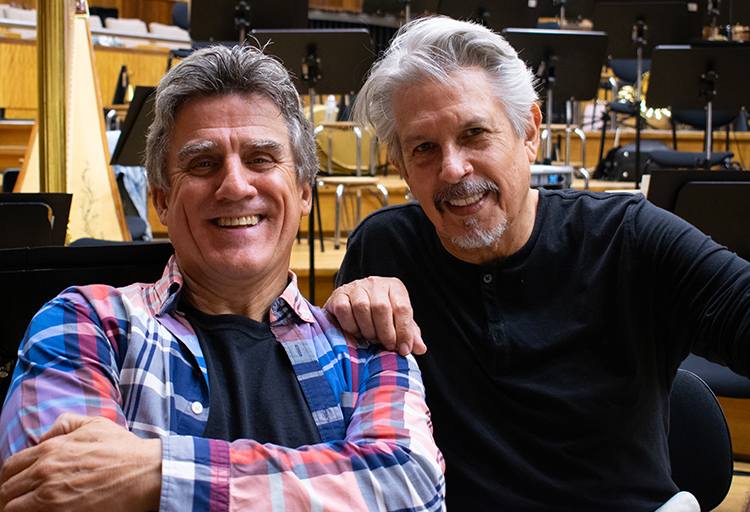
The following interview with Mr. Goldenthal was conducted after he finished the final recordings at Flagey and when he took the time to reflect on his work and craft as a film composer.
Mr. Goldenthal, when you are recording your music like you did this afternoon, what do you need to feel to be sure your score is exactly how you want it to be?
I need to feel clarity. I want to make sure that the accuracy of the parts and the musicians’ notes in their parts are correct because the emotions that I discovered in collaboration with a movie are something I might have responded to six months ago, five years ago, or maybe thirty years ago. All of those responses must be reproduced; when something is reproduced, it must be clear and without mistakes. Beyond that, it’s conveying the intentions. Sometimes, the intentions aren’t emotional; sometimes, they are objective or just in question of loud or soft. And sometimes—every once in a while—it has to do with tangable human emotions, like grief and romance. But not all of the time; there are a lot of degrees in between. Life is filled with many things, including objective observation of things. When we look at a beautiful sunset, a tree, a flower, or the ocean, I don’t feel sad or happy; it’s just an observation. A quality of light, a quality of a shadow, so all of that, including the original intention of the interaction between music and image, has to be reflected in the rendering of the conductor who maybe never saw the movie or maybe has no idea of what my emotion is. But on the page, it has to be correct and it has to be clear.
You are a very versatile composer and work on various films and film genres, from Shakespeare adaptations to “Alien” and “Batman” films. How do you approach all those different subjects?
Film is a collaborative art, so I’m trying to see what the director and the performances of the actors and the actresses are bringing to the final edit. Sometimes the director’s intentions trigger a musical thought; sometimes you see it in a performance or the set design when it’s set in a certain era of time. Sometimes it’s the speed of the editing. All of those factors play a part in what I respond to. I think it’s a very human thing to be able to have a deep religious experience in a church and then go to a carnival, laugh at comedy, or see the horror of the news on television. It’s all in front of us, it’s all being human, and especially Shakespeare had all of those qualities. That’s why he is such an amazing, timeless, and contemporary author of all time—he’s always contemporary because he takes in human truth and human emotions that are mundane and complex, and he expresses it through words. He’s a gift to all of us.
So if I understand you correctly, the director is your most important collaborator? And would it be correct to say that, along with the script and the characters, they define your score?
I don’t think they define it. They invite me to be a part of that vehicle of communication. I try to tell the story that the collaborators want to tell, and that includes myself. But I’m not the only one.
When did you first realize during your formative years that you wanted to write film scores?
It was a part of my life. Other composers in the nineteenth century had other things like the theater. [Felix] Mendelssohn, for example, was responding to Shakespeare and a theater experience. [Pyotr Ilyich] Tsjaikovsky resonated in many cases with the dance theater. There wasn’t any film then, but any composer always looks for things where they can contribute to general life because it’s there. It’s a means to express what you do naturally.
A cinematographer is always on the set, a set designer is always on the set, but film composers usually aren’t, I suppose?
Sometimes I’m given the opportunity to read the script first, and then being invited to the set—and sometimes not. Sometimes I come in two composers down the line if they didn’t work out. With the films I did with Neil Jordan, Julie Taymor, Joel Schumacher, they always invited me to the set and I read the script. When David Fincher was filming “Alien³,” he also invited me to the set. And in many cases, like with “Titus,” I had to compose things before the movie was shot so that the choreographer on the movie could take the music and choreograph his scenes. The opening of “Titus” was scored before it was shot. With “Frida,” the tango scene was rehearsed before the movie was shot. So it had to be composed before it was shot because it had to be rehearsed and choreographed in advance to the movie.
Film composers often work at night in their music studio. You too?
Yes, sometimes. It can also be hands-on from the very beginning. But I like the idea of working all night long. That’s what I do. In my music studio, I have everything I need: pencils, erasers, a computer, a piano,…
You just mentioned “Frida,” which earned you an Academy Award. Did your phone explode after the Oscars because everybody wanted to work with you?
No, absolutely not. No. I was surprised. I don’t know why… I was not upset but certainly a little surprised. I thought—like you—that a lot of offers could come in, but they didn’t.
Before “Frida,” you scored lots of films during the 1990s, and after “Frida,” your film output slowed down considerably…
…I guess because I won an Academy Award [laughs]. I don’t know. I had four Academy Award nominations, and with “Frida,” I was lucky to have won. After “Frida,” I composed “Grendel,” an opera, and for me, operas take time. It took nearly two years to compose, so that kept me very busy in 2003, 2004, and even 2005.
Mr. Goldenthal accepts his Oscar for “Frida” at the 75th Academy Awards ceremony on March 23, 2003
What is the difference when you’re writing a film score, compared to an opera or ballet?
They’re all very different. They all have different demands. In ballet, you have to think about the endurance of the dancers; if you write a duet or a solo, you have to keep into account that you can’t write a thirty-minute piece. So it has limitations built into that. In opera, it’s the same thing; you have to be careful about the range of taxation of the singers and the orchestration so it doesn’t cover the voice. You have to be careful with the balance between the voice and the orchestra. In musical theater, if you’re writing tunes, they have to be melodies that people can follow—whether you’re [George] Gershwin or Kurt Weill, the melodies must be applicable to the audiences. In classical composition you can be more adventourous, you can even be avant garde. So each type of medium has a different set of problems and a different set of obstacles that you need to understand.
Would you consider yourself a film composer, an opera composer, a theater composer…?
I’m a composer. I remember composers like [Dmitri] Shostakovich, for example, who wrote about forty film scores, and another film composer, [Erich Wolfgang] Korngold, wrote something like twelve operas, I think. So scoring a film is another way of expressing yourself. Now, sadly, there are less films being made, less venues, less movie theaters since Covid. People don’t attend movies like they used to unless it’s a big blockbuster like Marvel comics or something. There are less complicated subjects being limited to television, and that’s something else; that’s another art that’s also to be respected.
Last year, one of the issues that led to the Hollywood strike was the possibility of using artificial intelligence to generate scripts or to replicate actors’ likenesses. Is AI also a concern among film composers?
I think artificial intelligence will take work away from composers, but I don’t think it will do very well in melodic situations because a melody is a very difficult thing, even for human beings. Maybe copying other composers’ styles in action movies might be successful as a way of not hiring composers. But the audience might be upset as the score does not have a personality, you know. How can you account for personality—for example, the personality of Bernard Herrmann or Nina Rota? You can’t quantify, you can’t put it in digital numbers, or reduce it to digits. A personality in terms of working with a director or a writer, those things I don’t think AI is capable of doing because it’s way too complex and way too simple at the same time.
Flagey, Brussels
August 27, 2024
FILMS
COCAINE COWBOYS (1979) DIR Ulli Lommel PROD Franz-Christoph Giercke SCR Ulli Lommel, Spencer Compton, Tom Sullivan, Victor Bockris CAM Jochen Breitenstein ED Paul Evans MUS Elliot Goldenthal CAST Jack Palance, Andy Warhol, Tom Sullivan, Susannah Love, Esther Oldham-Farfan, Peter Huckabee, Richard Young, Tony Munafo
BLACK GENERATION (1980) DIR Ulli Lommel PROD Roger Deutsch SCR Ulli Lommel, Peter Muller, Robert Madero, Richard Hell (story by Ulli Lommel) CAM Atze Glanert ED Paul Evans MUS Elliot Goldenthal CAST Carole Bouquet, Richard Hell, Susannah Love, Howard Grant, Ulli Lommel, Andy Warhol, Ben Weiner, Robert Madero
 PET SEMATARY (1989) DIR Mary Lambert PROD Richard P. Rubinstein SCR Stephen King (novel “Pet Sematary” [1983] by Stephen King) CAM Peter Stein ED Michael Hill, Daniel P Hanley MUS Elliot Goldenthal CAST Dale Midkiff, Fred Gwynne, Denise Crosby, Brad Greenquist, Michael Lombard, Miko Hughes, Blaze Berdahl, Susan Blommaert, Stephen King
DRUGSTORE COWBOY (1989) DIR Gus Van Sant PROD Karen Murphy, Nick Wechsler SCR Gus Van Sant, Daniel Yost (novel “Drugstore Cowboy” by James Fogle) CAM Robert D. Yeoman ED Mary Bauer, Curtiss Clayton MUS Elliot Goldenthal CAST Matt Dillon, Kelly Lynch, James Le Gros, Heather Graham, Eric Hull, Max Perlich, James Remar, John Kelly, Grace Zabriskie
GRAND ISLE (1991) DIR Mary Lambert PROD Carolyn Pfeiffer SCR Hesper Anderson (novel “The Awakening” [1899] by Kate Chopin) CAM Toyomichi Kurita ED Tom Finan MUS Elliot Goldenthal CAST Kelly McGillis, Adrian Pasdar, Julian Sands, Glenne Headly, Ellen Burstyn, Anthony DeSando, Michael Audley, Marion Zinser, Marianne Weathers
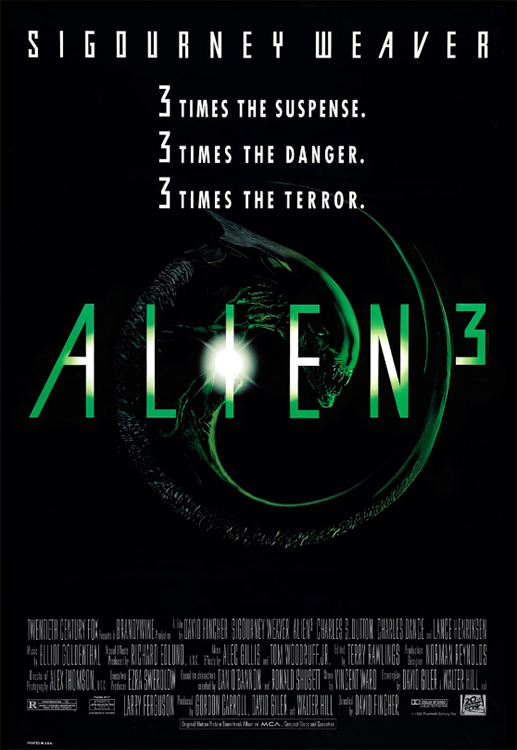 ALIEN³ (1992) DIR David Fincher PROD Walter Hill, David Giler, Gordon Carroll SCR Walter Hill, David Giler, Larry Ferguson (story by Vincent Ward; characters created by Dan O’Bannon, Ronald Shusett) CAM Alex Thompson ED Terry Rawlings MUS Elliot Goldenthal CAST Sigourney Weaver, Charles S. Dutton, Charles Dance, Lance Henricksen, Paul McGann, Brian Glover, Ralph Brown
DEMOLITION MAN (1993) DIR Marco Brambilla PROD Howard G. Kazanjian, Michael Levy SCR Peter M. Lenkov, Robert Reneau, Daniel Waters (story by Peter M. Lenkov, Robert Reneau) CAM Alex Thomson ED Stuart Baird MUS Elliot Goldenthal CAST Sylvester Stallone, Wesley Snipes, Sandra Bullock, Nigel Hawthorne, Benjamin Bratt, Bob Gunton, Glenn Shadix, Denis Leary, Jack Black, Adrienne Barbeau [voice only]
GOLDEN GATE (1993) DIR John Madden PROD Michael Brandman SCR David Henry Hwang CAM Bobby Bukowski ED Sean Barton MUS Elliot Goldenthal CAST Matt Dillon, Joan Chen, Bruno Kirby, Teri Polo, Jack Shearer, Keone Young, Tzi Ma, Paddy Morrissey, Cully Fredricksen, Leo Downey, Jay Jacobus
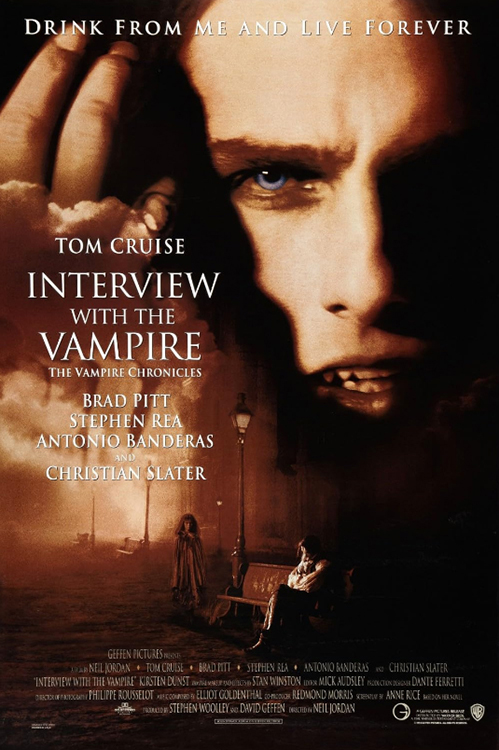 INTERVIEW WITH THE VAMPIRE: THE VAMPIRE CHRONICLES (1994) DIR Neil Jordan PROD Stephen Woolley, David Geffen SCR Anne Rice (also novel “Interview With the Vampire” [1976]) CAM Philippe Rousselot ED Joke Van Wijk, Mick Audsley MUS Elliot Goldenthal CAST Brad Pitt, Tom Cruise, Christian Slater, Kirsten Dunst, Antonio Banderas, Stephen Rea, Bellina Logan, Thandle Newton, Lyla Hay Owen
COBB (1994) DIR Ron Shelton PROD David V. Lester SCR Ron Shelton (book “Cobb: The Life and Times of the Meanest Man Who Ever Played Baseball” [1994] by Al Stump) CAM Russell Boyd ED Kimberly Ray, Paul Seydor MUS Elliot Goldenthal CAST Tommy Lee Jones, Robert Wuhl, Lolita Davidovich, Ned Bellamy, Scott Burkholder, Allan Malamud, Bill Caplan, Jeff Fellenzer, Stacy Keach Sr.
BATMAN FOREVER (1995) DIR Joel Schumacher PROD Tim Burton, Peter Macgregor-Scott SCR Janet Scott Batchler, Lee Batchler, Akiva Goldsman (story by Janet Scott Batchler, Lee Batchler; characters created by Bob Kane) CAM Stephen Goldblatt ED Mark Stevens, Dennis Virkler MUS Elliot Goldenthal CAST Val Kilmer, Tommy Lee Jones, Jim Carrey, Nicole Kidman, Chris O’Donnell, Michael Gough, Pat Hingle, Drew Barrymore, Debi Mazar, Elizabeth Sanders, Jon Favreau, Ed Begley Jr., Bob Kane
VOICES, a.k.a. VOICES FROM A LOCKED ROOM (1995) DIR Malcolm Clarke PROD Cary Brokaw, Dina De Luca SCR Nicholas Meyer, Peter Barnes (book “Double Jeopardy” by Mark A. Stuart) CAM Lauro Escorel ED Jonathan Shaw MUS Elliot Goldenthal CAST Jeremy Northam, Tushka Bergen, Allan Corduner, Hilton McRae, Bronwen Mantel, Dilys Laye, Domini Blythe
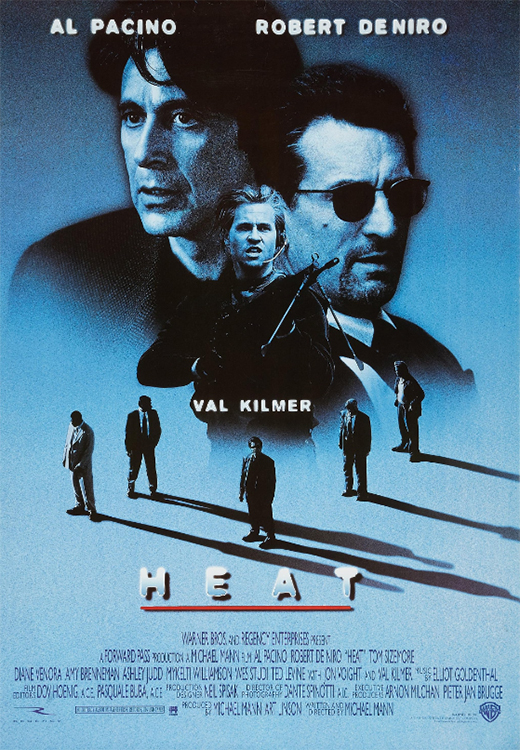 HEAT (1995) DIR – SCR Michael Mann PROD Michael Mann, Art Linson CAM Dante Spinotti ED William Goldenberg, Tom Rolf, Pasquale Buba, Dov Hoenig MUS Elliot Goldenthal CAST Al Pacino, Robert De Niro, Val Kilmer, Jon Voight, Tom Sizemore, Diane Venora, Amy Brenneman, Ashley Judd, Natalie Portman, Bud Cort
A TIME TO KILL (1996) DIR Joel Schumacher PROD John Grisham, Hunt Lowry, Arnon Milchan, Michael Nathanson SCR Akiva Goldsman (novel “A Time to Kill” [1989] by John Grisham) CAM Peter Menzies Jr. ED William Steinkamp MUS Elliot Goldenthal CAST Sandra Bullock, Samuel L. Jackson, Matthew McConaughey, Kevin Spacey, Oliver Platt, Charles S. Dutton, Brenda Fricker, Donald Sutherland, Kiefer Sutherland, Patrick McGoohan, Ashley Judd, Chris Cooper, Octavia Spencer, M. Emmet Walsh
MICHAEL COLLINS (1996) DIR – SCR Neil Jordan PROD Stephen Woolley CAM Chris Menges ED Tony Lawson, J. Patrick Duffner MUS Elliot Goldenthal CAST Liam Neeson, Aidan Quinn, Julia Roberts, Ian Hart, Alan Rickman, Stephen Rea, Brendan Gleeson, Gerard McSorley, Jean Kennedy Smith, Ronan McCairbre, Mike Dwyer
THE BUTCHER BOY (1997) DIR Neil Jordan PROD Stephen Woolley, Redmond Morris SCR Neil Jordan, Patrick McCabe (novel “The Butcher Boy” [1992] by Patrick McCabe) CAM Adrian Biddle ED Tony Lawson MUS Elliot Goldenthal CAST Stephen Rea, Fiona Shaw, Eamonn Owens, Alan Boyle, John Kavanaugh, Sean McGinley, Peter Gowen, Andrew Fullerton
BATMAN & ROBIN (1997) DIR Joel Schumacher PROD Peter Macgregor-Scott SCR Akiva Goldsman (characters created by Bob Kane) CAM Stephen Goldblatt ED Mark Stevens, Dennis Virkler MUS Elliot Goldenthal CAST George Clooney, Chris O’Donnell, Arnold Schwarzenegger, Uma Thurman, Alicia Silverstone, Michael Gough, Pat Hingle, John Glover, Elle Macpherson
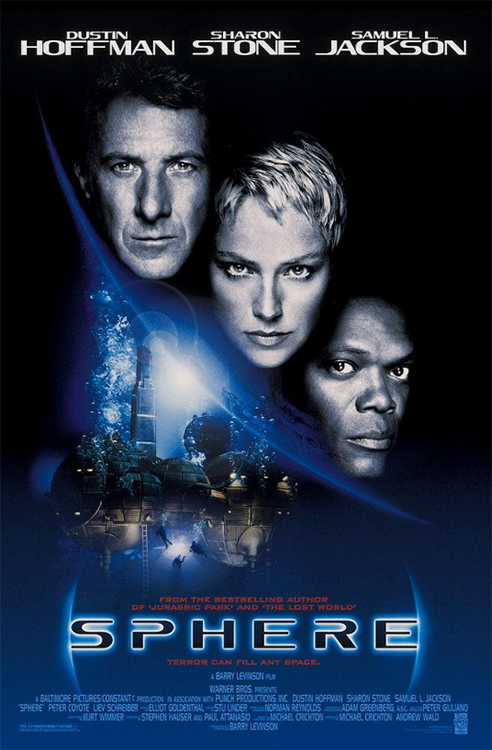 SPHERE (1998) DIR Barry Levinson PROD Barry Levinson, Michael Crichton, Andrew Wald SCR Stephen Hauser, Paul Attanasio (novel “Sphere” [1987] by Michael Crichton; adaptation by Kurt Wimmer) CAM Adam Greenberg ED Stu Linder MUS Elliot Goldenthal CAST Dustin Hoffman, Sharon Stone, Samuel L. Jackson, Peter Coyote, Liev Schreiber, Queen Latifah, Marga Gómez, Huey Lewis
IN DREAMS (1999) DIR Neil Jordan PROD Stephen Woolley, Charles Burke SCR Neil Jordan, Bruce Robinson (novel “Doll’s Eyes” [1993] by Bari Wood) CAM Darius Khondji ED Tony Lawson MUS Elliot Goldenthal CAST Annette Bening, Robert Downey Jr., Katie Sagona, Aidan Quinn, Paul Guilfoyle, Kathleen Langlois, Jennifer Berry, Stephen Rea
TITUS (1999) DIR Julie Taymor PROD Julie Taymor, Jody Patton, Conchita Airoldi SCR Julie Taymor (play “Titus Andronicus” [1588-1593] by William Shakespeare) CAM Luciano Tovoli ED Françoise Bonnot MUS Elliot Goldenthal CAST Anthony Hopkins, Jessica Lange, Alan Cumming, Colm Feore, James Frain, Laura Fraser, Harry Lennix, Angus Macfadyen, Matthew Rhys
FINAL FANTASY: THE SPIRITS WITHIN (2001, animation) DIR Hironobu Sakaguchi, Motonori Sakakibara PROD Chris Lee, Akio Sakai, Jun Aida SCR Jeff Vintar, Al Reinert (story by Hironobu Sakaguchi) CAM Motonori Sakakibara ED Christopher S. Capp MUS Elliot Goldenthal CAST (voices only) Ming-Na Wen, Alec Baldwin, Ving Rhames, Steve Buscemi, Peri Gilpin, Donald Sutherland, James Woods, Keith David, Jean Simmons, Matt McKenzie
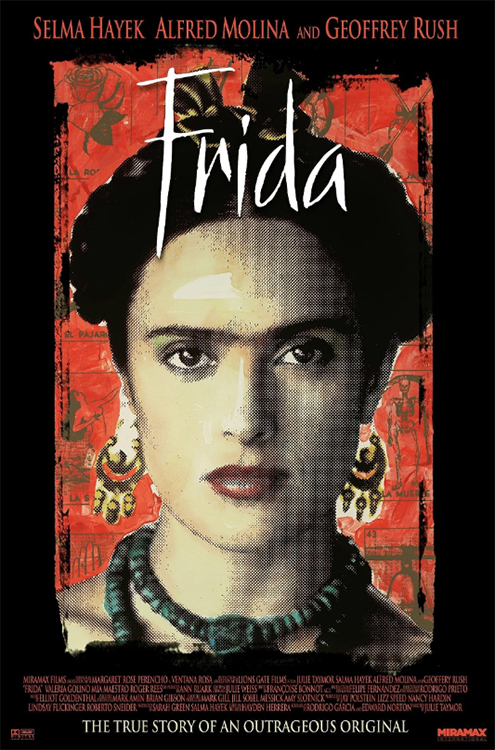 FRIDA (2002) DIR Julie Taymor PROD Salma Hayek, Roberto Sneider, Lizz Speed, Jay Polstein, Nancy Hardin, Sarah Green, Lindsay Flickinger SCR Anna Thomas, Diane Lake, Antonio Banderas, Clancy Sigal, Gregory Nava (book “Frida: A Biography of Frida Kahlo” [1983] by Hayden Herrera) CAM Rodrido Prieto ED Françoise Bonnot MUS Elliot Goldenthal CAST Salma Hayek, Alfred Molina, Geoffrey Rush, Ashley Judd, Antonio Banderas, Edward Norton, Valeria Golino, Mia Maestro, Roger Rees
THE GOOD THIEF (2002) DIR Neil Jordan PROD Stephen Woolley, John Wells, Seaton McLean SCR Neil Jordan (screenplay BOB LE FAMBEUR [1956] by Jean-Pierre Melville, Auguste Le Breton; story by Jean-Pierre Melville) CAM Chris Menges ED Tony Lawson MUS Elliot Goldenthal CAST Nick Nolte, Ralph Fiennes, Nutsa Kukhianidze, Gérard Darmon, Saïd Taghmaoui, Patricia Kell, Julien Maurel
S.W.A.T. (2003) DIR Clark Johnson PROD Neal H. Moritz, Chris Lee, Dan Halsted SCR David Ayer, David McKenna (story by Ron Mita, Jim McClain; characters created by Robert Hamner) CAM Gabriel Beristain ED Michael Tronick MUS Elliot Goldenthal CAST Samuel L. Jackson, Colin Farrell, Michelle Rodriguez, LL Cool J, Josh Charles, Jeremy Renner, Brian Van Holt, Olivier Martinez
ACROSS THE UNIVERSE (2007) DIR Julie Taymor PROD Matthew Gross, Jennifer Todd, Suzanne Todd SCR Ian La Frenias, Dick Clement (story by Julie Taymor, Ian La Frenias, Dick Clement) CAM Bruno Delbonnel ED Françoise Bonnot MUS Elliot Goldenthal CAST Evan Rachel Wood, Jim Sturgess, Joe Anderson, Dana Fuchs, Martin Luther McCoy, T.V. Carpio, Spencer Liff, Lisa Hogg, Nicholas Lumley, Danya Taymor, Salma Hayak
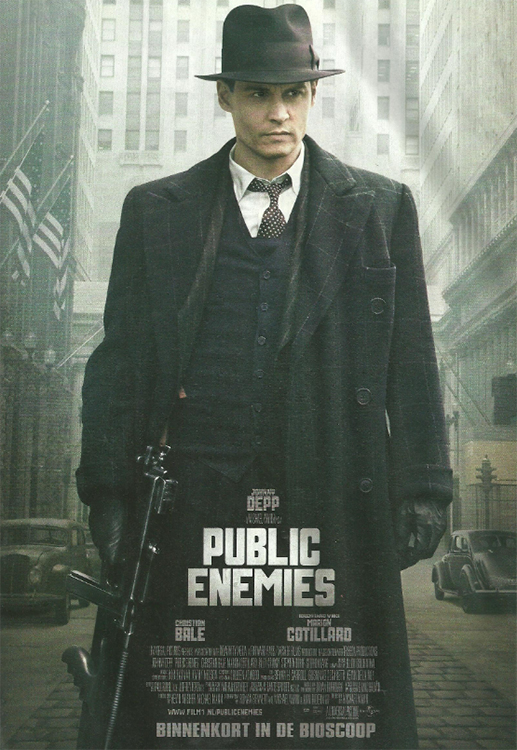 PUBLIC ENEMIES (2009) DIR Michael Mann PROD Michael Mann, Kevin Misher SCR Michael Mann, Ronan Bennett, Ann Biderman (book “Public Enemies: America’s Greatest Crime Wave and the Birth of the FBI, 1933-34” [2004] by Bryan Burrough) CAM Dante Spinotti ED Jeffrey Ford, Paul Rubell MUS Elliot Goldenthal CAST Johnny Depp, Christian Bale, Marion Cotillard, Jason Clarke, Billy Crudup, Stephen Dorff, Stephen Lang, Michael Bentt, Stephen Graham, Carey Mulligan, Channing Tatum
THE TEMPEST (2010) DIR Julie Taymor PROD Julie Taymor, Julia Taylor-Stanley, Jason K. Lau, Lynn Handee, Robert Chartoff SCR Julie Taymor (play “The Tempest” [1611] by William Shakespeare) CAM Stuart Dryburgh ED Françoise Bonnot MUS Elliot Goldenthal CAST Helen Mirren, Ben Winshaw, Djimon Hounsou, Felicity Jones, David Strathairn, Tom Conti, Reeve Carney, Chris Cooper, Alan Cumming, Alfred Molina
A MIDSUMMER NIGHT’S DREAM (2014) DIR Julie Taymor PROD Lynn Hendee, Ben Latham-Jones SCR (play “A Midsummer Night’s Dream” [around 1595] by William Shakespeare) CAM Rodrigo Prieto ED Barbara Tulliver MUS Elliot Goldenthal CAST Kathryn Hunter, David Harewood, Tina Benko, Lily Englert, Zach Appelman, Jake Horowitz, Mandi Masden, Roger Clark, Okwai Okpokwasili
OUR SOULS AT NIGHT (2017) DIR Ritesh Batra PROD Robert Redford, Finola Dwyer, Erin Simms SCR Scott Neustadter, Michael H. Weber (novel “Our Souls at Night” [2015] by Kent Haruf) CAM Stephen Goldblatt ED John F. Lyons MUS Elliot Goldenthal CAST Robert Redford, Jane Fonda, Matthias Schoenaerts, Judy Greer, Bruce Dern, Iain Armitage, Phyllis Somerville, John C. Ashton
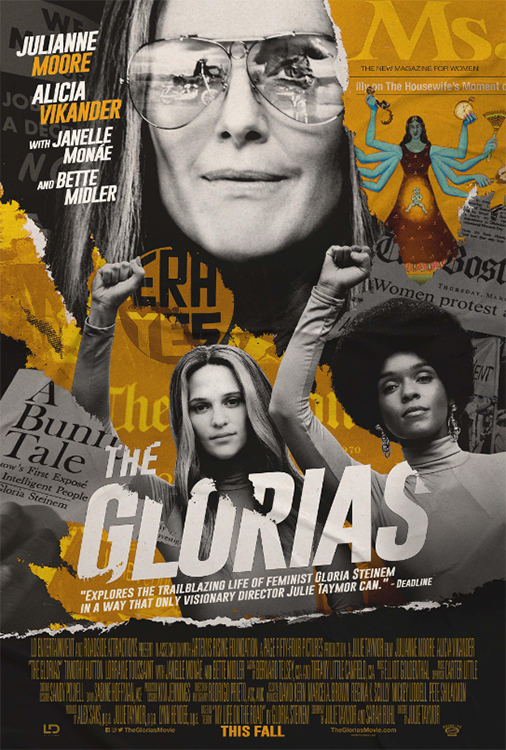 THE GLORIAS (2020) DIR Julie Taymor PROD Julie Taymor, Gregg Temkin, Alex Saks, Lynn Hendee SCR Julie Taymor, Sarah Ruhl (book “My Life on the Road” [2015] by Gloria Steinheim) CAM Rodrigo Prieto ED Sabine Hoffman MUS Elliot Goldenthal CAST Julianne Moore, Alicia Vikander, Janelle Monáe, Bette Midler, Ryan Kiera Armstrong, Lulu Wilson, Gloria Steinheim, Timothy Hutton
TV MOVIES
CRIMINAL JUSTICE (1990) DIR – SCR Andy Wolk PROD Michael Nozik CAM Steven Fierberg ED Katherine Wenning MUS Elliot Goldenthal CAST Forest Whitaker, Anthony LaPaglia, Rosie Perez, Jennifer Grey, Tony Todd, Saundra McClain, Joe Lisi, Stephen Pearlman
FOOL’S FIRE (1992) DIR Julie Taymor PROD Julie Taymor, Kerry Orent SCR Julie Taymor (short story “Hop-Frog” [1849] by Edgar Allan Poe) CAM Bobby Bukowski ED Alan Miller MUS Elliot Goldenthal CAST Michael J. Anderson, Mureille Mossé, Tom Hewitt, Paul Kandal, Reg E. Cathey, Kelly Walters, Thomas Derrah
ROSWELL (1994) DIR Jeremy Kagan PROD Jeremy Kagan, Ilene Kahn SCR Arthur Kopit (story by Arthur Kopit, Jeremy Kagan, Paul Davids; book “UFO Crash at Roswell” [1991] by Kevin D. Randle, Donald R. Schmitt) CAM Steven Poster ED David Holden, Bill Yahraus MUS Elliot Goldenthal CAST Kyle MacLachlan, Martin Sheen, Dwight Yoakam, Xander Berkeley, Bob Gunton, Kim Greist, peter MacNicol, Charles Martin Smith, Philip Baker Hall, Arthur Hiller
 FILM TALK
You must be logged in to post a comment.