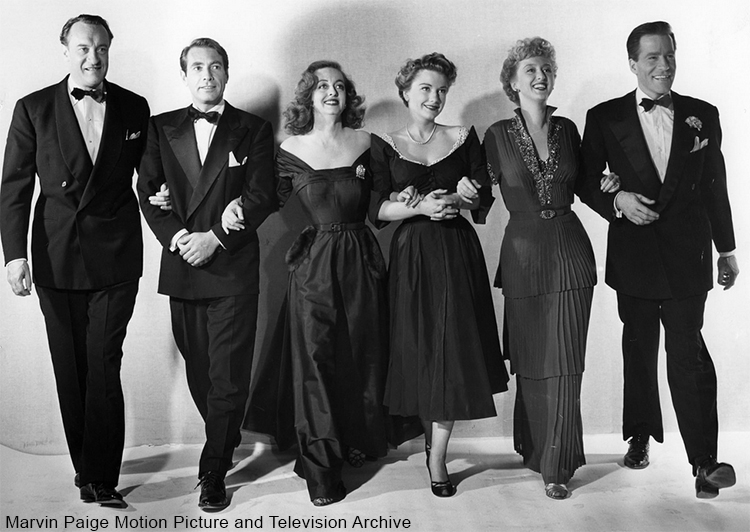
“All About Eve” (1950), written and directed by Joseph L. Mankiewicz, was on BBC just recently on a Saturday afternoon as part of a Bette Davis double bill; Edmund Goulding’s ”Dark Victory” (1939) was the other film. Both films were preceeded by a few BBC interviews she did over the years. Since “All About Eve” is one of the most iconic and enduring films of Hollywood’s Golden Age, why not take a closer look at Mankiewicz’s masterpiece, which is based on the 1946 short story (and subsequent 1949 radio drama) “The Wisdom of Eve” by Mary Orr, although she did not receive any screen credit. Feature image: from left to right, George Sanders, Gary Merrill, Bette Davis, Anne Baxter, Celeste Holm, Hugh Marlowe, Celeste Holm.
The film explores themes of ambition, betrayal, and the complexities of female relationships within the competitive world of the theater. Known for its sharp wit, layered characters, and insight into the darker sides of fame, “All About Eve” is a work of art that remains relevant to this day.
The film opens at a theater awards banquet by the Sarah Siddons Society (officially founded in 1952, two years after the film was made), where the fictional Sarah Siddons Award for Prestigious Achievement in the Theater is awarded to rising star Eve Harrington (played by Anne Baxter). Bemused, cynical, and manipulative theater critic Addison DeWitt (played by British actor George Sanders) narrates the scene and introduces the main characters. As the fatuous old emcee praises Eve’s greatness, the faces of those attending reflect a different story, especially when you look at Karen Richards (Celeste Holm), her husband and playwright Lloyd Richards (Hugh Marlowe), theatrical producer Max Fabian (Gregory Ratoff), seasoned and celebrated Broadway actress—and aging star—Margo Channing (Bette Davis), and the recipient of the award for best actress, Margo’s protégé Eve Harrington who, in the beginning of the film, is a young and seemingly innocent fan who becomes entangled in Margo’s life. “All About Eve” then traces Eve’s rise to stardom.
As the plot unfolds and thickens, Eve’s intentions become more questionable as she maneuvers her way into Margo’s inner circle of friends and even attempts to take her place on stage. Eve’s true nature is gradually revealed, and the film explores her ruthless ambition, the backstage backstabbing, and her willingness to manipulate others, such as Margo’s lover Bill, playwright Lloyd Richards and his wife Karen, who become unwitting players in Eve’s schemes. Addison DeWitt, a theater critic, ultimately exposes Eve’s manipulate nature.
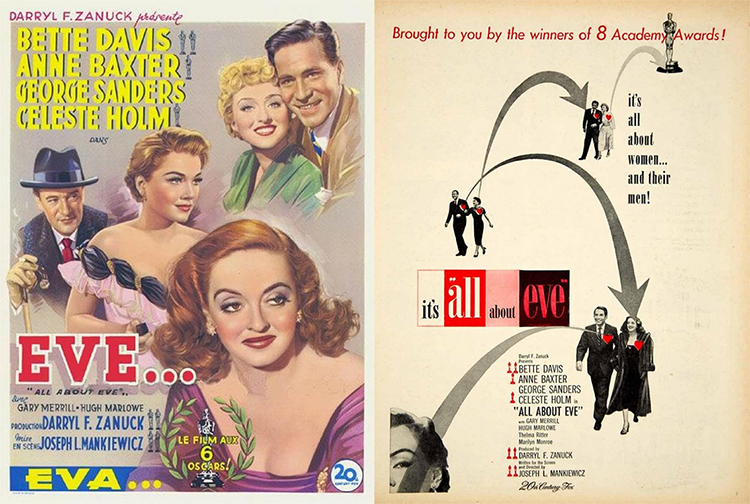
Bette Davis, who made the film a smash hit, is perfect as Margo Channing, even though producer Darryl F. Zanuck initially considered Marlene Dietrich for the role (in the end, she was too German), and then hoped to cast Susan Hayward, until he and Manckiewicz decided she was not old enough to play the part (Hayward was 33 at the time, Bette Davis was 42). Other actresses in the running to play Margo were reportedly Gertrude Lawrence, Ingrid Bergman, Claudette Colbert (she withdrew two weeks before filming began after an injury during “Three Came Home”), and Barbara Stanwyck and Joan Crawford (both were working on other films).
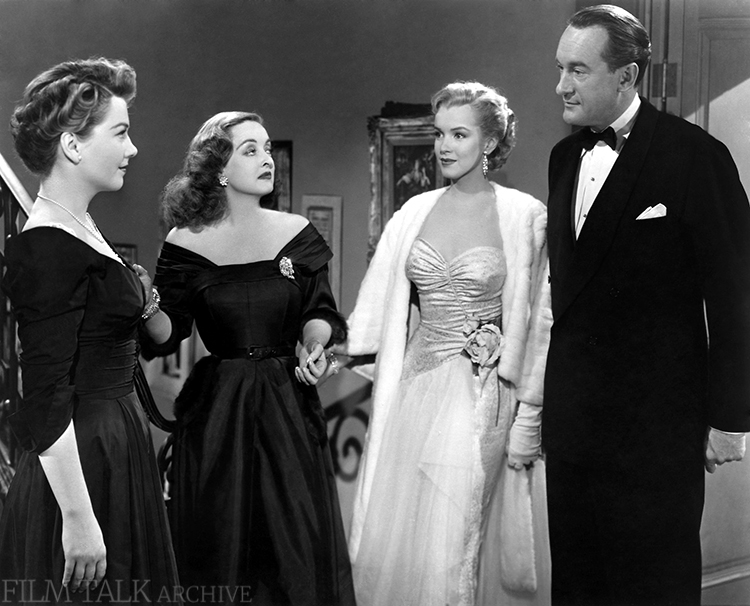
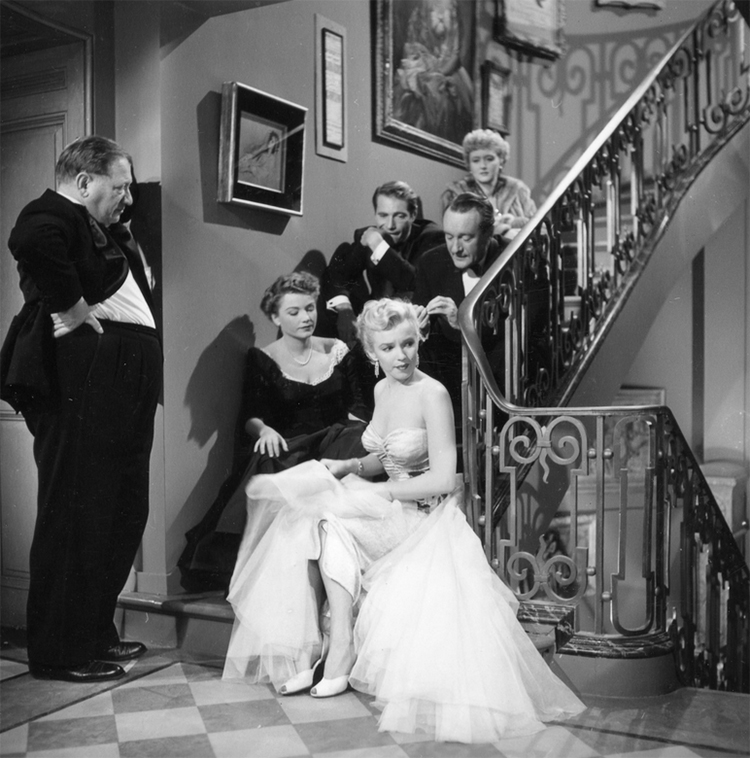
Glittering in the center of “All About Eve” is a brief supporting performance by Marilyn Monroe as Addison DeWitt’s date at Margo’s party, playing a young starlet who intends on advancing her career by befriending powerful men. “All About Eve” and John Huston’s film noir drama “The Asphalt Jungle,” released earlier that same year, launched her career. In “All About Eve,” she was already the Marilyn Monroe, in every detail. In her brief scenes, surrounded by actors much more experienced, she is all you look at. That’s not a coincidence; those who saw “All About Eve” in 1950, when she was unknown, also singled her out.
In Kenneth L. Geist’s “Pictures Well Talk: The Life and Films of Joseph L. Mankiewicz” (published in 1972 by Charles Scribner’s Sons, New York), Celeste Holm says, ‘She [Marilyn Monroe] was terribly shy. In fact, she was scared to death because she was playing in a pretty big league, you know, but Joe [Joseph L. Mankiewicz] relaxed her into it.’
Basically, “All About Eve” is a film about ambition. Eve’s desire for fame drives her to shed her innocence and embrace a path of deceit and manipulation. Her transformation underscores the lengths to which people are willing to go to achieve their dreams, especially in a world as unforgiving as the theater. The film paints a picture of fame as a double-edged sword, showcasing its allure, but also the price one must pay to maintain it. Margo’s struggle to remain relevant and respected as she ages contrasts with Eve’s intense hunger for recognition, drawing a parallel between two women at different stages of their careers.
The relationship between Margo and Eve highlights the tension between experience and youth. Margo, who is approaching middle age, feels threatened by the younger Eve, who represents the new generation. This dynamic not only brings to light the pressure that aging actresses face in an industry obsessed with youth, but also explores the insecurities that accompany aging in general. Mankiewicz’s portrayal of Margo is deeply sympathetic, offering a nuanced look at the vulnerability that often lies behind public personas.
Eve embodies deception, concealing her true motives behind a facade of innocence and admiration. The film suggests that people are not always as they seem, especially in an industry built on illusion. Eve’s character also raises questions about identity: does the mask one wears eventually become the person? Mankiewicz subtly critiques the theater industry, where reality and performance often blend. The idea of identity is further complicated by Addison DeWitt, who, despite being aware of Eve’s duplicity, finds her ambition and cunning intriguing, showing the allure of the darker aspects of human nature.
One of the film’s most intriguing aspects is its depiction of female relationships. The bond between Margo and her best friend Karen is complex, filled with moments of jealousy, loyalty, and betrayal. Karen’s decision to introduce Eve into Margo’s life sets off a chain of events that strains their friendship. At the same time, Karen’s friendship with Margo demonstrates the solidarity and understanding that women can have, even when they are faced with competition and rivalry. Margo’s relationship with Eve is more ambivalent, oscillating between maternal protectiveness and outright rivalry.
Bette Davis’ portrayal of Margo Channing is one of the defining performances of her career. Margo is both vulnerable and fierce, embodying the paradoxes of an actress who fears losing relevance but refuses to conform to society’s expectations for aging women. Her nuanced performance captures Margo’s wit, insecurity, and intelligence, making her one of cinema’s most memorable characters. Margo’s famous line, “Fasten your seatbelts, it’s going to be a bumpy night,” epitomizes her larger-than-life personality and her determination to face adversity head-on.
Anne Baxter’s Eve is a fascinating study in duality. At first, she appears as a timid, starstruck fan, but her ambitions slowly reveal her to be calculating and manipulative. Eve’s seemingly innocent persona and her gradual unveiling as a sweet-faced, young predator and a ruthless opportunist create a compelling character arc. Her transformation raises questions about authenticity and the cost of ambition. Baxter’s stunning performance emphasizes Eve’s intelligence and cunning, making her both a formidable opponent and a tragic figure.
George Sanders’ portrayal of Addison DeWitt, the sardonic critic, adds another layer to the story. Addison is the only character who sees through Eve’s facade and is fascinated by her ambition. His relationship with Eve is complex, blending elements of mentorship, manipulation, and mutual exploitation. Through Addison, the film offers a commentary on the role of critics in shaping careers and the complicated power dynamics in the world of theater.
RKO Pantages Theater in Hollywood, March 29, 1951: Mercedes McCambridge announces George Sanders as the recipient for the Oscar for Best Supporting Actor in “All About Eve”
Joseph L. Manckiewicz’s direction, along with Milton Krasner’s cinematography, gives the film a sharp, almost stage-like quality. The film uses long takes and careful framing to emphasize the intimacy of the characters’ interactions. Close-ups are used sparingly, giving the scenes a theatrical, larger-than-life feel. Mankiewicz’s script, filled with wit and incisive dialogue, drives the film. Every line of dialogue has weight, often layered with irony or double meanings, making the characters’ conversations compelling and rich with subtext. Besides that, in all the films Mankiewicz wrote and directed, women have the best parts and they are the most three-dimensional. Two of his earlier films, “The Ghost and Mrs. Muir” (1947) and “A Letter to Three Wives” (1949), demonstrate his ability to explore the female psyche—the latter film lauded for its sophistication and wit, weaving together humor, drama, and suspense with sharp and intelligent dialogue that revealed the characters’ inner conflicts. It would become one of Mankiewicz’s trademarks.
“All About Eve” is widely regarded as a classic, and its influence on popular culture is profound. Several films offer variations on the same, central theme of a female mentor and her protégé, such as “Opening Night” (1977, directed by John Cassavetes), Paul Verhoeven’s “Showgirls” (1995), Pedro Almodóvar’s “Todo sobre mi madre” (1999, a.k.a. “All About My Mother”), “Clouds of Sils Maria” (2014) starring Juliette Binoche and Kristen Stewart, and Yorgos Lanthimos’ “The Favourite” (2018).
One way or another, they all endure as a brilliant dissection of fame, ambition, and the intricacies of human relationships. “All About Eve” portrays complex female characters, especially Margo and Eve, and offers a rare depth, highlighting the multifaceted nature of ambition and rivalry. Mankiewicz’s direction and script, combined with outstanding performances from Davis, Baxter, and Sanders, create a timeless film that resonates with audiences to this day. “All About Eve” is not just a film about the theater but a commentary on the human condition—its vanity, vulnerabilities, and the relentless pursuit of dreams, even when the cost may be higher than anticipated.
The final scene showcases Barbara Bates in a small but memorable role of Phoebe, a young, aspiring actress who hints at a new cycle of rivalry and ambition—much like the main character Eve Harrington—as she attaches herself to Eve in much the same manner as Eve had to Margo. After the success of “All About Eve,” Barbara Bates appeared in another film with Marilyn Monroe (“Let’s Make It Legal,” 1952), and Charles Chaplin offered her the lead role in “Limelight” (1952), but 20th Century Fox made her turn it down. She then played a string of undistinguished roles, mostly in B films, until she died in 1969 at 43.
The story of “All About Eve” originated in an event that happened to Elisabeth Bergner, an Austrian-British actress and in 1935 Academy Award nominee for Best Actress. While performing on Broadway in “The Two Mrs. Carrolls” (1943-1944), Bergner allowed a young fan to become part of her inner circle and employed her as an assistant, but later regretted her generosity when the woman tried to undermine her. Bergner told the event about this ‘terrible girl,’ as she described her, to Mary Orr, who then used it as the basis for her short story “The Wisdom of Eve” with Orr giving the girl an even more ruthless character. Bergner later confirmed the basis of the story in her autobiography “Bewundert viel, und viel gescholten…” (1978; English title, “Greatly Admired and Greatly Scolded”).
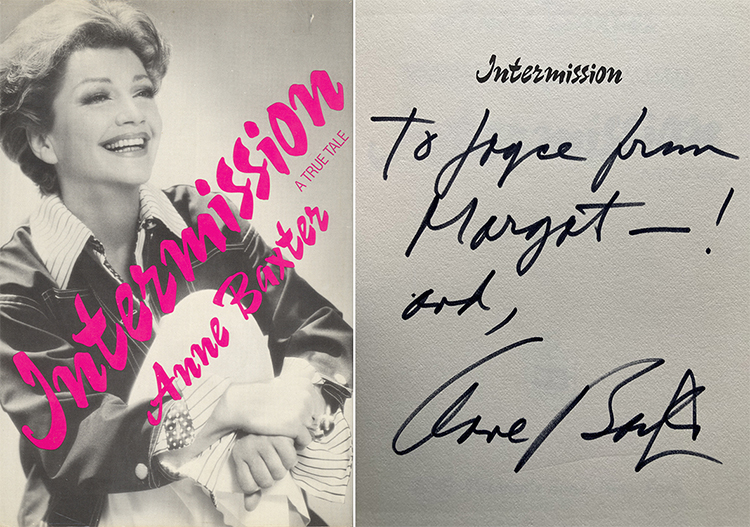
In 1964, Mary Orr and her husband, director and playwright Reginald Denham, published a play titled “The Wisdom of Eve,” which was produced off-off-Broadway in 1979. In 1970, Orr and 20th Century Fox agreed to a musical theater adaptation, which became the basis for the hit musical comedy “Applause” and thus further cemented its legacy. It opened on Broadway on March 30, 1970, with Lauren Bacall playing Margo; in July 1971, she was replaced by Anne Baxter of all people who appeared as Margo until May 1972 when Arlene Dahl took over for the remaining four weeks. “Applause” was also adapted as a TV movie in 1973, again with Lauren Bacall. In the early 1950s, there were also a few radio adaptations with Bette Davis and Anne Baxter reprising their roles.
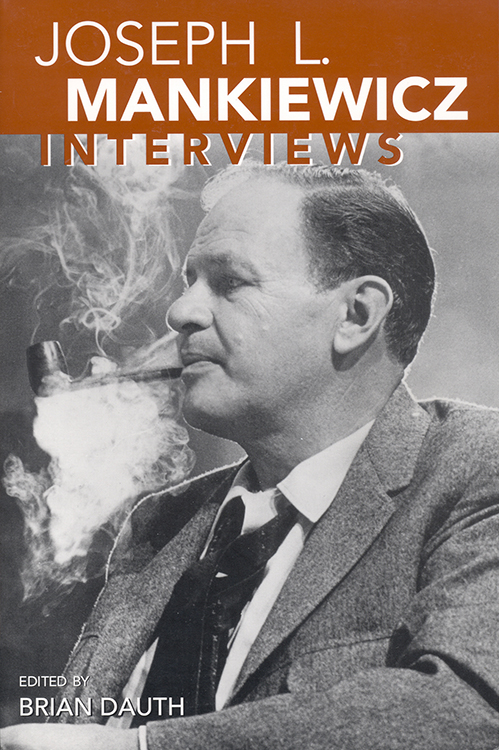
In 1972, “More About “All About Eve”: A Colloquy by Gary Carey with Joseph L. Mankiewicz” was published, with Gary Carey’s extended conversation with filmmaker Joseph L. Mankiewicz who talks about the making of the screen classic. The book also included the screenplay of the film. In 2000, “All About “All About Eve”: The Complete Behind-the-Scenes Story of the Bitchiest Film Ever Made” was published, authored by Sam Staggs; it focused in great length on the making of the film, including everything that went on behind the camera, such as the romance that developed between Bette Davis and Gary Merrill almost from the first day of shooting and the stormy marriage (from 1950-1960) that resulted, and George Sanders, whose jealous wife Zsa Zsa Gabor (they were married from 1949-1954) forbade him to speak to Marilyn Monroe on the set or off.
“All About Eve” wins Oscar for Best Picture
“All About Eve” received fourteen Oscar nominations—a record that remained unbroken until “Titanic” matched it in 1997—and won six: Best Picture, Best Director and Best Writing (both for Mankiewicz, after he had also won the same two Oscars the year before for “A Letter to Three Wives” [YouTube clip]), Best Supporting Actor (George Sanders), Best Costume Design (Edith Head, Charles Le Maire), and Best Sound (Thomas T. Moulton). Bette Davis and Anne Baxter were both nominated for Best Actress—the first time two actresses were nominated for starring roles in the same film—but the Oscar went to Judy Holiday for “Born Yesterday.” Celeste Holm and Thelma Ritter were nominated for Best Supporting Actress; they lost to Josephine Hull in “Harvey.”
Joseph L. Mankiewicz (1909-1993) was the younger brother of Oscar-winning screenwriter Herman J. Mankiewicz (1897-1953) who co-wrote “Citizen Kane” (1942) with Orson Welles, and he was the father of screenwriter and director Tom Mankiewicz (1942-2010).
“All About Eve” (1950, trailer)
ALL ABOUT EVE (1950) DIR – SCR Joseph L. Mankiewicz PROD Darryl F. Zanuck CAM Milton Krasner ED Barbara McLean MUS Alfred Newman CAST Bette Davis (Margo Channing), Anne Baxter (Eve Harrington), George Sanders (Addison DeWitt), Celeste Holm (Karen), Gary Merrill (Bill Simpson), Hugh Marlowe (Lloyd Richards), Gregory Ratoff (Max Fabian), Thelma Ritter (Birdie), Marilyn Monroe (Miss Casswell), Barbara Bates (Phoebe)
 FILM TALK
You must be logged in to post a comment.