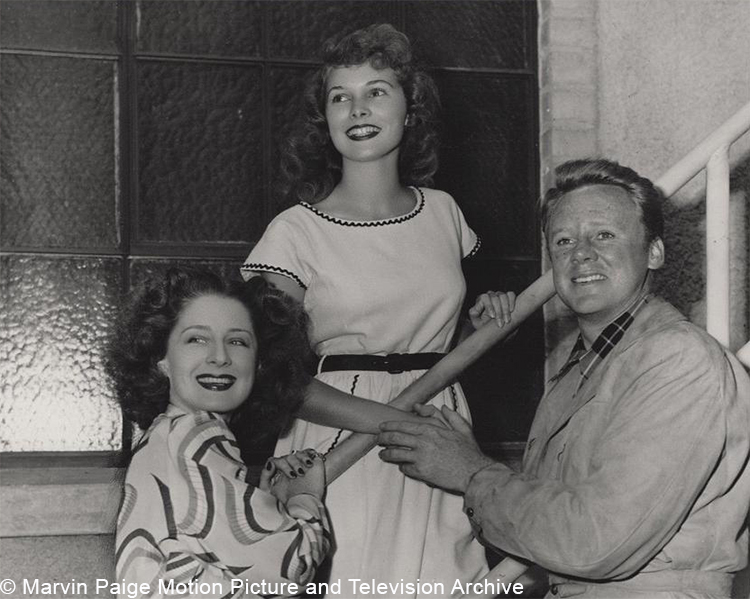
In February 1946, Norma Shearer swept into the lobby of the Sugar Bowl Ski Lodge in Soda Springs, California. She saw a picture of a fresh-faced teenage girl with an undeniable charm on the clerk’s desk. ‘What a pretty face,’ she said, ‘she should be in pictures. May I have a copy of that photograph to take with me?’
That pretty face belonged to Janet Leigh, who later became an iconic actress, best known for her role in Alfred Hitchcock’s “Psycho” (1960). Janet Leigh expressed deep admiration for classic Hollywood star Norma Shearer (1902-1983) on more than one occasion. Though they came from different eras—Shearer’s prominence peaked in the 1930s and Leigh rose to fame in the late 1940s—their careers intersected through a shared studio legacy at MGM and a mutual respect for craftsmanship in acting. Ms. Leigh’s debut film was “The Romance of Rosy Ridge” (1947); feature image, Norma Shearer (left) visits Janet Leigh and Van Johnson on the set of the film.
Norma Shearer, often hailed as “The First Lady of MGM,” was a true trailblazer. She successfully transitioned from silent films to talkies and remained a top box office draw for over a decade. Known for her elegance, intelligence, and commanding screen presence, she was not afraid to portray sexually liberated or complex women, particularly in the pre-Code era. Roles in films like “The Divorcee” (1930), for which she won an Academy Award as Best Actress, and “A Free Soul” (1931), helped define her as a symbol of progressive womanhood on screen.
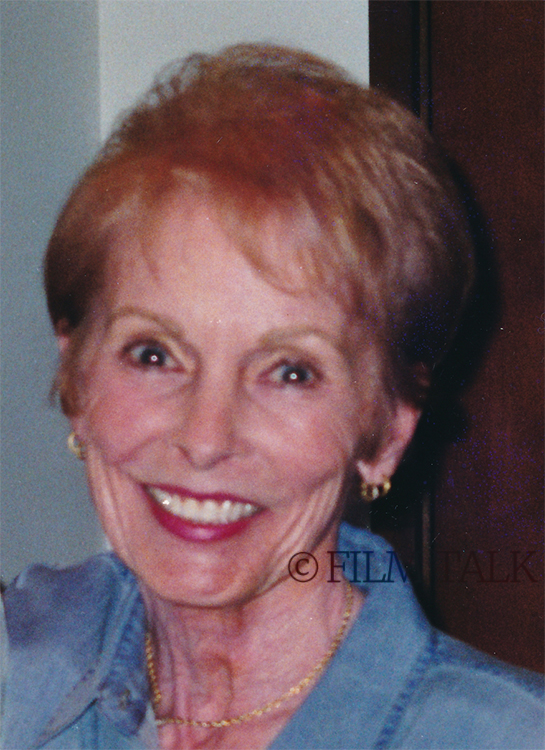
Janet Leigh often cited Shearer as a key inspiration, particularly admiring her ability to balance strength and vulnerability. Leigh once remarked that Shearer ‘never settled for being just beautiful,’ and that her portrayals ‘had integrity, layers, and purpose.’
What Leigh found especially compelling was how Shearer crafted roles that defied the expectations of women in Hollywood at the time. She also admired Shearer’s seamless elegance, both on and off screen. In an era where image was everything, Shearer exuded grace without seeming distant. Leigh, known for her down-to-earth nature despite her own fame, appreciated this quality and emulated it throughout her entire career—a career that began with Oscar-winning screen legend Norma Shearer seeing her photograph at the Sugar Bowl Ski Lodge. She sent the photograph to [then Hollywood agent] Lew Wasserman, and in no time, Janet Leigh was on the MGM lot. ‘I am very grateful for that, as Norma Shearer was the one who started it all, although later on she didn’t have anything to do with the pictures I made. It was just a matter of perfect timing,’ Janet Leigh told me when I met her for an interview at her home on Summitridge Drive in Beverly Hills, in August 2000.
It was no coincidence that Norma Shearer brought Leigh to the attention of Metro-Goldwyn-Mayer, of all studios. Shearer had always worked at MGM—she even signed with Louis B. Mayer Pictures in 1923, a year before it merged with Metro Pictures and the Samuel Goldwyn Company to form Metro-Goldwyn-Mayer—and she worked there exclusively until her voluntary retirement in 1942 at age 40.
She was married to the studio’s vice president and production chief, Irving G. Thalberg, from 1927 until his untimely death in September 1936 at age 37. Consequently, when you talk about Norma Shearer, you also need to focus on Thalberg; they go hand in hand. You can’t separate one from the other because during their heyday, they wrote their unique chapter in Hollywood history with each other, for each other, because of each other, and thanks to each other. Thalberg supervised not only Shearer’s films, but ‘more pictures from start to finish than any other producer in Hollywood’s history,’ yet refused to take screen credit as a producer. ‘I don’t want my name on the screen because credit is something that should be given to others. If you are in a position to give credit to yourself, you don’t need it,’ he said. The New York Times described him in an editorial after his death as ‘the most important force in Hollywood history.’
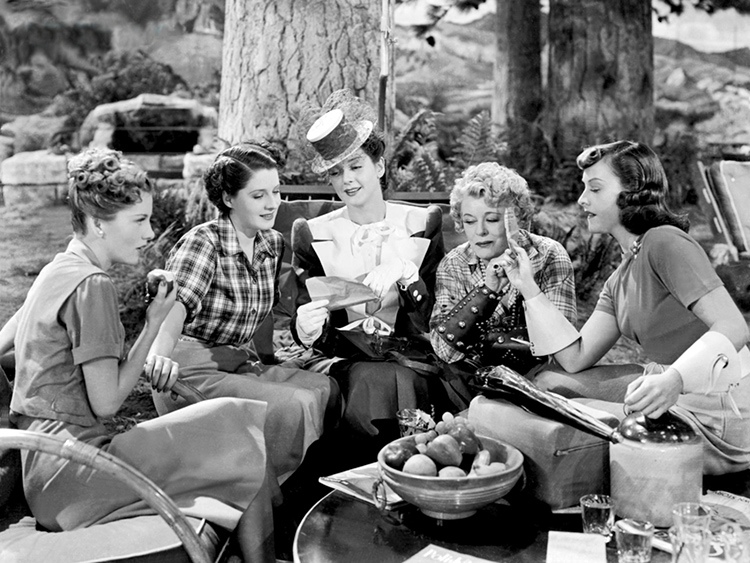
Dubbed one of Hollywood’s power couples—along with Douglas Fairbanks and Mary Pickford—the Thalbergs shaped the early film industry with a blend of creative vision, business acumen, and star power that defined the 1920s and 1930s. Hollywood history remembers them not only for their individual accomplishments but for how their partnership elevated both art and business in early cinema. After his death, Norma Shearer remained a powerful figure at the studio, even during her retirement, when she stayed out of the limelight. She also owned a large share of company stock.
Shortly after my interview with Janet Leigh, I sent her a fax and asked her if I could call her briefly, for some more background information on Norma Shearer and what the former screen legend meant to her. The next day, we were on the phone, and she said, ‘Norma Shearer was the quintessential star, she was a star like no other, and she was my fairy godmother. She had enormous flair and presence. She electrified the room when she made her entrance.’
Norma Shearer in “Marie Antoinette” (1936)
What was her favorite Norma Shearer film? ‘That’s “Marie Antoinette” [1936], no doubt about that. She is just stunning in the costume scenes, and do you remember the sequence when she was locked in her prison cell, desperately worried about her children? That’s one of the most memorable scenes in film history.’
‘I was so fortunate to be taken under her wings. She made it possible for me to have a chance, and she opened a whole new world for me,’ Ms. Leigh said. ‘She included me in her circle of friends. I went to parties at her estate, I went skiing with her at Sun Valley, and over the years we became good friends.’
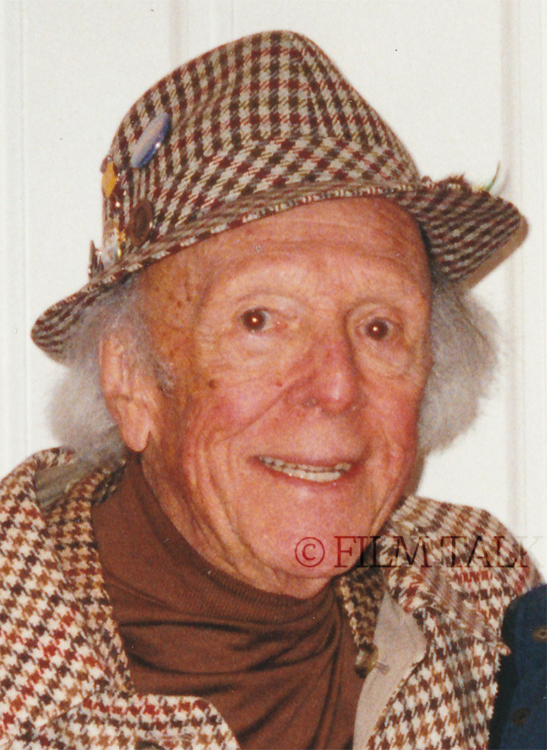
MGM director George Sidney (1916-2002) knew Irving G. Thalberg and Norma Shearer very well. He talked about the Thalbergs a few months earlier, in February 2000, when I visited him at his home in Las Vegas, and he said, ‘Everybody called Mr. Thalberg just Irving. He was a very gentle man. He never screamed or yelled, and he would always stop to explain things. He took me to the projection room; we sat there, and he explained everything, everything, everything. Irving died very young; that was a very sad day at the studio. Norma made a few more pictures, but then she quit: she gave it up. She married a lovely man called Marty Arrougé, and they lived just two blocks away from me in Beverly Hills—everybody lived right two blocks away from me in Beverly Hills [laughs]. One day, Harry Cohn had bought this new play, and I said, ‘Well, maybe we could get Norma Shearer to play it.’ So I called her and explained it to her. I said, ‘What about it? Come back, you know.’ She thought about it and said, ‘Well, I have to see how I look.’ I said, ‘With our range of screen tests, we’ll make a screen test at night, so no one will know. I’ll get the great photographer Harry Stradling and a wonderful make-up man. We’ll make it at night, we’ll develop it in our own laboratory, and we won’t even run the film in the studio. We’ll take it right to my house and run it in my projection room.’
‘She thought about it and said, ‘All right.’ She read the script, and we were going to do the test a few days later. One night at about twelve o’clock, I felt somebody walked on my property. I walked out to the door, opened it and there was a letter. I opened it, and it was from Norma. It was the sweetest, loving note. It read, ‘I thought about it and you were very kind to get all of these wonderful people to come out at night to see how I look, but I just want to leave it the way it was. I’m very happy with my marriage. The past is the past, and it shouldn’t be trampled on. No sense to revitalize it.’ Naturally, we never knew what would have been the result.’
I was always fascinated by her life and the career of the Thalbergs; Norma Shearer liked to say she had a storybook life, but it was a life she made for herself. A life story without controversy or notoriety, as some of her contemporaries, but a great story nonetheless, and that made her a unique and very interesting figure in the early decades of Hollywood’s Golden Age.

Irving G. Thalberg, MGM’s Boy Wonder, as he was often referred to, died of pneumonia in 1936, a few weeks after the principal photography of “The Good Earth” was completed; he had suffered from a weak heart his whole life. The film was dedicated ‘To the memory of Irving Grant Thalberg—His last great achievement.’ Thalberg was Louis B. Mayer’s creative driving force, and insisted that German-born actress Luise Rainer (1910-2014) would play the leading role of O-Lan in “The Good Earth”—very much against Louis B. Mayer, who wanted her to be beautiful, ‘one of his racehorses in the stable,’ as she remembered.
In the 1930s, no studio in Hollywood had as deep of a roster as MGM which proclaimed to have ‘more stars than there are in the heavens,’ with actors such as Greta Garbo, Jean Harlow, Mickey Rooney, Spencer Tracy, Robert Taylor, Greer Garson, Joan Crawford, Myrna Loy, Judy Garland, Clark Gable, John Barrymore, Lionel Barrymore, and many others under contract to MGM. ‘But,’ Luise Rainer pointed out, ‘the three big stars at the studio were Greta Garbo, Norma Shearer, and I because we were the only ones with a bungalow on the lot.’
Rainer didn’t know Thalberg very well, though. When she was one week in Hollywood, she was invited to a small party where she met the Thalbergs. ‘He saw me,’ she told me in March 2000, ‘but I did not see him then, you understand?’ Rainer also said, ‘His death was a terrible shock to us. He was young and ever so able. Had it not been that he died, I think I may have stayed much longer in films.’ Thalberg was known to prefer more literary works than Mayer’s crowd pleasers; his ability to craft eloquent, epic yet accessible dramas makes him one of the defining forces in Hollywood history. After Thalberg passed away, Rainer made a few more films and left Hollywood in 1943, where she had made ten films and became the first actress to win two consecutive Oscars as Best Actress, with “The Great Ziegfeld” (1936) and “The Good Earth” (1937).

Thalberg began his career at Universal in 1919, first as personal secretary to the studio’s founder and president, Carl Laemmle, and then as studio manager, before moving to Metro-Goldwyn-Mayer in 1924. Laemmle’s niece, Carla Laemmle (1909-2014), told me in 2008, ‘Irving G. Thalberg was a very brilliant young man. Uncle Carl always spoke very highly of him. He was in his early twenties when he began working at Universal, and almost right from the start, he was allowed to have full autonomy in whatever decision he made. He couldn’t get along with Erich von Stroheim, though, because he was spending too much money. They always argued about that. When Thalberg worked for my uncle, he was engaged to my niece Rosabelle Laemmle—she was Uncle Carl’s daughter—but after they broke up, he was approached by Louis B. Mayer. He began working for him, and married MGM actress Norma Shearer a few years later. Rosabelle then married another man. She passed away a long time ago [in 1965 at age 64].’
Thalberg’s trademarks were his innovative approach to filmmaking, his ability to manage large-scale productions, and his unique vision that combined commercial appeal with artistic integrity. He was known for his meticulous attention to detail and his understanding of both the artistic and business sides of filmmaking. He worked closely with directors, actors, and writers, ensuring that each project had the potential for both commercial and creative success. He also developed MGM’s reputation for sophisticated films. His efforts helped elevate the role of the producer in Hollywood, making it as important as that of the director. In 1937, the Academy of Motion Picture Arts and Sciences created the Irving G. Thalberg Memorial Award, which honors ‘creative producers, whose bodies of work reflect a consistently high quality of motion picture production.’
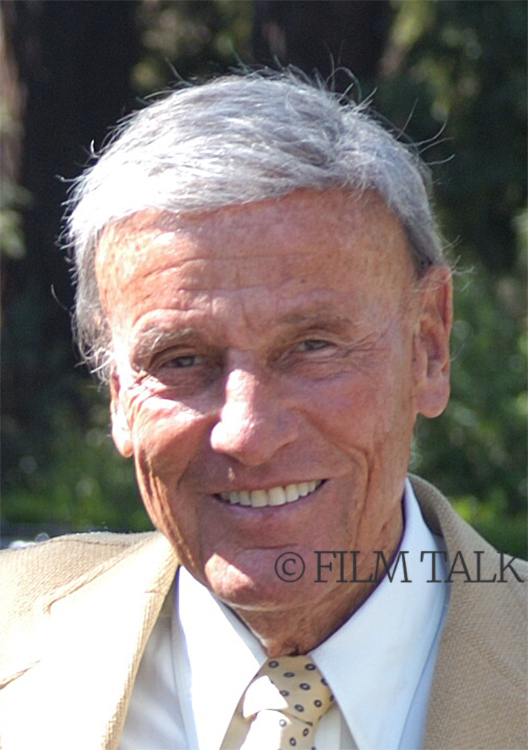
In 2010, I met Richard Anderson (1926-2017) for an interview at the Beverly Hills Country Club. He was a contract player at MGM in the 1950s and later became a household name when he played Oscar Goldman in the TV series “The Six Million Dollar Man” (1974-1978) and “The Bionic Woman” (1976-1978). I thought he could be my way in to new insights into the legacy of the Thalberg family; from 1961 till 1973, he was married to Katherine Thalberg (1935-2006), the second of two children of Irving G. Thalberg and Norma Shearer. Richard Anderson and Katherine Thalberg also had three children.
The day before our encounter, I had dinner at Musso & Frank Grill on Hollywood Boulevard with casting director Marvin Paige, my partner in crime who had introduced me to numerous actors and actresses, and who gave me unlimited access to his motion picture and television archive. ‘Who are you meeting tomorrow?’ he asked. ‘Richard Anderson. And I can’t wait to ask him all about Norma Shearer and Irving G. Thalberg. I hope he will give me a film history lesson.’ Marvin then said, ‘Oh, but he doesn’t talk about that.’ ‘Really? But I can still ask, can’t I?’ ‘Believe me, he won’t talk about that.’ That was a big disappointment, to say the least, and so, I did not ask him anything about his former mother-in-law or the Thalberg dynasty. We had a great conversation about film, and he shared lots of Hollywood stories, but it would have been a hell of a lunch if he could have talked about Norma Shearer, reminiscing about her life and career that maybe would have taken me beyond Gavin Lambert’s highly-praised biography “Norma Shearer” (1990).
Shearer’s fame declined after her retirement in 1942. She was rediscovered in the late 1950s when her films were screened on television. When she died in 1983 at the Motion Picture Country Home in Woodland Hills, California, she was also known for playing noble roles in films such as “Marie Antoinette” (1936) and “The Women” (1939). In 1956, she also discovered actor-turned-producer Robert Evans; she thought he was perfect to play Thalberg in “Man of a Thousand Faces” (1957), and made sure he got the part.
At the 1987 Oscars, Richard Dreyfuss said, “Young Irving Thalberg was the main architect of Hollywood’s Golden Age,” followed by Billy Wilder receiving the Irving G. Thalberg Memorial Award
Norma Shearer was the first five-time Academy Award nominee, and her brother, Douglas Shearer (1899-1971), was a renowned sound engineer who won seven Academy Awards, making Norma and Douglas Shearer the first Oscar-winning siblings in history. Their sister Athole (1900-1985) was a Hollywood actress with a few uncredited screen roles and was married to film director Howard Hawks from 1928 until their divorce in 1940. Irving G. Thalberg Jr., son of Irving G. Thalberg and Norma Shearer, was a professor of philosophy at the University of Illinois in Chicago. He died of cancer in Syracuse, New York, in 1987, at age 57. His second wife, Deborah Pellow, an American anthropologist, died last May, also in Syracuse, New York, at age 80. Janet Leigh died of vasculitis in 2004 at her Beverly Hills home at age 77.
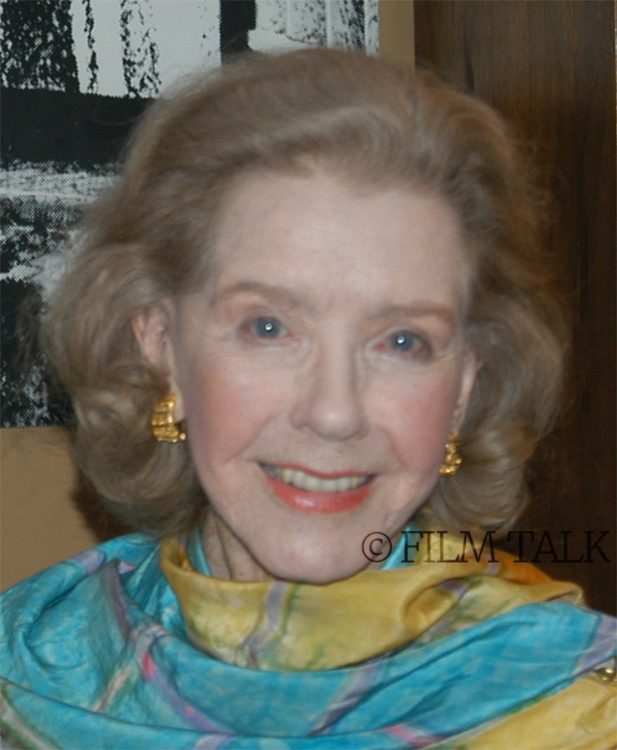
Finally, here is actress Marsha Hunt (1917-2022) looking back with nothing but respect and admiration when she talks about her encounters with Norma Shearer and Irving G. Thalberg during an interview we had in the Green Room at the Egyptian on Hollywood Boulevard in April 2004—thanks to Marvin Paige. She said, ‘I did know Mr. Thalberg. I had met him at the first party I went to when I was 17, when I had just arrived in Hollywood. A French screenwriter had invited me to the Charles Boyer’s, a beautiful home, and after dinner, I heard a ping pong game being played. I loved ping pong, so I went out to the terrace, and there were a lot of Hungarian writers. They always played a lot of ping pong, and they played very well [laughs]. They smashed; they were very fancy. The year before, I had won the ping pong championship at school. I didn’t smash; I just got the ball back. I kept returning the ball until sooner or later, the flashy people would hit it out. I asked somebody if they wanted a game, and I beat that person, and then I beat the next, and they were saying, ‘Well, let me take her on!’ And one by one, I was beating everyone at the party. Then I played against Mr. Thalberg and Mr. [David O.] Selznick, and each of them would bet on me against the other. And finally, Mr. Selznick said to me, ‘Well, Miss Hunt, where would you rather work? At MGM or at my Selznick studio?’ [Laughs.] But I was under contract at Paramount…—so who’s next? [Laughs.] I had a night of glory at my first party. But Mr. Thalberg was so kind; he invited me to dinner in his beach home in Santa Monica. I must have been the youngest person there by at least fifteen or twenty years. The dinner table was filled with important, gifted, famous people, and it was such a compliment that he had included me. I don’t know why Mr. Thalberg did it, but I had a wonderful evening, and then Miss Shearer invited me on the set while she was shooting “Marie Antoinette.” I was pretty thrilled. I was new to MGM, but just to be on that lot was pretty exciting—I was still at Paramount. However charming and courteous she was to me, I don’t think I ever saw Mr. Thalberg again after that dinner party. I sent flowers to his funeral and received a very beautiful note from Miss Shearer, but I didn’t see her again until she was ill and was a patient at the hospital at the Motion Picture Country Home. She was quite blind then, but still beautiful. Her hair was snow-white, and there was that classic profile, that wonderful nose, her skin was milky white, and she looked so young. She couldn’t see me, but she held out her hand and remembered me. I just wanted to see her to thank her for her early kindness to me. We had a lovely visit; she didn’t last a great deal longer. That was my short history over many years with the Thalbergs.’
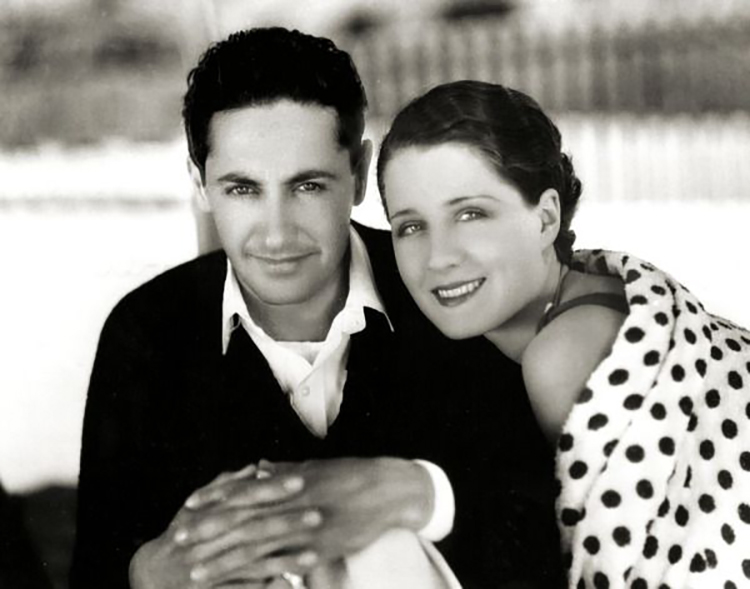
Norma Shearer pushed boundaries before the Production Code crackdown in 1934, and throughout her career, she seamlessly transitioned from flapper roles to weighty and controversial material with a sense of elegance and style—beginning with her Oscar-winning performance in “The Divorcee”—and to historical figures, as she did in the opulent costume drama “Marie Antoinette,” one of her most ambitious roles. It was MGM’s most expensive film at the time and showcased Shearer’s dramatic range. Other notable roles she played include “A Free Soul” (1931), as a woman torn between a respectable man and a dangerous gangster, played by Clark Gable; “Romeo and Juliet” (1936), and although controversial due to the age difference—Shearer was 34 playing a teenager—it was a high-prestige production aimed at showcasing Shakespeare on screen; and George Cukor’s “The Women” (1939), a rare film with an all-female cast, with Shearer as a refined woman navigating divorce and female friendships. It was one of her last and most enduring films, and it’s still praised for its ensemble and wit.
Her most iconic role was in “The Divorcee” (1930), where she played a modern woman who, after discovering her husband’s infidelity, decides to live by the same sexual double standard. Her character, Jerry, was strong and sympathetic, rather than bitter and vindictive. The film helped usher in the more liberated portrayals of women. At least, that’s how it worked in Pre-Code Hollywood because in 1934, a strict moral code was laid out by Film Czar William Hays, an American politician and member of the Republican Party, who spelled out a set of moral guidelines for self-censorship in American cinema.
The enforcement of the draconian Motion Picture Production Code censorship guidelines, a.k.a. the Hays Code, became the law in Hollywood and basically told the studios what they could and could not show. It covered a wide range of subjects, including violence, sex, crime, religion, and politics. The Code detailed what was considered acceptable for American audiences to look upon when watching a motion picture. Its impact on storytelling, censorship challenges, and the eventual push for artistic freedom was huge, and its restrictions shaped Hollywood for decades.
In retrospect, it is difficult now to fully grasp the impact of the Hays Code on the career of Norma Shearer, and the women with real personalities she played—pretty much like Jean Harlow, Mae West, Marlene Dietrich, Tallulah Bankhead, and Barbara Stanwyck did—or what it meant for the Hollywood film industry altogether. But the guidelines were strictly enforced, and chances were that a film that did not adhere to the Hays Code could not be released. This age of censorship lasted until the Code’s gradual decline in the late 1960s.
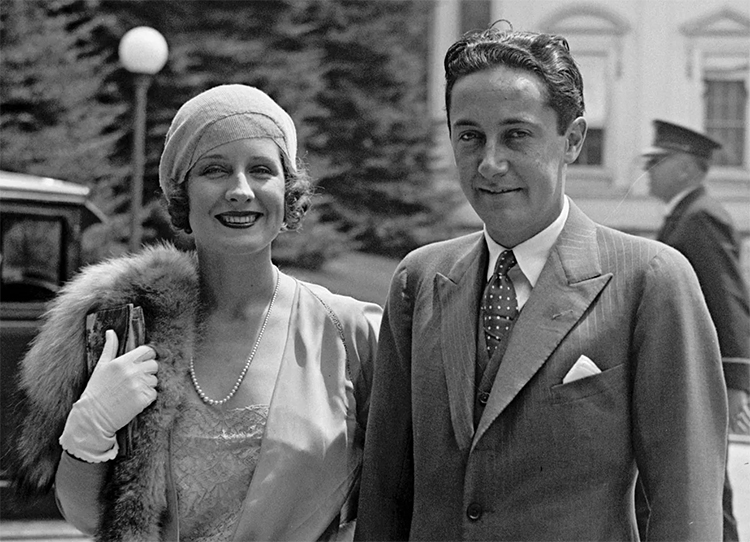
While Norma Shearer was once one of the biggest names in Hollywood and one of MGM’s prime moneymakers, her legacy has been somewhat overshadowed by later stars like Bette Davis and Joan Crawford. However, film historians and feminist critics have re-evaluated her as a key player in early studio-era Hollywood, as a pioneer of female autonomy on the screen by playing strong, unapologetic characters, and as an influence on how women could own desire, power, and self-determination in narrative film.
In the beginning, women on screen came in two varieties: the sweet ingénue or the vamp. Then two stars—both at MGM—came along who blasted away those stereotypes: Greta Garbo became the femme fatale, and Norma Shearer succeeded in taking the ingénue to a place she’s never been—the bedroom. Her poise, elegance, driving ambition, and thorough understanding of the nature of motion pictures were crucial in this makeover.
Despite retiring in the early 1940s, Norma Shearer managed to leave a legacy that still fascinates classic film fans and historians, as she was a defining figure and one of the boldest stars of Pre-Code Hollywood when she made a radical shift from playing sweet, wholesome roles, the all-American girl-next-door, to playing strong, liberated, and independent women. To prove she could do it, she did a daring photoshoot in 1929 in revealing lingerie, directed by famous photographer George Hurrell. This helped convince MGM and her husband, Irving G. Thalberg, to cast her in more provocative roles.

She could play a single woman who was not a virgin, or, as film critic Mick LaSalle wrote, ‘Norma Shearer made it chic for women to have sex and not be punished for it.’ LaSalle authored two books on pre-Code Hollywood; the first one being “Complicated Women: Sex and Power in Pre-Code Hollywood” (2000), a critical study of actresses who worked in films between 1929 and 1934, an era when women in American cinema were really modern. They took lovers, had babies out of wedlock, got rid of cheating husbands, enjoyed their sexuality, and acted the way many think women acted only since the late 1960s.
He ended this in-depth study with an interesting anecdote when a Norma Shearer Tribute was held in San Francisco in 1994 with sold-out screenings of her films like “Let Us Be Gay” and “The Divorcee” (both 1930).
‘I noticed that many individual men came every night,’ he wrote. ‘They would sit in the same spot, usually close to the screen. They would sink into their seats and gaze up, basking in the image of this pretty woman from sixty-five years before. Make no mistake, this was love. These fellows looked too serious not to be serious. Shearer’s appeal, an arrow launched in the bygone era of the Hoover administration, was striking home at a time and place no one could ever have anticipated. It was strange. It was painful. It was wonderful. It was something unique to the twentieth century. To sit in a theater in 1994 and fall in love with a woman from 1929… that would be like sitting in a theater in 1929 and falling in love with someone from 1864… or like watching 1994 from the year 2059…’
Or, as Janet Leigh had put it, ‘Norma Shearer was the quintessential star, she was a star like no other.’
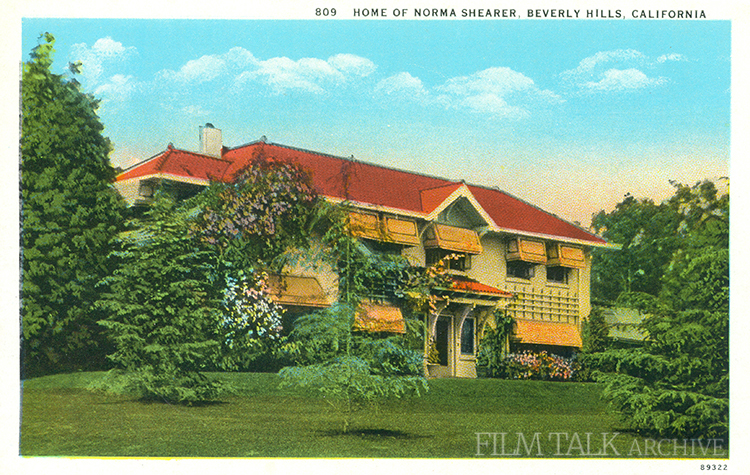
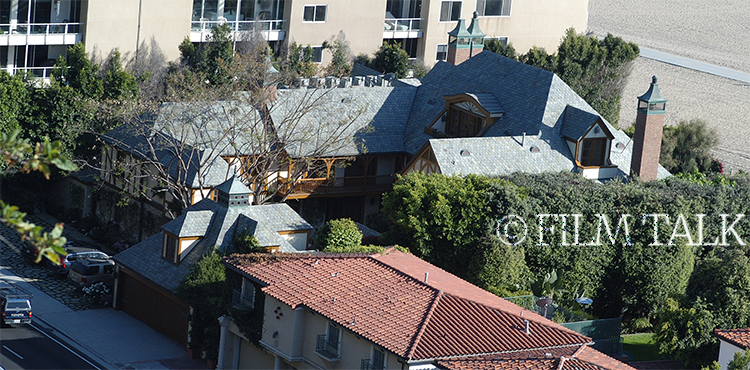
FILMS OF NORMA SHEARER
THE FLAPPER (1920) DIR Alan Crosland SCR Frances Marion (also story) CAM John W. Brown ED H.J. McCord CAST Olive Thomas, Theodore Westman Jr., William P. Carleton, Warren Cook, Katherine Johnston, Arthur Housman, Louise Lindroth, Norma Shearer (Schoolgirl [uncredited])
 WAY DOWN EAST (1920) DIR – PROD D.W. Griffith SCR Anthony Paul Kelly (play “Way Down East” [1897] by Lottie Blair Parker) CAM G.W. Bitzer, Paul H. Allen, Charles Downs, Hendrik Sartov ED Rose Smith, James Smith CAST Lillian Gish, Richard Bartelmess, Mrs. David Landau, David Sherman, Burr McIntosh, Josephine Bernard, Mrs. Morgan Belmont, Norma Shearer (Barn Dancer [uncredited])
THE RESTLESS SEX (1920) DIR Robert Z. Leonard, Leon D’Usseau SCR Frances Marion (novel “The Restless Sex” [1918] by Robert W. Chambers) CAM Allen G. Siegler CAST Marion Davies, Ralph Kellard, Carlyle Blackwell, Charles Lane, Robert Vivian, Etna Ross, Stephen Carr, Jane Darwell, Norma Shearer (Reveler at Artists ball [uncredited])
THE STEALERS (1920) DIR Christy Cabanne SCR Christy Cabanne (also story) CAM Georges Benoît CAST William H. Tooker, Robert Kenyon, Myrtle Morse, Norma Shearer (Julie Martin), Ruth Dwyer, Eugene Borden, Jack Crosby, Matthew Betz, John B. O’Brien, Downing Clarke, Walter Miller
THE LEATHER PUSHERS (1922) DIR Edward Laemmle PROD Carl Laemmle SCR H.C. Witwer CAM George Coudert CAST Reginald Denny, Billy Sullivan, Hayden Stevenson, Sam J. Ryan, Charles Ascot, Sam McVey, Helen Toombs, Brian Darley, Edgar Kennedy, Norma Shearer (Rose Del Mar)
THE MAN WHO PAID (1922) DIR Oscar Apfel SCR Marion Brooks (also story) CAST Wilfred Lytell, Norma Shearer (Jeanne Thornton), Florence Rogan, Fred C. Jones, Bernard Siegel, David Hennessey, Charles Byer, Erminie Gagnon, Frank Montgomery, Oscar Apfel
THE BOOTLEGGERS (1922) DIR Roy Sheldon SCR Thomas F. Fallon (also story) CAM Anthony G. Trigili CAST Walter Miller, Paul Panzer, Jules Cowles, Hazel Flint, Norma Shearer (Helen Barnes), Jane Allen, Lucia Backus Seger
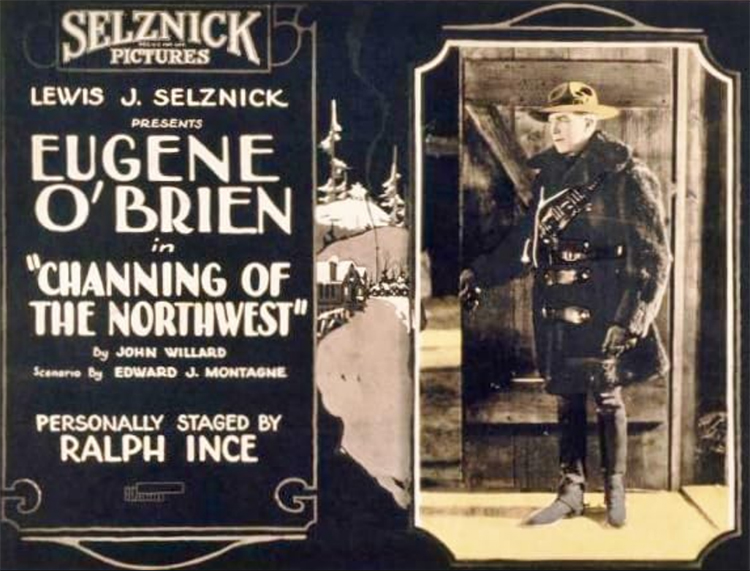 CHANNING OF THE NORTHWEST (1922) DIR Ralph Ince SCR Edward J. Montagne (story by John Willard) CAM John W. Brown CAST Eugene O’Brien, Gladden James, Norma Shearer (Jess Driscoll), James Seeley, Pat Hartigan, Nita Naldi, Harry Lee, Jack W. Johnston, Ralph Ince
A CLOUDED NAME (1923) DIR Austin O. Huhn SCR Austin O. Huhn (story by Tom Bret) CAM Jean Logan ED Tom Bret CAST Norma Shearer (Marjorie Dare), Gladden James, Yvonne Logan, Richard Neill, Charles Miller, Frederick Eckhart, Martha Langford, Marion Bradley
MAN AND WIFE (1923) DIR John L. McCutcheon SCR Leota Morgan (also story) CAST Maurice Costello, Gladys Leslie, Norma Shearer (Dora Perkins), Edna May Spooner, Robert Elliott, Ernest Hilliard, Charles Ascot
THE DEVIL’S PARTNER (1923) DIR Caryl S. Fleming CAST Norma Shearer (Jeanne), Henry Sedley, Charles Delaney, Edward Roseman, Stanley Walpole
PLEASURE MAD (1923) DIR Reginald Barker SCR Andrew Percival Younger (novel “The Valley of Content” by Blanche Upright) CAM Norbert Brodine, Alvin Wyckoff CAST Huntley Gordon, Mary Alden, Norma Shearer (Elinor Benton), William Collier Jr., Winifred Bryson, Ward Crane, Frederick Truesdell, Joan Standling
 THE WANTERS (1923) DIR John M. Stahl PROD Louis B. Mayer SCR Paul Bern, J.G. Hawks (story by Leila Burton Wells) CAM Ernest Palmer ED Margaret Booth CAST Marie Prevost, Robert Ellis, Norma Shearer (Marjorie), Gertrude Astor, Huntley Gordon, Lincoln Stedman, Lillian Langdon, Louise Fazenda
LUCRETIA LOMBARD (1923) DIR Jack Conway PROD Harry Rapf SCR Sada Cowan, Bertram Millhauser (novel “Lucretia Lombard” [1922] by Kathleen Norris) CAST Irene Rich, Monte Blue, Marc McDermott, Norma Sherer [Norma Shearer] (Mimi Winship), Alec B. Francis, John Roche, Lucy Beaumont, Otto Hoffman, Florence Lawrence
THE WOLF MAN (1923) DIR Edmund Mortimer SCR Fanny Hatton, Frederic Hatton (story by Reed Heustis) CAM Michael Farley, Don Short CAST John Gilbert, Norma Shearer (Elizabeth Gordon), Alma Francis, George Barraud, Eugene Pallette, Edgar Norton, Thomas R. Mills, Max Montesole
THE TRAIL OF THE LAW (1924) DIR – PROD Oscar Apfel SCR Marion Brooks (also story) CAM Alfred Gandolfi CAST Wilfred Lytell, Norma Shearer (Jerry Vardon), John P. Morse, George Stevens, Richard Neill, Charles Byer
BLUE WATER (1924) DIR David Hartford PROD Ernest Shipman SCR Faith Green (novel “Blue Water: A Tale of the Deep Sea Fishermen” [1907] by Frederick William Wallace) CAM Walter L. Griffin CAST Pierre Gendron, Jane Thomas, Norma Shearer (Lillian Denton), John Webb Dillion, Harlan Knight, Louis Darclay
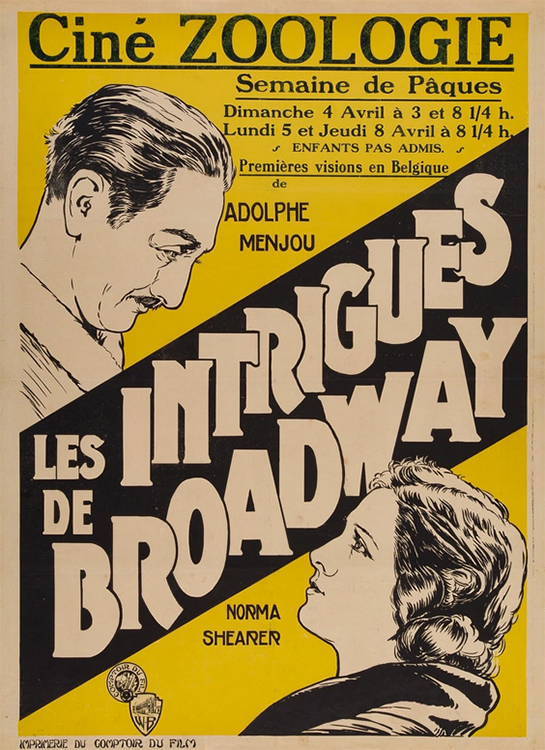 BROADWAY AFTER DARK (1924) DIR Monta Bell PROD Harry Rapf SCR (play “Broadway After Dark” by Owen Davis; adaptation by Douglas Z. Doty) CAM Charles Van Enger CAST Adolphe Menjou, Norma Shearer (Rose Dulane), Anna Q. Nilsson, Edmund Burns, Carmel Myers, Vera Lewis, Willard Louis, Mervyn LeRoy, Edgar Norton
BROKEN BARRIERS (1924) DIR Reginald Barker SCR Sada Cowan, Howard Higgin (novel “Broken Barriers” [1924] by Meredith M. Nicholson) CAM Percy Hilburn CAST James Kirkwood, Norma Shearer (Grace Durland), Adolpe Menjou, Mae Busch, George Fawcett, Margaret McWade, Robert Agnew, Ruth Stonehouse, Robert Frazer
EMPTY HANDS (1924) DIR Victor Fleming SCR Carey Wilson (story by Arthur Stringer) CAM Charles Edgar Schoenbaum ED Howard Hawks CAST Jack Holt, Norma Shearer (Claire Endicott), Charles Clary, Hazel Keener, Gertrude Olmstead, Ramsay Wallace, Ward Crane, Charles Stevens
MARRIED FLIRTS (1924) DIR Robert G. Vignola SCR Julia Crawford Ivers (novel “Mrs. Paramor” [1923] by Louis Joseph Vance) CAM Oliver T. Marsh ED Frank E. Hull MUS CAST Pauline Frederick, Conrad Nagel, Mae Busch, Huntley Gordon, Paul Nicholson, Patterson Dial, Alice Hollister: (as themselves [uncredited]) John Gilbert, Robert Z. Leonard, Louis B. Mayer, May McAvoy, Mae Murray, Aileen Pringle, Norma Shearer
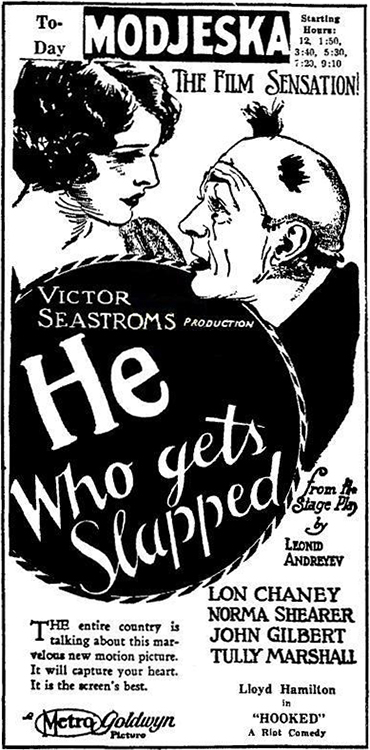 HE WHO GETS SLAPPED (1924) DIR Victor Seastrom [Victor Sjöström] PROD Victor Seastrom [Victor Sjöström], Irving G. Thalberg [uncredited] SCR (play “He Who Gets Slapped” [1915] by Leonid Andreyev; adaptation by Victor Seastrom [Victor Sjöström], Carey Wilson) CAM Milton Moore ED Hugh Wynn MUS William Axt CAST Lon Chaney, Norma Shearer (Counsuelo), John Gilbert, Ruth King, Marc McDermott, Ford Sterling, Tully Marshall
THE SNOB (1924) DIR Monta Bell SCR Monta Bell (novel “The Snob: The Story of a Marriage” [1924] by Helen Reimensnyder Martin) CAM André Barlatier ED Ralph Nelson CAST John Gilbert, Norma Shearer (Nancy Claxton), Conrad Nagel, Phyllis Haver, Hedda Hopper, Margaret Seddon, Aileen Manning, Hazel Kennedy, Gordon Sackville
EXCUSE ME (1925) DIR Alfred J. Goulding SCR Rupert Hughes (also play “Excuse Me” [1911]) CAM John W. Boyle, Paul Eagler, Max Fabian CAST Norma Shearer (Marjorie Newton), Conrad Nagel, Renée Adorée, Walter Hiers, John Boles, Bert Roach, William V. Mong, Edith Yorke, Gene Cameron
LADY OF THE NIGHT (1925) DIR Monta Bell SCR Alice D.G. Miller (story by Adela Rogers St. Johns) CAM André Barlatier ED Ralph Dawson MUS John Mirsalis CAST Norma Shearer (Molly Helmer/Florence Banning), Malcolm McGregor, George K. Arthur, Fred Esmelton, Dale Fuller, Lew Harvey, Betty Morrissey, Joan Crawford
WAKING UP THE TOWN (1925) DIR James Cruze SCR (story by James Cruze, Frank Condon) CAM Paul P. Perry, Arthur Edeson CAST Jack Pickford, Norma Shearer (Mary Ellen Hope), Claire McDowell, Alec B. Francis, Herbert Prior, Ann May, George Dromgold, Jack Edwards
THE END OF THE WORLD (1925) DIR Harvey G. Matherson PROD Thomas J. Geraghty, J.C. Lambden SCR (story by James Cruze, Frank Condon: adaptation by Thomas J. Geraghty) CAM Arthur Edeson, Richard Holahan ED Robert M. McPaul CAST Jack Pickford, Norma Shearer (Mary Ellen Hope), Claire McDowell, Alec B. Francis, Herbert Prior, Ann May, George Dromgold
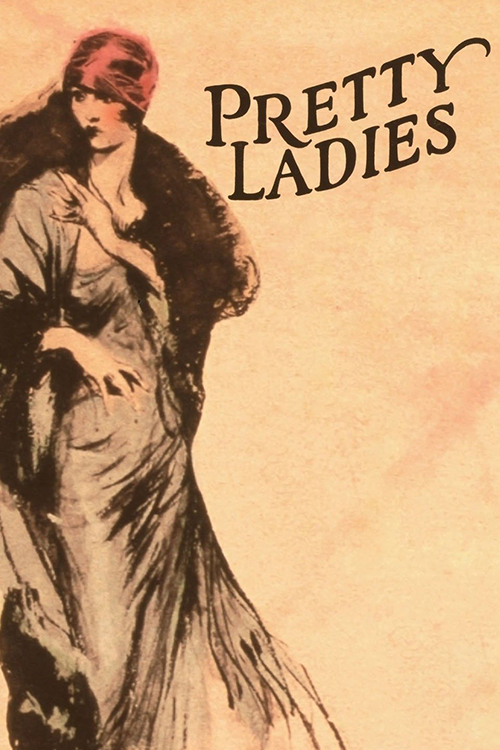 PRETTY LADIES (1925) DIR Monta Bell SCR Alice D.G. Miller (also adaptation: story “Maggie Qunanne” by Adela Rogers St. Johns) CAM Ira H. Morgan ED Blanche Sewell CAST ZaSu Pitts, Tom Moore, Ann Pennington, Lilyan Tashman, Bernard Randall, Helena D’Algy, Conrad Nagel, Norma Shearer (Frances White), Joan Crawford, Carole Lombard, Myrna Loy
A SLAVE OF FASHION (1925) DIR Hobart Henley SCR Bess Meredyth, Jane Murfin (story by Samuel Shipman) CAM Ben F. Reynolds CAST Norma Shearer (Katherine Emerson), Mary Carr, James Corrigan, Vivia Ogden, Miss DuPont, Estelle Clark, Joan Crawford
THE TOWER OF LIES (1925) DIR Victor Seastrom [Victor Sjöström] PROD Irving G. Thalberg [uncredited] SCR Agnes Christine Johnston, Max Marcin (novel “Kejsarn av Portugallien en Värmlandsberättelse,” a.k.a. “The Emperor of Portugallia” [1914] by Selma Lagerlöf) CAM Percy Hilburn ED Joseph Hayden CAST Norma Shearer (Glory or Goldie), Lon Chaney, Ian Keith, Claire McDowell, William Haines, David Torrence, Lew Cody
HIS SECRETARY (1925) DIR Hobart Henley SCR Hope Loring, Louis D. Lighton (story by Carey Wilson, Frederica Sagor Maas) CAM Ben F. Reynolds ED Frank Davis CAST Norma Shearer (Ruth Lawrence), Lew Cody, Willard Louis, Karl Dane, Gwen Lee, Mabel Van Buren, Estelle Clark, Donald Reed
 THE DEVIL’S CIRCUS (1926) DIR Benjamin Christianson SCR Benjamin Christianson (also story) CAM Ben F. Reynolds ED Ben Lewis CAST Norma Shearer (Mary), Charles Emmett Mack, Carmel Myers, John Miljan, Claire McDowell, Charles Emmett Mack, Joyce Coad, Karl Dane, Mack Swain
THE WANING SEX (1926) DIR Robert Z. Leonard PROD Harry Rapf SCR Frederica Sagor Maas (play “The Waning Sex” [1923] by Fanny Hatton, Frederic Hatton; adaptation by F. Hugh Herbert) CAM Ben F. Reynolds ED William LeVanway CAST Norma Shearer (Nina Duane), Conrad Nagel, George K. Arthur, Mary McAllister, Charles McHugh, Tiny Ward
UPSTAGE (1926) DIR Monta Bell SCR Lorna Moon (story by Walter DeLeon) CAM Tony Gaudio ED Frank Sullivan CAST Norma Shearer (Dolly Haven), Oscar Shaw, Tenen Holtz, Gwen Lee, Dorothy Phillips, J. Frank Glendon, Ward Crane, Charles Meakin, Margie Angus, Mary Angus
THE DEMI-BRIDE (1927) DIR – PROD Robert Z. Leonard SCR F. Hugh Herbert, Florence Ryerson CAM Percy Hilburn ED William LeVanway CAST Norma Shearer (Criquette), Lew Cody, Carmel Myers, Dorothy Sebastian, Lionel Belmore, Tenen Holtz, Nora Cecil
 AFTER MIDNIGHT (1927) DIR Monta Bell PROD Harry Rapf SCR Lorna Moon (story by Monta Bell) CAM Percy Hilburn ED Blanche Sewell CAST Norma Shearer (Mary Miller), Lawrence Gray, Gwen Lee, Eddie Sturgis, Philip Sleeman, Johnny Mack Brown, Robert Dudley
THE STUDENT PRINCE IN OLD HEIDELBERG, a.k.a. THE STUDENT PRINCE and OLD HEIDELBERG (1927) DIR – PROD Ernst Lubitsch SCR (play “Old Heidelberg” [1901] by Wilhelm Meyer-Förster; musical play “The Student Prince” [1924] by Dorothy Donnelly) CAM John J. Mescall ED Andrew Marton CAST Ramon Navarro, Norma Shearer (Kathi), Jean Hersholt, Gustav von Seyffertitz, Philippe De Lacy, Edgar Norton
THE LASTEST THING FROM PARIS (1928) DIR Sam Wood SCR Andrew Percival Younger (also story) CAM William H. Daniels ED Basil Wrangell CAST Norma Shearer (Ann Dolan), George Sidney, Ralph Forbes, Tenen Holtz, William Bakewell, Margaret Landis, Bert Roach
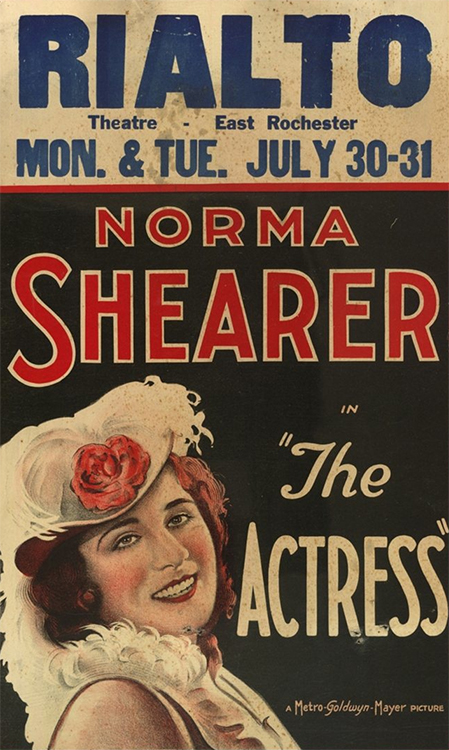 THE ACTRESS (1928) DIR Sidney Franklin SCR Albert Lewin, Richard Schayer (play “Trelawney of the Wells” [1898] by Arthur Wing Pinero) CAM William H. Daniels ED Conrad A. Nervig CAST Norma Shearer (Rose Trelawney), Owen Moore, Gwen Lee, Lee Moran, Roy D’Arcy, Virginia Pearson, William Humphrey, Ralph Forbes
A LADY OF CHANCE (1928) DIR – PROD Robert Z. Leonard SCR Andrew Percival Younger (story “Little Angel” by Leroy Scott; adaptation by Edmund Goulding) CAM William H. Daniels, J. Peverell Marley ED Margaret Booth MUS Christopher Caliendo CAST Norma Shearer (Dolly Morgan a.k.a. Angel Face), Lowell Sherman, Gwen Lee, Johnny Mack Brown, Eugenie Besserer, Buddy Messinger, Polly Moran, Bert Roach
THE TRIAL OF MARY DUGAN (1929) DIR Bayard Veiller PROD Irving G. Thalberg [uncredited] SCR Bayard Veiller (also play “The Trial of Mary Dugan” [1927]) CAM William H. Daniels ED Blanche Sewell CAST Norma Shearer (Mary Elizabeth Dugan), Lewis Stone, H.B. Warner, Raymond Hackett, Lilyan Tashman, Olive Tell, Adrienne D’Ambricourt
A MAN’S MAN (1929) DIR – PROD James Cruze SCR (play “A Man’s Man” [1925] by Patrick Kearney; adaptation by Forrest Halsey) CAM Merritt B. Gerstad ED George Hively CAST William Haines, Josephine Dunn, Sam Hardy, Mae Busch, Gloria Davenport; (as themselves [uncredited]) Greta Garbo, John Gilbert, John Miljan, Fred Niblo, Mary Nolan, Norma Shearer
HOLLYWOOD REVUE OF 1929, a.k.a. HOLLYWOOD REVUE (1929) DIR Charles F. Riesner PROD Harry Rapf, Irving G. Thalberg [uncredited] SCR (dialogue by Robert E. Hopkins, Al Boasberg) CAM Max Fabian, John Arnold, Irving G. Ries, John M. Nickolaus ED Cameron K. Wood, William S. Gray MUS Arthur Lange CAST Conrad Nagel, Jack Benny, John Gilbert, Norma Shearer (Norma Shearer/Juliet), Joan Crawford, Bessie Love, Cliff Edwards, Stan Laurel, Oliver Hardy, Anita Page, Nils Asther, Marion Davies, William Haines, Buster Keaton, Marie Dressler, Polly Moran, Karl Dane, Gwen Lee, Lionel Barrymore, Ann Dvorak, Carla Laemmle
THE LAST OF MRS. CHEYNEY (1929) DIR Sidney Franklin PROD Irving G. Thalberg [uncredited] SCR Claudine West, Hanns Kräly (play “The Last of Mrs. Cheyney” [1925] by Frederick Lonsdale) CAM William H. Daniels ED Conrad A. Nervig MUS William Axt CAST Norma Shearer (Fay Cheyney), Basil Rathbone, Herbert Bunston, George Barraud, Hedda Hopper, Moon Carroll, Madeline Seymour, Cyril Chadwick
THEIR OWN DESIRE (1929) DIR E. Mason Hopper SCR Frances Marion, James Forbes (novel by Sarita Fuller [Beulah Marie Dix]) CAM William H. Daniels ED Harry Reynolds MUS William Axt CAST Norma Shearer (Lally), Belle Bennett, Lewis Stone, Robert Montgomery, Helene Millard, Cecil Cunningham, Henry Hebert, Mary Doran, Bess Flowers
 THE DIVORCEE (1930) DIR Robert Z. Leonard PROD Robert Z. Leonard, Irving G. Thalberg [uncredited] SCR Zelda Sears, Nick Grinde (novel “Ex-Wife” [1929] by Ursula Parrott) CAM Norbert Brodine ED Hugh Wynn MUS CAST Norma Shearer (Jerry), Chester Morris, Conrad Nagel, Robert Montgomery, Florence Eldridge, Helene Millard, Robert Elliott, Mary Doran, Tyler Brooke, Zelda Sears
LET US BE GAY (1930) DIR Robert Z. Leonard PROD Robert Z. Leonard, Irving G. Thalberg [uncredited] SCR Frances Marion (play “Let Us Be Gay” [1929] by Rachel Crothers) CAM Norbert Brodine ED Basil Wrangell CAST Norma Shearer (Kitty Brown), Rod La Rocque, Marie Dressler, Gilbert Emery, Hedda Hopper, Raymond Hackett, Sally Eilers, Tyrell Davis, Dickie Moore
STRANGERS MAY KISS (1931) DIR – PROD George Fitzmaurice SCR John Meehan (book “Strangers May Kiss” [1930] by Ursula Parrott) CAM William H. Daniels ED Hugh Wynn CAST Norma Shearer (Lisbeth), Robert Montgomery, Neil Hamilton, Marjorie Rambeau, Irene Rich, Hale Hamilton, Conchita Montenegro, Jed Prouty, Bess Flowers, Ray Milland, Karen Morley
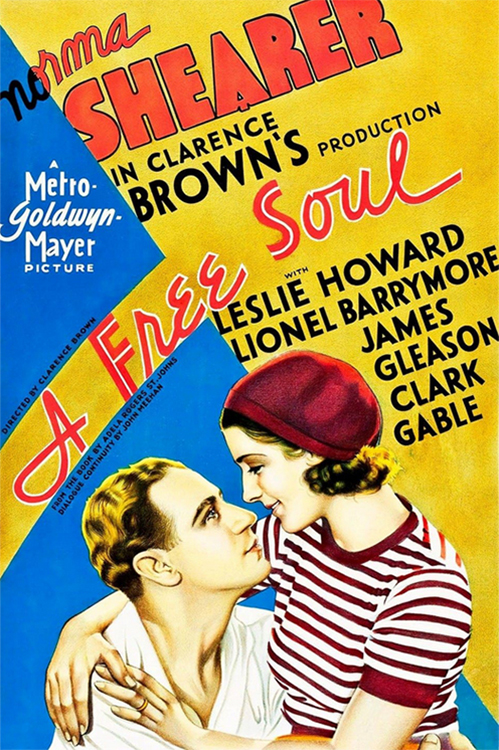 A FREE SOUL (1931) DIR – PROD Clarence Brown SCR Dorothy Farnum, Philip Dunning, John Lynch (book “A Free Soul” [1927] by Adela Rogers St. Johns; play “A Free Soul” [1928] by Willard Mack; adaptation by Becky Gardiner) CAM William H. Daniels ED Hugh Wynn MUS CAST Norma Shearer (Jane Ashe), Leslie Howard, Lionel Barrymore, James Gleason, Clark Gable, Lucy Beaumont, Roscoe Ates, Bess Flowers
PRIVATE LIVES (1931) DIR Sidney Franklin PROD Irving G. Thalberg [uncredited] SCR Hanns Kräly, Richard Schayer (play “Private Lives” [1930] by Noël Coward) CAM Ray Binger ED Conrad A. Nervig MUS William Axt CAST Norma Shearer (Amanda), Robert Montgomery, Reginald Denny, Jean Hersholt, Una Merkel, George Davis
STRANGE INTERLUDE (1932) DIR Robert Z. Leonard PROD Robert Z. Leonard, Irving G. Thalberg [uncredited] SCR Bess Meredyth, C. Gardner Sullivan (play “Strange Interlude” [1928] by Eugene O’Neill) CAM Lee Garmes ED Margaret Booth CAST Norma Shearer (Nina Leeds), Clark Gable, Alexander Kirkland, Ralph Morgan, Robert Young, May Robson, Maureen O’Sullivan, Henry B. Walthall, Mary Alden
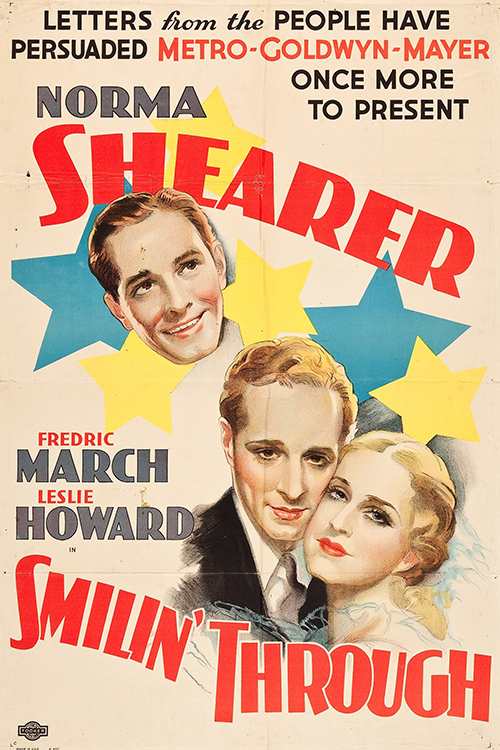 SMILIN’ THROUGH (1932) DIR Sidney Franklin PROD Albert Lewin, Irving G. Thalberg [uncredited] SCR Claudine West, Ernest Vajda (play “Smilin’ Through” [1919] by Allan Langdon Martin [Jane Murfin, Jane Cowl]) CAM Lee Garmes ED Margaret Booth CAST Norma Shearer (Kathleen/Moonyean Clare), Fredric March, Leslie Howard, O.P. Heggie, Ralph Forbes, Beryl Mercer, Margaret Seddon, Forrester Harvey, Cora Sue Collins
RIPTIDE (1934) DIR – SCR Edmund Goulding PROD Irving G. Thalberg [uncredited] CAM Ray June ED Margaret Booth MUS Herbert Stothart CAST Norma Shearer (Lady Mary Rexford), Herbert Marshall, Robert Montgomery, Mrs. Patrick Campbell, Richard ‘Skeets’ Gallagher, Ralph Forbes, Lilyan Tashman, Arthur Jarrett, Helen Jerome Eddy, Walter Brennan
THE BARRETTS OF WIMPOLE STREET (1934) DIR Sidney Franklin PROD Irving G. Thalberg [uncredited] SCR Claudine West, Ernest Vajda, Donald Ogden Stewart (play “The Barretts of Wimpole Street” [1930] by Rudolph Besier) CAM William H. Daniels ED Margaret Booth MUS Herbert Stothart CAST Norma Shearer (Elizabeth Barrett), Fredric March, Charles Laughton, Maureen O’Sullivan, Katharine Alexander, Ralph Forbes, Marion Clayton Anderson, Ian Wolfe, Leo G. Carroll
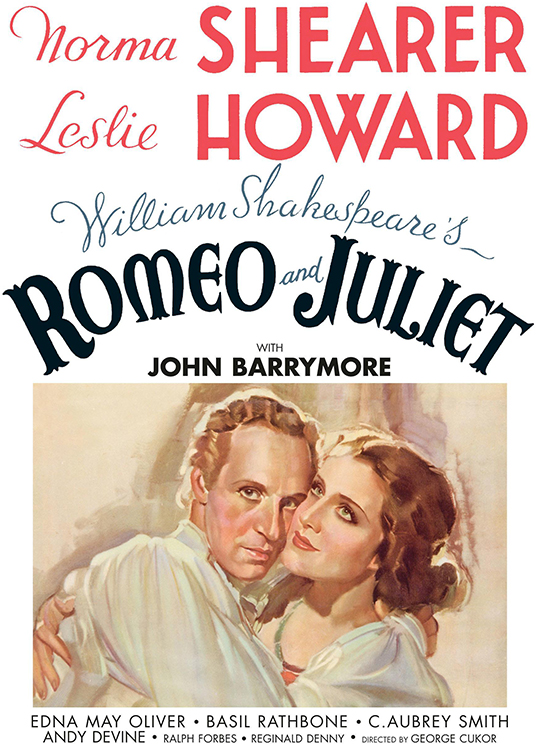 ROMEO AND JULIET (1936) DIR George Cukor PROD Irving G. Thalberg [uncredited] SCR (play “The Tragedy of Romeo and Juliet” a.k.a. “Romeo and Juliet” [ca. 1597] by William Shakespeare; adaptation by Talbot Jennings) CAM William H. Daniels ED Margaret Booth MUS Herbert Stothart CAST Leslie Howard, Norma Shearer (Juliet), John Barrymore, Edna May Oliver, Basil Rathbone, C. Aubrey Smith, Andy Devine, Katherine DeMille
MARIE ANTOINETTE (1936) DIR W.S. Van Dyke II PROD Hunt Stromberg, Irving G. Thalberg [uncredited] SCR Claudine West, Ernest Vajda, Donald Ogden Stewart (book “Marie Antoinette: Portrait of an Average Woman” [1932] by Stefan Zweig) CAM William H. Daniels, George J. Folsey, Leonard Smith ED Robert Kern MUS Herbert Stothart CAST Norma Shearer (Marie Antoinette), Tyrone Power, John Barrymore, Robert Morley, Anita Louise, Joseph Schildkraut, Gladys George, Henry Stephenson, Cora Witherspoon, Barry Fitzgerald, Ruth Hussey
IDIOT’S DELIGHT (1939) DIR Clarence Brown PROD Clarence Brown, Irving G. Thalberg [uncredited] SCR Robert E. Sherwood (also play “Idiot’s Delight” [1936]) CAM William H. Daniels ED Robert Kern MUS Herbert Stothart CAST Norma Shearer (Irene), Clark Gable, Edward Arnold, Charles Coburn, Joseph Schildkraut, Burgess Meredith, Laura Hope Crews, Richard ‘Skeets’ Gallagher, Virginia Grey, Hobart Cavanaugh, Claire McDowell, Joe Yule
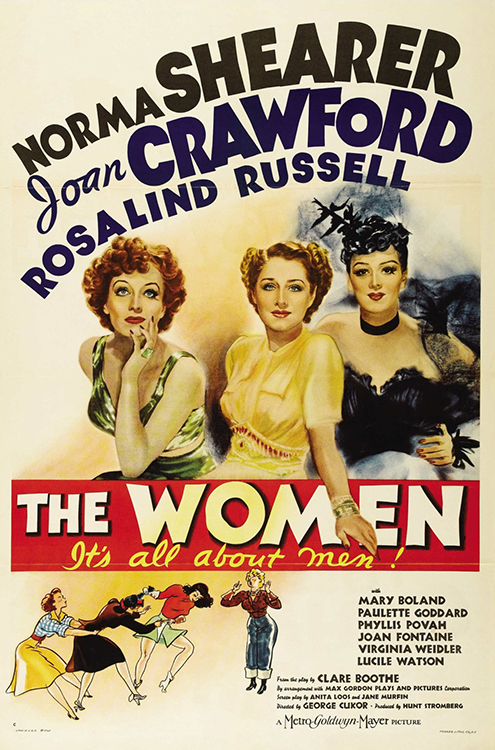 THE WOMEN (1939) DIR George Cukor PROD Hunt Stromberg SCR Anita Loos, Jane Murfin (play “The Women” [1936] by Clare Boothe Luce) CAM Joseph Ruttenberg, Oliver T. Marsh ED Robert Kern MUS Edward Ward, David Snell CAST Norma Shearer (Mrs. Stephen Haines, a.k.a. Mary), Joan Crawford, Rosalind Russell, Mary Boland, Paulette Goddard, Phyllis Povah, Joan Fontaine, Virginia Weidler, Lucile Watson, Marjorie Main, Virginia Grey, Ruth Hussey, Hedda Hopper, Cora Witherspoon, Gertrude Astor, Butterfly McQueen
ESCAPE (1940) DIR Mervyn LeRoy PROD Mervyn LeRoy, Lawrence Weingarten SCR Marguerite Roberts, Arch Oboler (novel “Escape” [1939] by Grace Zaring Stone [Ethel Vance]) CAM Robert H. Planck ED George Boemler MUS Franz Waxman CAST Norma Shearer (Countess von Treck), Robert Taylor, Conrad Veidt, Alla Nazimova, Felix Bressart, Albert Basserman, Philip Dorn
WE WERE DANCING (1942) DIR Robert Z. Leonard PROD Robert Z. Leonard, Orville O. Dull SCR Claudine West, Hans Rameau, George Froeschel (play “Tonight at 8:30” [1936] by Noël Coward) CAM Robert H. Planck ED George Boemler MUS Bronislau Kaper CAST Norma Shearer (Vicki Wilomirska), Melvyn Douglas, Gail Patrick, Lee Bowman, Marjorie Main, Reginald Owen, Alan Mowbray, Florence Bates, Bess Flowers
HER CARDBOARD LOVER (1942) DIR George Cukor PROD J. Walter Ruben SCR Jacques Deval, John Collier, Anthony Veiller, William H. Wright (play “Dans sa candeur naïve” [1926] by Jacques Deval; English play adaptation by Valerie Wyngate, P.G. Wodehouse) CAM Robert H. Planck, Harry Stradling Sr. ED Robert Kern MUS Franz Waxman CAST Norma Shearer (Consuelo Croyden), Robert Taylor, George Sanders, Frank McHugh, Elizabeth Patterson, Chill Wills, Hobart Cavanaugh, Bess Flowers
 FILM TALK
You must be logged in to post a comment.