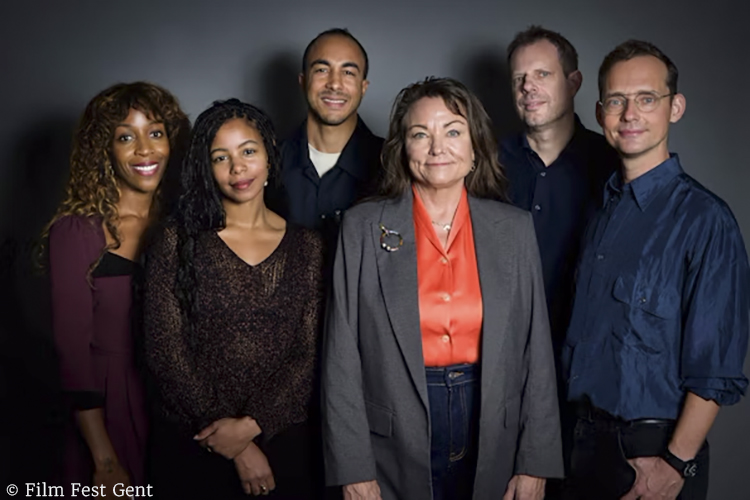
The 52nd edition of Film Fest Gent came to a close on Sunday evening after twelve days filled with premieres, encounters, and concerts. Feature image: the Festival’s International Jury, from left to right, Charlotte Adigéry, Denise Fernandes, Maxime Jean-Baptiste, Theresa Russell (Jury President), Alain Desauvage, and Ramon Zürcher.
In a world increasingly divided, the festival made a deliberate choice for films that put humanity and care at the center, works that resist polarisation and call for tenderness, connection, and resistance.
The tone was set with “Julian,” the impressive debut by Cato Kusters, about two women who decide to get married in every country where it’s legal. The result is ‘an ode to love as an act of resistance in a time when LGBTQIA+ rights are under pressure worldwide,’ said Program Director Wim De Witte at the Festival’s opening. At just 26, Kusters became the youngest director ever to open the festival, and as if that weren’t enough, she also received the Jo Röpcke Award. ‘We tried to put a face to an issue that otherwise remains very abstract,’ she said of her debut film. ‘It starts from love; the activism that follows from that is self-evident.’ That final line resonated throughout the Festival.
 The closing film, “Urchin” by Harris Dickinson, was equally in tune with this socially engaged attitude. In his social-realist debut, Dickinson turns his camera on the life of a young homeless man in central London, holding British society to account.
The call for humanity also resonated strongly in the competitions and among the award winners of the 52nd edition. It was especially evident in the Grand Prix winner “The Voice of Hind Rajab” by Kaouther Ben Hania, a film that reconstructs the final moments of six-year-old Palestinian Hind Rajab. Its unflinching confrontation with systemic and international failure to stand up in the face of violence makes “The Voice of Hind Rajab” a moral appeal to keep looking and to turn empathy into action.
Other award winners, too, were driven by social engagement. “Barrio Triste” by Stillz, winner of the Georges Delerue Award, immerses viewers in the raw street life of Medellín. In the short film competition, “O Rio de Janeiro continua lindo” by Felipe Casanova, was recognized for its epistolary indictment of racial power structures rooted in a colonial past. Each of these filmmakers uses cinema in their own way to create tender spaces of connection and resistance.
In that same spirit, the festival sought other ways to be actively situated in the present socio-political conjuncture. It signed the “Film Workers for Palestine” declaration and presented the Industry Award during the WSA Film Music Days to the Composers Diversity Collective. Founder Michael Abels thanked the festival ‘for having the courage to celebrate diversity in a time when some claim that diversity is unpatriotic or even demonic,’ calling it ‘inspiring that the WSA consciously makes this choice in such a climate.’

This 52nd edition of Film Fest Gent featured 120 feature films, 36 short films, two TV series, and two VR projects. Many filmmakers expressed their pursuit of tenderness in more implicit ways, for instance by drawing attention to the intimate and the everyday. In “Blue Heron,” winner of the Explore Award, Canadian-Hungarian director Sophy Romvari draws on her own biography to create a delicate, embodied portrait of a fractured family trying to heal. Noting the abundance of films exploring the intimacy and complexity of family life, such as “The Love That Remains” by Hlynur Pálmason, “Omaha” by Cole Webley, and “Dreams (Sex Love)” by Dag Johan Haugerud, the Festival introduced a new tag: “Family First?” In doing so, it deliberately chose stories that slow down and listen, that seek beauty and tenderness in times of hardening.
The fact that the audience felt actively engaged was reflected in once again surpassing 100,000 visits. In addition, a trend can be observed: an increasing number of visitors are opting for 5- or 10-ride passes, indicating a growing rate of repeat attendance.
The search for tenderness and social engagement was also reflected in the films, many of which drew sold-out audiences, including “Roofman,” “I Am Martin Parr,” “The Blue Trail,” “The Voice of Hind Rajab,” “Die, My Love,” “Anything That Moves,” “Urchin,” “Competition for Belgian Student Shorts 2025,” “Bugonia,” Christy,” “A Useful Ghost,” “After the Hunt,” “Julian,” “Left-Handed Girl” and “The Spy.”
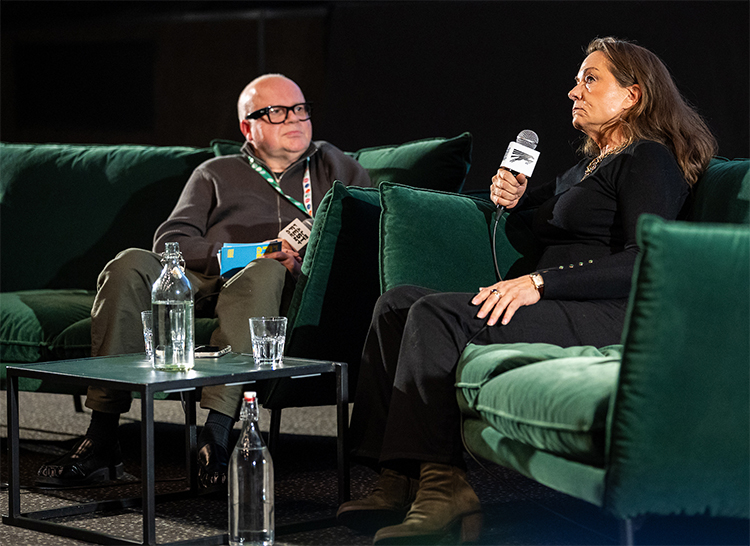
On the red carpet, too, the Festival embraced diversity in every sense of the word. Alongside Cato Kusters, Film Fest Gent welcomed Belgian filmmakers, including Caroline Strubbe, Maja Ajmia Yde Zellama, Laura Wandel, and the duo Kato De Boeck and Flo Van Deuren with “Roomies 2.” From abroad, guests such as “The Square” lead actor Claes Bang, Nadia Melliti (Best Actress, Cannes Film Festival, 2025), Denis Côté, Damien Hauser, Gabriel Mascaro, Shih-Ching Tsou, Zinnini Elkington, Jaume Claret Muxart, Golden Bear winner Dag Johan Haugerud, Igor Bezinovic, Cole Webley, and Sophy Romvari all traveled to Ghent. Harris Dickinson and Frank Dillane presented the closing film “Urchin,” while actress Theresa Russell received the Joseph Plateau Honorary Award and gave an inspiring Actor’s Talk.
In the festival’s second week, music took center stage during the WSA Film Music Days. The 25th edition of the World Soundtrack Awards became a joyful yet deeply moving celebration of the power of film music, featuring internationally acclaimed guests such as Debbie Wiseman, A.R. Rahman, Martin Phipps, and Emilie Levienaise-Farrouch. Both the WSA Ceremony & Concert and the additional concert “Minimalism in Motion: Glass, Nyman and Beyond” sold out in no time. VIDEODROOM, the annual dream date between Film Fest Gent and VIERNULVIER where cult films receive new soundtracks, also enjoyed a particularly successful edition with roughly twice as many visitors as last year. Together, they formed the beating heart of a festival that breathes film and music as one, and whose audience once again wholeheartedly embraced its musical soul.
 FILM TALK
You must be logged in to post a comment.