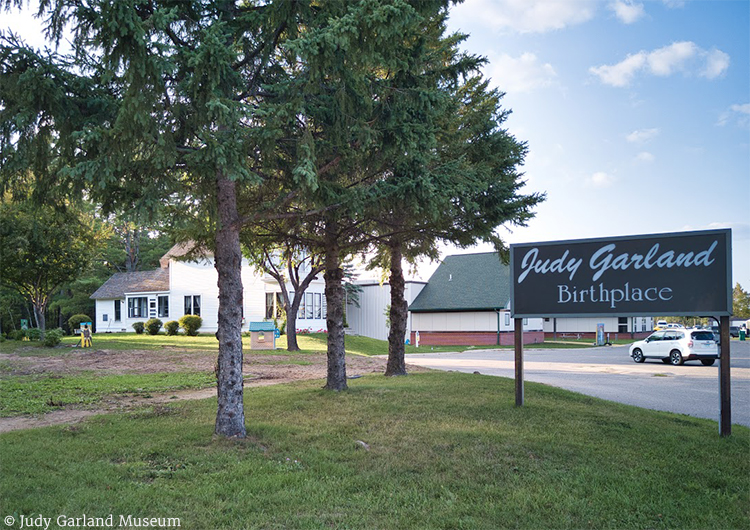
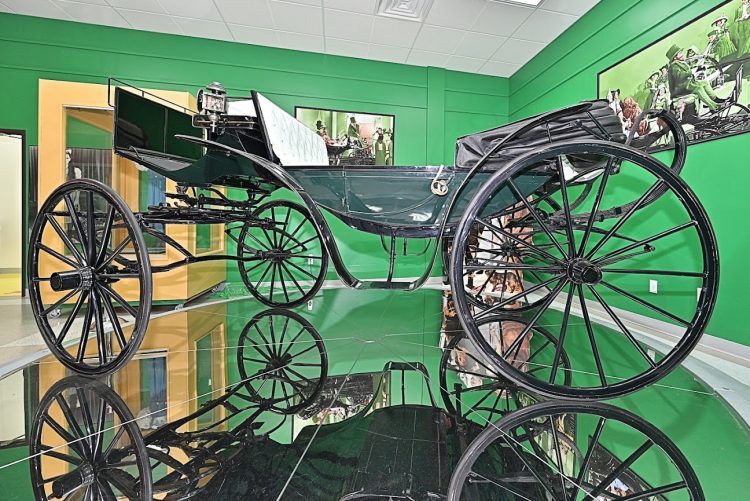
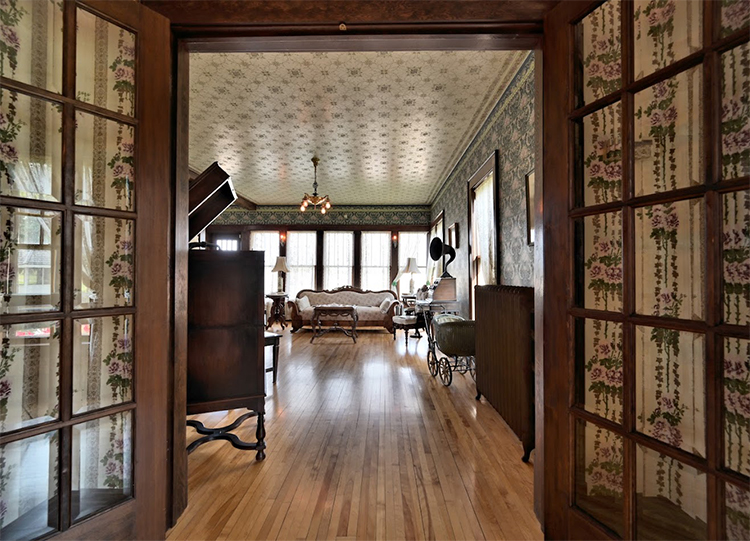
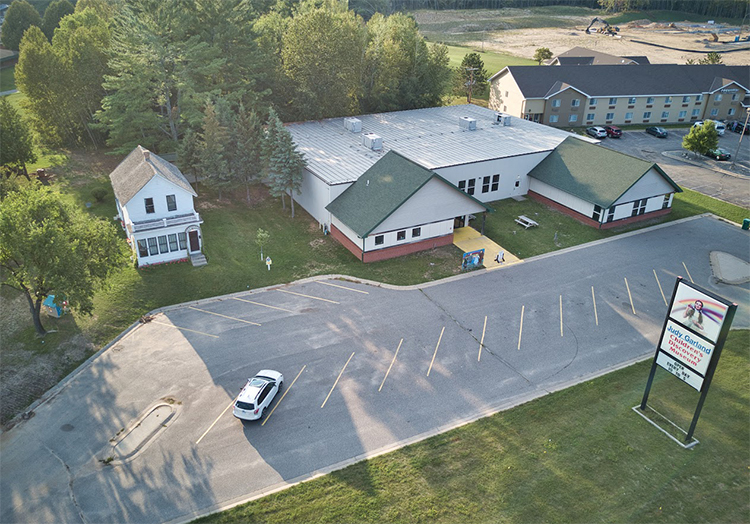
Judy Garland, born Frances Ethel Gumm on June 10, 1922, in Grand Rapids, Minnesota, occupies a unique place in American cultural history, and even more so in Grand Rapids, Minnesota, where the Judy Garland Museum and the Children’s Discovery Museum are located. The first one features her restored childhood home and various “Wizard of Oz” and Judy Garland exhibitions, with the original carriage featured in “The Wizard of Oz,” a Dorothy Gale test dress worn by Judy Garland, and many personal Judy Garland items collected over the past forty years.
The attached Children’s Discovery Museum is a ‘learning through play and open exploration space filled with fun, educational, hands-on exhibits kids and adults are sure to enjoy,’ as it says on its website. The two museums on one location have been created for all ages.
More than fifty years after Judy Garland passed away in London in 1969, they remind everyone that she was a girl from a small Minnesota town, and they continue to draw fans from around the world who get a chance to connect with the golden age of cinema in an intimate, heartfelt way, as it’s a place that honors not just the glamour of stardom but also the roots from which greatness can grow.
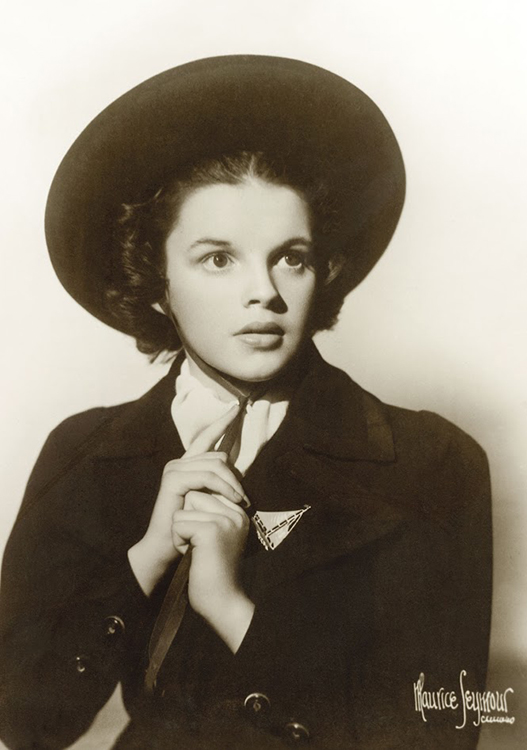
The Judy Garland Museum was founded in 1975 to celebrate and honor her birthplace and her legacy as a singer, an actress, a performer, and an entertainer. Memorabilia, costumes, and props give visitors an idea of who she really was, and her restored childhood home—where you can literally walk through her early life—illustrates her humble beginnings. It has inspired many generations of Judy Garland fans who have visited the museum over the years.
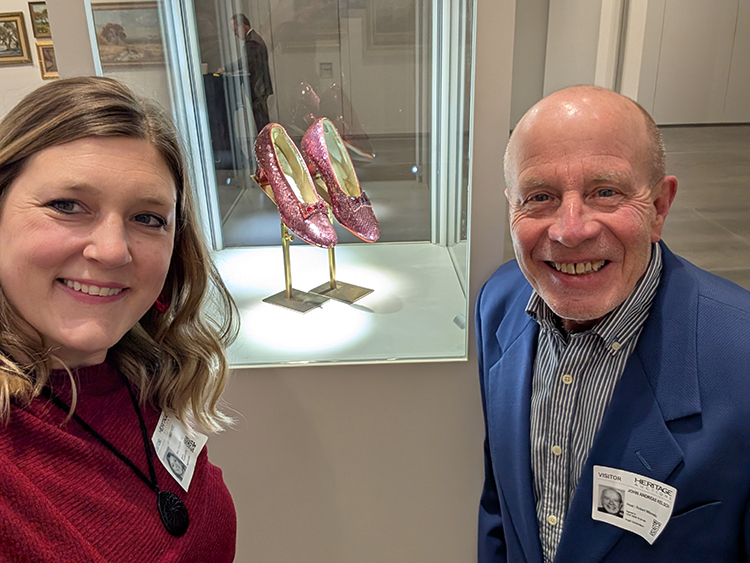
In 2005, the Judy Garland Museum attracted national media coverage after the ruby slippers she wore in “The Wizard of Oz” were stolen from the museum. In the classic 1939 musical, Garland’s character, Dorothy, had to click the heels of her ruby slippers three times and repeat, ‘There’s no place like home,’ to return to Kansas from Oz. She wore several pairs during filming, but only four authentic pairs are known to remain. One pair was on loan to the museum when it was stolen. After the ruby slippers were recovered in 2018, they did not return to the museum, but to their private owner, who subsequently slated them for auction. Still, even without the ruby slippers, the museum continues to draw fans from around the world.
I was fascinated about this project, primo because it looked pretty much like a labor of love for the most part, and secundo, the people behind it must be very passionate to offer such a deeply personal and historic look at Judy Garland’s roots and her Hollywood legacy. I got in touch with the museum, and the result was a highly interesting video call with John Kelsch, curator of the Judy Garland Museum, and Janie Heitz, executive director of the Judy Garland and Children’s Discovery Museum. They’re the driving forces behind it all, and their in-depth look into the museum was very interesting and inspiring. But first—for those who may not be too familiar with Judy Garland—why would they invest so much time and energy to pay tribute to an iconic star in an era of social media when news comes and goes just like that, and when it seems that nothing’s here to stay?
Well, Judy Garland, for one, is here to stay. That’s for sure. Her short life story is one of dazzling artistic triumphs and tragic personal struggles, a combination that has elevated her to near-mythic status. She was not only a successful Hollywood actress and a talented performer; she was a phenomenon whose voice, emotional honesty, and vulnerability forged a connection with audiences that remains powerful, more than half a century after her death.
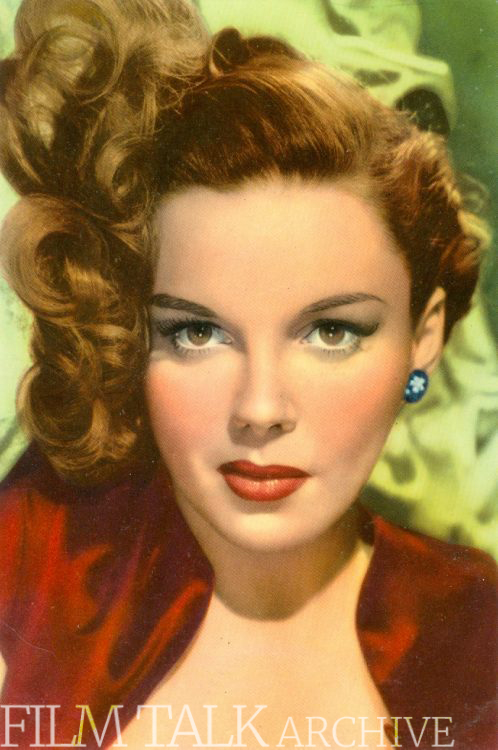
Judy Garland was born into a show business family. Her parents, Frank Gumm (1886-1935) and Ethel Marion Milne (1893-1953), operated a movie theater that also hosted live performances; it was only natural that their three daughters—Mary Jane (1915-1964), Dorothy Virginia (1917-1977), and Frances—became entertainers. Frances (Judy), the youngest, displayed an exceptional gift from the very beginning. Not yet three years old, she made her stage debut singing “Jingle Bells” with her sisters. Audiences immediately responded to the power and clarity of her voice, which was astonishingly mature for a child. These early performances laid the foundation for what would become one of the most celebrated careers in entertainment history.
In 1926, the Gumm family left Grand Rapids and moved to Lancaster, California, seeking greater opportunities in the expanding world of film. The sisters continued performing in a vaudeville act as The Gumm Sisters, later rebranded as The Garland Sisters. Frances adopted the first name Judy soon after. The Gumm Sisters were never major stars in their own right—they only found moderate success on the West Coast vaudeville circuit—but their contributions to vaudeville and early cinema remain a significant part of Garland’s early history. Judy’s extraordinary voice and charismatic presence always drew the most attention.
Her big break came in 1935, when the 13-year-old Garland was auditioned personally by studio chief Louis B. Mayer who, impressed by her voice, signed her on a contract without a screen test. At that time, MGM was the most prestigious of all Hollywood studios, known and praised for its lavish musicals and stable of glamorous stars—‘more stars than there are in heaven.’ In the beginning, the studio did really not know too well what to do with her; aged 13, she was too old to be a child star, but too young for adult roles. She did not fit the standard mold of MGM starlets; she was neither statuesque nor conventionally glamorous. Instead, her appeal was grounded in her relatability, vulnerability, and emotional depth. The studio, recognizing her potential, cultivated her talents, and Garland’s star ascended rapidly.

Her youthful sincerity and unmatched vocal expressiveness captivated audiences; her pairing with Mickey Rooney (1920-2014) was a winning and popular formula when they appeared in a series of musicals about wholesome American teens, and MGM associated Garland’s screen persona with a carefully cultivated girl-next-door image. In “Throughbreds Don’t Cry” (1938) she was cast for the first time opposite Mickey Rooney; in all, they made nine films together. In “Love Finds Andy Hardy” (1938), she played Betsy Booth, and she was literally the girl next door to Rooney’s character Andy Hardy, although Hardy’s love interest in that film was played by Lana Turner. But the following year, they were cast as lead characters in “Babes in Arms”; from then on, they were household names and top moneymakers.
However, it was in 1939 that Judy Garland achieved cinematic immortality with her portrayal of Dorothy Gale in “The Wizard of Oz.” At 16, she delivered what would become one of the most iconic performances in film history. Her interpretation of “Over the Rainbow,” which won an Academy Award for Best Original Song, captured the bittersweet longing of adolescence; it resonated deeply with audiences and became Garland’s signature song. The film was not only a milestone in her career but also a cornerstone of American culture. Garland’s Dorothy remains one of the most beloved characters in movie history, and “Over the Rainbow” has come to symbolize hope, resilience, and the quest for a better world. Her performance as Dorothy earned her a special Oscar as ‘the best juvenile performer of the year’ for a role that was originally intended for Shirley Temple.
“The Wizard of Oz” (1939, trailer)
The success of “The Wizard of Oz” ushered in a prolific period for Garland during the 1940s. She starred in some of MGM’s most successful musicals, such as “Ziegfeld Girl” (1941), “For Me and My Gal” (1942), and “Meet Me in St. Louis” (1944), the latter directed by Vincente Minnelli, who became her second husband from 1945 to 1951. In that film, Garland delivered a deeply moving performance when she sang “Have Yourself a Merry Little Christmas,” which has since become a holiday standard. Her ability to blend musical excellence with dramatic authenticity was unmatched. She wasn’t simply singing; she was interpreting, conveying emotion with an honesty that made each performance feel personal.
Despite her public success, her personal life was marked by a series of challenges and struggles that impacted her career and overall well-being. She faced numerous obstacles that took a toll on her mental and emotional health. She also experienced financial mismanagement that contributed to her ongoing struggles.
Her marriage to Vincente Minnelli, though creatively fruitful, was turbulent. They welcomed a daughter, Liza Minnelli (b. 1946), who became a celebrated performer and an Oscar-winning actress (“Cabaret,” 1972). Garland’s attempts to balance family life with the demands of her career proved challenging, and the marriage ended in divorce in 1951. In September 1950, MGM terminated her contract; after fifteen years, the studio and Garland parted company. Her final MGM film was “Summer Stock” with the musical number “Get Happy” as one of the film’s highlights.
In “That’s Entertainment!” (1974), MGM’s compilation film to celebrate the studio’s 50th anniversary, various segments were hosted by some of the studio’s most legendary stars. One of them was Frank Sinatra, who introduced Garland’s “Get Happy” and said, ‘With this song she saved the best for last.’
Judy Garland sings “Get Happy” in “Summer Stock” (1950), her final MGM film
Once one of MGM’s brightest musical stars, she suddenly found herself without the security of the system that had both nurtured and controlled her. Ironically, the following year Louis B. Mayer was ousted from the studio which he had co-founded in 1924; he was replaced by Dore Schary. As Julius Caesar had a closing line, ‘Et tu, Brute,’ so did Louis B. Mayer. Looking back through the door, he said, ‘Dore, they will have to cut down the forest in America to make enough plaques to suit your ego.’ Schary was known as ‘Plaque-happy.’
After leaving MGM in 1950, Judy Garland proved she was resilient and reemerged with a new energy, reinventing herself as a concert performer. Her live appearances became legendary for their raw emotional power. One of her most celebrated achievements was her live concert at Carnegie Hall in April 1961, an event often described as “the greatest night in show business history.” She delivered a performance of such intensity and brilliance that the resulting live album, “Judy at Carnegie Hall,” spent thirteen weeks at #1 on the Billboard album chart, and won four Grammy Awards, including the Grammy for Best Album of the Year, making her the first woman to win the award. Her connection with audiences during these concerts was profound; she sang not with the polished veneer of Hollywood but with the hard-won depth of a woman who had lived through triumph and turmoil.
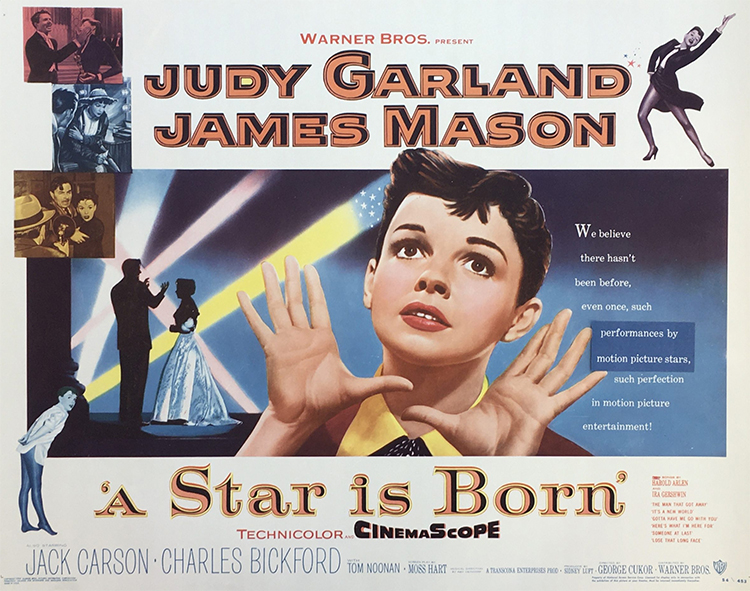
She also returned to film with notable success. Her performance in “A Star Is Born” (1954) is frequently cited as her greatest dramatic role. Playing Esther Blodgett, a talented singer whose career rises as her husband’s declines, she infused the role with authentic emotional weight. Her rendition of “The Man That Got Away” remains one of her most powerful screen moments. Time wrote in its film review that ‘Garland gives what is just about the greatest one-woman show in modern movie history.’ Her extraordinary performance earned her an Academy Award nomination (Grace Kelly won for “The Country Girl”). However, she did win a Golden Globe for Best Actress in a Musical. In 1961, a second Academy Award nomination followed for her portrayal of a German hausfrau in Stanley Kramer’s screen classic “Judgment at Nuremberg”; Rita Moreno won for “West Side Story.”
In 1963, CBS launched “The Judy Garland Show,” a television variety program intended to showcase her immense talents. Despite critical praise, an incredible list of guests, and unforgettable performances, the show struggled with network interference and scheduling conflicts, including being placed in the time slot opposite NBC’s “Bonanza.” It was cancelled after one season, a loss that hit Garland hard both personally and financially.
Looking back, “The Judy Garland Show” offered several unforgettable moments; her spontaneous interaction with her guests, including Mickey Rooney (episode aired on November 29, 1963)—their professional chemistry remained intact—or “The Judy Garland Christmas Show,” a few weeks later, when she sang “Have Yourself a Merry Little Christmas” to her children, are just a few examples of the natural and quite unique entertainer she was. All through the 26 episodes of “The Judy Garland Show,” she was still the Judy Garland from the late 1930s and 1940s, performing effortlessly because of her genuine charisma, humor, and emotional honesty.
By the late 1960s, her health had deteriorated significantly. She continued to perform, but her appearances were inconsistent. Tragically, on June 22, 1969, she died in London at the age of 47. The cause was an accidental overdose of barbiturates. The world mourned the loss of a singular artist whose life had been as luminous as it was troubled.
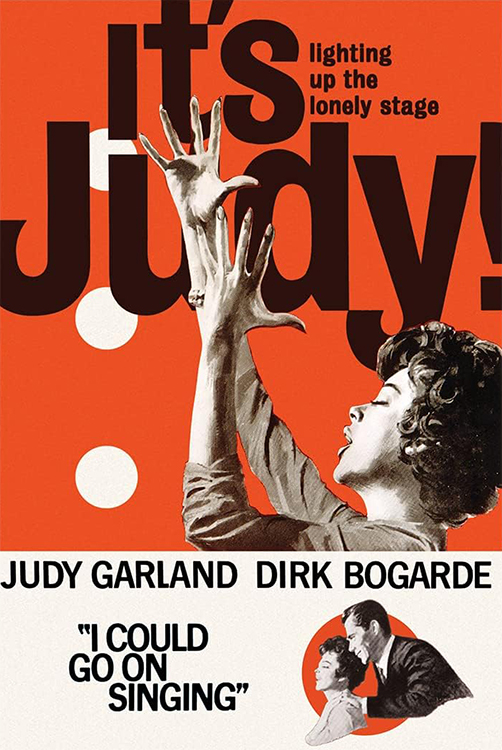 The best Judy Garland tribute I ever heard came from British-born filmmaker Ronald Neame (1911-2010), who had directed her in her final film, “I Could Go On Singing” (1962). During an interview I had with him at his Hollywood home in March 2003, he went into detail about working with her.
‘Judy Garland was still a star when we made that film, but we had a terrible time: we had a love-hate relationship. She often fired her directors, except for Vincente Minnelli. When I was pleasing her, I was her pussycat. But when she hated me, which was about a third of the time, she’d say, ‘Get that Goddamn British Henry Hathaway off the set!’ Henry Hathaway had a reputation for being a bully, and whenever she disliked me, she used to call me the British Henry Hathaway. But you’d never know: you’d have four or five wonderful days… thank God for [her co-star] Dirk Bogarde because she really loved him, and he was a great help, although it didn’t stop her from throwing her breakfast at him one morning. She tried to get me off the picture right towards the end. She once walked off the set and said she wasn’t coming back. She didn’t care about the film anymore.’
‘Arthur Krim [1910-1994] then came up to me and said, ‘Ronnie, what are you going to do? She wants you to leave.’ I said, ‘I’d willingly leave—just like that—because I want to see the picture finished, but I have a feeling that it won’t get any better. Tough as it is, if you’ll stand by me, then I’ll go through it to the bitter end.’ And he said, ‘Okay, we’ll stand by you.’ That same day, this was on a Thursday, we stopped shooting for three days and sent Judy a telegram through her agent, saying that if Miss Garland wasn’t on the set the following Monday—which was at the London Palladium, where she had to do her last song—we will cancel the picture and we will sue her. I had to take that chance, hoping she would be there. I called a thousand extras at the London Palladium, and they were all there by nine o’clock on Monday morning, but no Judy. I had three cameras, and by ten o’clock I turned the cameras around on the audience, and I played Judy to the audience. I did all the movements, miming to her voice, and got all the crowd reactions. I had that done by about 11:30. At twelve o’clock, Judy comes in. The make-up man, I think, asked me, ‘What do you want her to do?’ I said, ‘Tell her to get ready and come to the set. I’ll take her through the song.’ She apparently said, ‘Ronnie’s gonna teach me how to sing??’ Anyway, at about half past twelve, I took her through the movements, and she said, ‘That’s all right, pussycat, let’s do it.’ And she was great! We were out of the theater at six o’clock, and for the rest of the film, she behaved beautifully.’
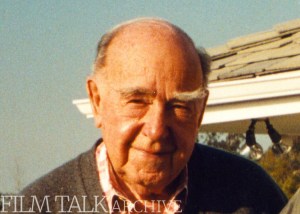
‘Afterwards, she did a long sequence—about six minutes—which was so much like her in real life; it was the scene where Dirk goes to rescue her from the hospital. It was a very intimate scene, so close. So I planned to start on her as a sort of me figure, and very slowly, as the scene developed, come into a waste figure. Then at a certain point, halfway through, cut, and I would do the rest in close shots. As we came in, the close shots would get bigger and bigger. So we started the first shot, which was supposed to end halfway through. As the scene went on, I realized more and more that something magical was happening. It was no longer the character from the film, it was Judy being herself. The dialogue was more or less the same, and Dirk—such a fine actor—adjusted to her dialogue. When we were a third of the way through, I knew that something was happening that I’d never get again because the tears were streaming down her face, and it was so genuine. There was no acting about it. We were on a dolly track, and I went like this to the man who was pushing the camera, that he’d continue to move in closer and Dirk, who was so intuitive, realized what I was doing, so he got in closer to Judy. And then—horror of horrors—a little light on the top of the camera, which was for her eyes, started to burn up as we got closer in. The cameraman signaled to the chief electrician and slid something very slowly in front of this little lamp, so that it didn’t destroy the scene. We shot it, and it went on for, I suppose, six minutes. At the end of it, there was nothing I could do but say, ‘That was magnificent. Print.’ We never cut into the close shots. That was the magic of this woman; despite everything—and God, she put me through some hell—we loved her very much.’
‘My wife once asked me, ‘How can you like Judy after all the things she tried to do to you?’ I said, ‘Well, we can’t help it, but we all do, the whole unit.’ And at the end of the film, we were doing a last close shot of her at the Shepperton studios. It was a very simple sequence with only two or three lines of dialogue that I wanted to cut into another sequence that we had already shot. After the third take, it was excellent, and I said, ‘That’s it, Judy darling. That’s really it.’ She looked at me, she looked around at the whole unit, and she looked back at me again, and she said, ‘You’ll miss me when I’m gone.’ And she walked away. We were all in tears; she just had this way, and we missed her—my goodness, we missed her. I tried to put it down in my autobiography [“Straight From the Horse’s Mouth,” 2003], but you can’t really get anywhere near what this experience was like.’
That interview was conducted more than twenty years ago now. To this day, I’m still very grateful that an august storyteller like Mr. Neame allowed me to spend an entire afternoon at his home and shared his insights with me. His thoughts and comments on Judy Garland also encouraged me to find out all about the Judy Garland Museum when I got to talk a few weeks ago to Janie Heitz and John Kelsch.
Judy Garland’s childhood home was always a private residence until it became a part of the Judy Garland Museum. How did that happen?
[JOHN KELSCH] In 1989, we celebrated the 50th anniversary of “The Wizard of Oz”; that was such a big event that we started thinking about that house. People would drive by and take pictures of it, or they’d even knock on the door and ask, ‘Could we take a look inside? I’m up here fishing, and my wife would like to see it.’ It was still a private residence then; the house was built in 1892, and many families had lived in it. It had been moved in 1938 from its original site to another part of the town. Luckily, Judy had returned home, and she got to see it on its original site when she was 15, almost 16 years old, and she came back to visit her home town. So they moved the house, and over the years, many people had lived in it.
After our big event in 1989, we started thinking about the house, and we knew the owners. They were going to sell the house, and they called the Historical Society where I was working. They said, ‘We’d like to give you the first opportunity to buy it for the museum.’ The local Historical Society turned it down; they didn’t want it, they felt it was too risky as a project. It took individuals here in this town to make it happen, because this is a small town with only 10,000 people, way up north by Canada, and everybody told us, ‘It’s impossible. You can’t do this in a small town. It’s too remote, and no one is going to come. But John Miner, a wealthy man who had grown up there, felt the best thing we could do for the town was to use Judy Garland to promote it. So he bought the house in 1991 for $50,000. Then he rented it out for three years because we didn’t know exactly what to do.
I had left the Historical Society, and in 1994, John called me and said, ‘Now we are going to do something with the house.’ He then found three other wealthy families in town and twisted their arm to give money. If I would had them, they would have said no. But it takes a peer to ask another peer, and so he got the banker, the grocer, and other people to donate land, to give cash, and then we moved the house again in 1994. We moved it out to a good, visible location on the highway. Everyone has to drive by it. In 1995 and 1996 we restored it; with the purchase price of the house, we spent a quarter of a million dollars to restore the house.
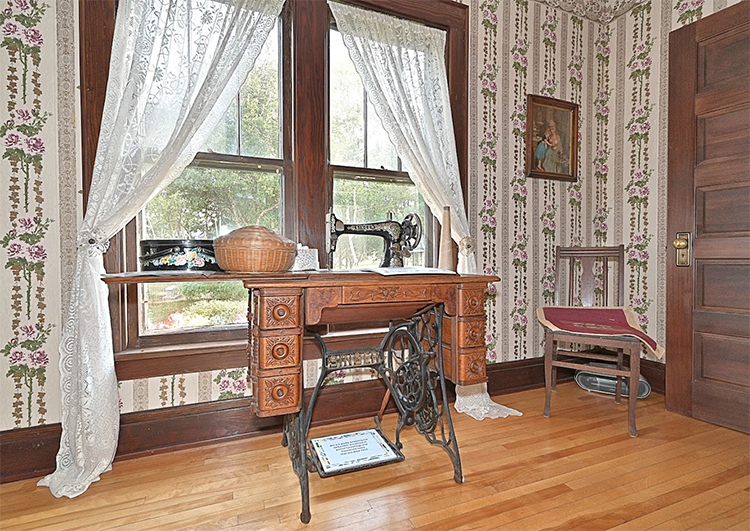
We found old photos that were really valuable, we could rebuild parts of the house that were torn of, windows had been changed, and there were about a dozen women still alive in town that remembered going to birthday parties there with Judy’s older sister. They were in the house every year at the birthday party. We had found a lady who had gone to high school and lived with Judy’s parents to watch the girls while they attended the movie theater every night. If you were a farm girl, you couldn’t go to school unless you moved into town because the roads were impassable at that time. So a lot of young girls moved into this little town to go to high school. We had found Wilma down in Iowa, and she had lived a whole school year with the Gumms in that house. She was just invaluable; she could tell us where the piano stood, what kind of piano was it, where the sewing machine was in front of the dining room window… So we were very fortunate because without those ladies, we would not have had a clue what the house looked like inside. That was our first project.
Then we built a museum next to the house in 2003. It’s fifteen thousand square feet; nothing fancy, but it provided a museum right next to the house. Back then, we were told, ‘Well, who will come there in the winter? You will have to shut it down in the winter because there’s nobody around.’ Gerald Clarke told me, ‘John, you’ve got to have something broader. You need to get more than just Judy people or “The Wizard of Oz” people in there.’ That’s where we got the idea, and that’s the history of how it happened. Gerald Clarke was writing a book about Judy Garland at that time, called “Get Happy: The Life of Judy Garland” [2000].
[JANIE HEITZ] Legally, our name is Judy Garland’s Children’s Museum, and we operate two businesses under one non-profit: Judy Garland Museum, which is a registered trademark, and the Children’s Discovery Museum. And it works well; one supports the other. We’re in a pretty rural area in Northeastern Minnesota, not near any major cities. We’re about three and a half hours north of the Minneapolis-Saint Paul area, and about ninety minutes from Duluth.
What activities do you do in The Children’s Museum?
[JANIE HEITZ] The Children’s Museum is really an interactive, hands-on learning place where we do a lot of educational field trips. The children will come in the winter, and in the spring, children come in for field trips. We have an educator who runs the field trip program; there are three different spaces where they can play, and there’s also an art room. With hands-on learning, they learn how to interact with other kids; parents often have to be with them unless they’re on a field trip, and local families become members of the Museum.
What is the mission of the Judy Garland Museum?
[JANIE HEITZ] Our mission is to keep her life and legacy alive. Everything we got here has been donated minus one or two items. John Miner, the original founding board member, bought the “Wizard of Oz” carriage at an auction. He believed in it so much, and he found some key pieces. We also focus a lot on the positive things in Judy’s life; that’s also what her family wanted us to do. She had a lot of ups and downs in her life and pretty bad times. Over the years, our collection grew to several thousand pieces, and we never had a budget to have professional exhibiting. John Kelsh and his wife pretty much curated the entire museum. It’s a pretty grassroots effort in a small community.
How many people visit the museum on a yearly basis?
[JANIE HEITZ] We serve about 25,000 people annually for the whole facility, including the Children’s Museum. About a third of them go to the Judy Garland Museum specifically, and they’re coming from all over the world. I checked the numbers since the beginning of last May, and we have a guest book that they can sign. They don’t have to sign, but they often do; we recommend that they do so that we know where they are coming from. Since the beginning of May, all fifty states are represented, and fifteen countries. A lot of times people say that they heard about the museum; it’s always been on their list to come, they were in the city for something, and they made the drive up, or ‘I’m driving across the country, and I made a detour to come to the Judy Garland Museum.’ Some people come because this was the only thing on their agenda, but usually, they’re in the region, and they just have to come to check it out.
[JOHN KELSCH] We’re not fans, by the way, but we all admired her great talent, and we’re very interested in the history of the young Judy. What influenced her as a child that fashioned her life? The more we dug into her early years, the more we found out. She gave her first concert tour by the time she was four, traveling and performing all over Northern Minnesota. So when we realized that there was a local part to the story, that was important to us to develop.
[JANIE HEITZ] There are some great anecdotes from her living in the house that her sisters told her or that she remembered, so we had that to work with. Her father wrote for the local paper, and John found over five hundred articles written by Frank Gumm. That gave us a very good idea of what they were doing in the community and how they were interacting, because he mentioned his family hundreds of times. So the people who come here are looking for something to do, some of them know every movie she did, and they know everything. But because of our “Wizard of Oz” collection, we get the “Wizard of Oz” fans, too. Those people love “The Wizard of Oz” so much that they would do anything to see anything from it. So it works well, it’s a good mix. The Munchkins used to come here—John had found all of them and invited them to come here—and when you talk to local people, they remember getting autographs from the Munchkins.
Did any celebrities visit the museum too?
[JOHN KELSCH] Over the years, nine celebrities came over. Mickey Rooney, June Allyson, Margaret O’Brien, June Lockhart, Andy Williams, Jayne Meadows… They all came to honor Judy at our Festival. Mickey Rooney came three times to Grand Rapids. Laurence Olivier was asked, ‘Who is the most talented of your peers?’ He said, ‘Mickey Rooney,’ because he could do everything.
Do you also have private memorabilia?
[JANIE HEITZ] Oh yes. Some jewelry, some of the clothing that she did not wear in movies—quite a few dresses she wore when she went out, also a make-up kit, lots of shoes, photographs, books from her library…
[JOHN KELSCH] Sid Luft [film producer and Judy Garland’s husband from 1952-1965] donated quite a few objects over the years. He really liked the idea of restoring the house. There would be no museum without Sid Luft; he made sure that the children signed the document that we could have a museum in her name. He died in 2005 and he was ninety; he knew everybody in Hollywood. Lorna Luft [their daughter, b. 1952] has been to the museum five times, and Joey Luft [their son, b. 1955] probably ten times.
[JANIE HEITZ] Joey also came in 2022 for Judy’s 100th birthday celebration to raise money; we had to preserve the house, get a new roof, new windows, and we raised about $90,000 to do that. There were people in the hallway crying to meet him because he was Judy’s son. That was a year after I started at the Museum, and it was a really good eye-opener for me. We live in a small town, and I wasn’t a huge Judy Garland fan. When I became the executive director of the Judy Garland Museum, at first it was a job in the town where I live, but it opened my eyes when I saw how many Judy fans there are. They’re so far away and they’re so grateful to have a place to come together. It’s not a trip that you do every year; it’s a trip you do every five years, and it costs a lot of money to get here. You fly into Minneapolis, rent a car, drive up and then you want to make your stay worth it. So that’s why we do these festivals, to give her fans a place and a time to be together. She also has a lot of young fans, people who are like twenty. That’s just a testament to her greatness.
Video call
November 19, 2025
FILMS
PIGSKIN PARADE (1936) DIR David Butler PROD Darryl F. Zanuck SCR Harry Tugend, Jack Yellen, William M. Conselman (story by Mark Kelly, Nat Perrin, Arthur Sheekman) CAM Arthur C. Miller ED Irene Morra MUS David Buttolph CAST Stuart Erwin, Patsy Kelly, Jack Haley, The Yacht Club Boys, Johnny Downs, Betty Grable, Arline Judge, Dixie Dunbar, Judy Garland (Sairy Dodd), Tony Martin
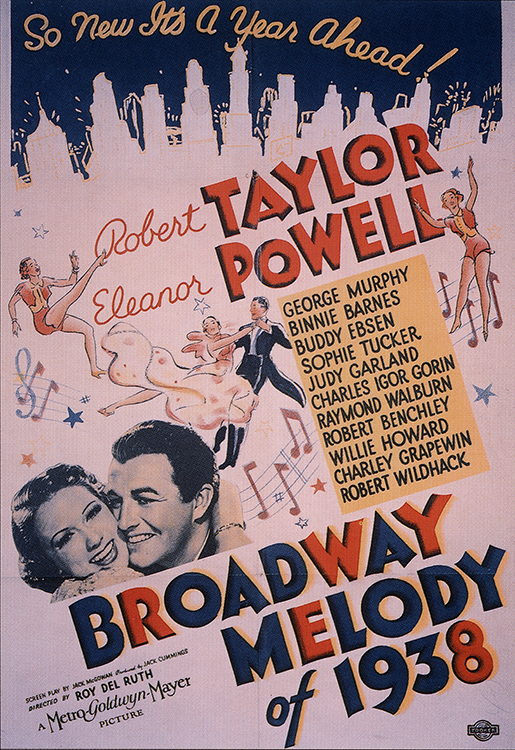 BROADWAY MELODY OF 1938 (1937) DIR Roy Del Ruth PROD Jack Cummings SCR Jack McGowan (story by Jack McGowan, Sid Silvers) CAM William H. Daniels ED Blanche Sewell MUS Murray Cutter, Leo Arnaud CAST Robert Taylor, Eleanor Powell, George Murphy, Buddy Ebsen, Sophie Tucker, Judy Garland (Betty Clayton), Charles Igor Gorin, Raymond Walburn, Robert Benchley, Willie Howard, Charley Grapewin, Robert Wildhack
THOROUGHBREDS DON’T CRY (1937) DIR Alfred E. Green PROD Harry Rapf SCR Lawrence Hazard (story by Eleanore Griffin, J. Walter Ruben) CAM Leonard Smith ED Elmo Veron MUS William Axt CAST Judy Garland (Cricket West), Mickey Rooney, Sophie Tucker, C. Aubrey Smith, Ronald Sinclair, Forrester Harvey, Charles D. Brown, Elisha Cook Jr.
EVERYBODY SING (1938) DIR Edwin L. Marin PROD Harry Rapf SCR Florence Ryerson, Edgar Allan Woolf (story by Florence Ryerson, Edgar Allan Woolf) CAM Joseph Ruttenberg ED William S. Gray MUS William Axt CAST Allan Jones, Judy Garland (Judy Bellaire), Fanny Brice, Reginald Owen, Billie Burke, Reginald Gardiner, Lynne Carver, Henry Armetta
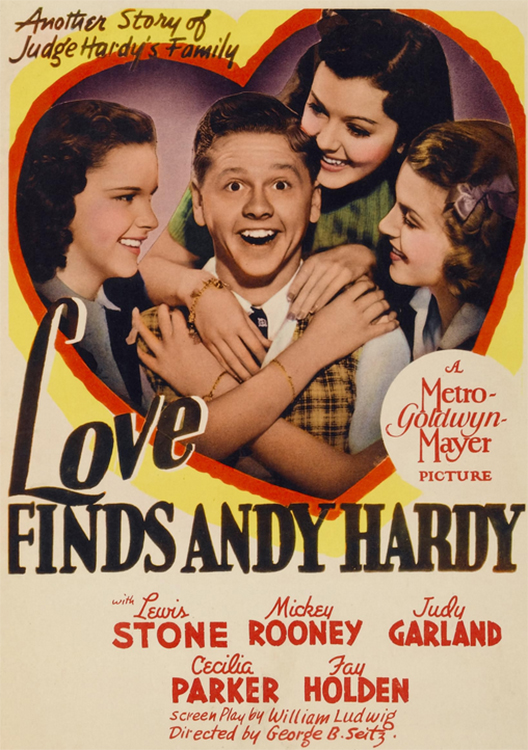 LOVE FINDS ANDY HARDY (1938) DIR George B. Seitz PROD Carey Wilson, Lou L. Ostrow SCR William Ludwig (stories by Vivien R. Bretherton; characters created by Aurania Rouverol) CAM Lester White ED Ben Lewis MUS David Snell CAST Lewis Stone, Mickey Rooney, Judy Garland (Betsy Booth), Cecilia Parker, Fay Holden, Lana Turner, Ann Rutherford, Mary Howard, Gene Reynolds
LISTEN, DARLING (1938) DIR Edwin L. Marin PROD Jack Cummings SCR Elaine Ryan, Anne Morrison Chapin (story by Katharine Brush) CAM Charles Lawton Jr. ED Blanche Sewell MUS William Axt CAST Freddie Bartholomew, Judy Garland (‘Pinkie’ Wingate), Mary Astor, Walter Pidgeon, Alan Hale, Scotty Beckett, Barnett Parker, Gene Lockhart, Charley Grapewin
THE WIZARD OF OZ (1939) DIR Victor Fleming PROD Mervyn LeRoy SCR Florence Ryerson, Edgar Allan Woolf, Noel Langley (book “The Wonderful Wizard of Oz” [1900] by L. Frank Baum) CAM Harold Rossen ED Blanche Sewell MUS Harold Arlen, Herbert Stothart CAST Judy Garland (Dorothy), Frank Morgan, Ray Bolger, Bert Lahr, Billie Burke, Margaret Hamilton, Charles Grapewin, The Munchkins
 BABES IN ARMS (1939) DIR Busby Berkeley PROD Arthur Freed SCR Kay Van Riper, Jack McGowan (Broadway musical [1937] and book by Richard Rogers, Lorenz Hart) CAM Ray June ED Frank Sullivan MUS George Stoll, George Bassman CAST Mickey Rooney, Judy Garland (Patsy Barton), Charles Winninger, Guy Kibbee, June Preisser, Grace Hayes, Douglas McPhail, Rand Brooks, Neli Lynn, John Sheffield, Margaret Hamilton
ANDY HARDY MEETS DEBUTANTE (1940) DIR George B. Seitz PROD J. J. Cohn SCR Annalee Whitmore, Thomas Seller, Aurania Rouverol (story by Carey Wilson; characters created by Aurania Rouverol) CAST Mickey Rooney, Lewis Stone, Fay Holden, Cecilia Parker, Judy Garland (Betsy Booth), Ann Rutherford, Sara Haden
STRIKE UP THE BAND (1940) DIR Busby Berkeley PROD Arthur Freed SCR Fred F. Finklehoffe, John Monks Jr. CAM Ray June ED Ben Lewis MUS George Stoll, Leo Arnaud CAST Mickey Rooney, Judy Garland (Mary Holden), Paul Whiteman, June Preisser, William Tracy, Larry Nunn, Margaret Early, Ann Shoemaker
LITTLE NELLIE KELLY (1940) DIR Norman Taurog PROD Arthur Freed SCR Jack McGowan (stage musical comedy “Little Nellie Kelly” [1922] by George M. Cohan) CAM Ray June ED Fredrick Y. Smith MUS George Stoll, George Bassman, Roger Edens CAST Judy Garland (Nellie Kelly/Little Nellie Kelly), George Murphy, Charles Winninger, Douglas McPhail, Arthur Shields, Rita Page, Forrester Harvey
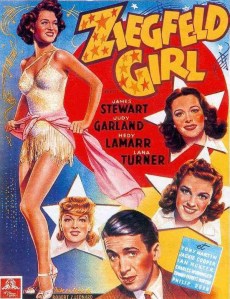 ZIEGFELD GIRL (1941) DIR Robert Z. Leonard PROD Pandro S. Berman SCR Marguerite Roberts, Sonya Levien (story by William Anthony McGuire) CAM Ray June ED Blanche Sewell MUS Herbert Stothart CAST James Stewart, Judy Garland (Susan Gallagher), Hedy Lamarr, Lana Turner, Tony Martin, Jackie Cooper, Ian Hunter, Charles Winninger, Edward Everett Horton, Philip Dorn, Eve Arden, Fay Holden, Bess Flowers
LIFE BEGINS FOR ANDY HARDY (1941) DIR – PROD George B. Seitz SCR Agnes Christine Johnston (characters created by Aurania Rouverol) CAM Lester White ED Elmo Veron CAST Lewis Stone, Mickey Rooney, Fay Holden, Ann Rutherford, Sara Haden, Judy Garland (Betsy Booth), Patricia Dane, Bess Flowers
BABES ON BROADWAY (1941) DIR Busby Berkeley PROD Arthur Freed SCR Fred F. Finklehoffe, Elaine Ryan (story by Fred F. Finklehoffe) CAM Lester White ED Frederick Y. Smith MUS George Stoll, George Bassman, Leo Arnaud CAST Mickey Rooney, Judy Garland (Penny Morris), Fay Bainter, Virginia Weidler, Ray McDonald, Richard Quine, Donald Meek, Alexander Woolcott, Bess Flowers, Margaret O’Brien, Donna Reed, Joe Yule
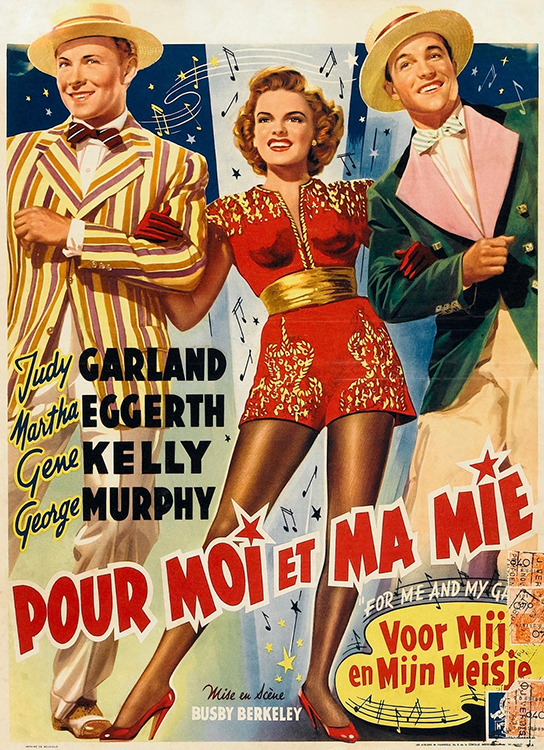 FOR ME AND MY GAL (1942) DIR Busby Berkeley PROD Arthur Freed SCR Fred F. Finklehoffe, Richard Sherman, Sid Silvers (story by Howard Emmett Rogers) CAM William H. Daniels ED Ben Lewis MUS Roger Edens CAST Judy Garland (Jo Hayden), Mártha Eggerth, Gene Kelly, George Murphy, Ben Blue, Stephen McNally, Richard Quine, Keenan Wynn, Joe Yule
PRESENTING LILY MARS (1943) DIR Norman Taurog PROD Joe Pasternak SCR Gladys Lehman, Richard Connell (novel “Presenting Lily Mars” [1933] by Booth Tarkington) CAM Joseph Ruttenberg ED Albert Akst MUS George Stoll CAST Judy Garland (Lily Mars), Van Heflin, Fay Bainter, Richard Carlson, Spring Byington, Mártha Eggerth, Connie Gilchrist, Leonid Kinskey, Tommy Dorsey and His Orchestra, Bob Crosby and His Orchestra, Frank Coghlan Jr., Virginia Gumm, Marilyn Maxwell, Joe Yule
THOUSANDS CHEER (1943) DIR George Sidney PROD Joe Pasternak SCR Paul Jarrico, Richard Collins (story “Private Miss Jones” by Paul Jarrico, Richard Collins) CAM George Folsey ED George Boemler MUS Herbert Stothart CAST Kathryn Grayson, Gene Kelly, Mary Astor, John Boles, Ben Blue, Mickey Rooney, Judy Garland (Herself), Red Skelton, Eleanor Powell, Ann Sothern, Lucille Ball, Virginia O’Brien, Frank Morgan, Lena Horne, Marsha Hunt, Marilyn Maxwell, Donna Reed, Margaret O’Brien, June Allyson, Gloria DeHaven, Sara Haden, José Iturbi, Cyd Charisse
GIRL CRAZY (1943) DIR Norman Taurog PROD Arthur Freed SCR Fred F. Finklehoffe (musical play “Girl Crazy” [1930] by George Gershwin, Ira Gershwin; book by Jack McGowan, Guy Bolton) CAM William H. Daniels, Robert H. Planck ED Albert Akst MUS George Stoll, Conrad Salinger CAST Mickey Rooney, Judy Garland (Ginger Gray), Gil Stratton, Robert E. Strickland, ‘Rags’ Ragland, June Allyson, Nancy Walker, Guy Kibbee, Frances Rafferty, Tommy Dorsey and His Orchestra, Peter Lawford
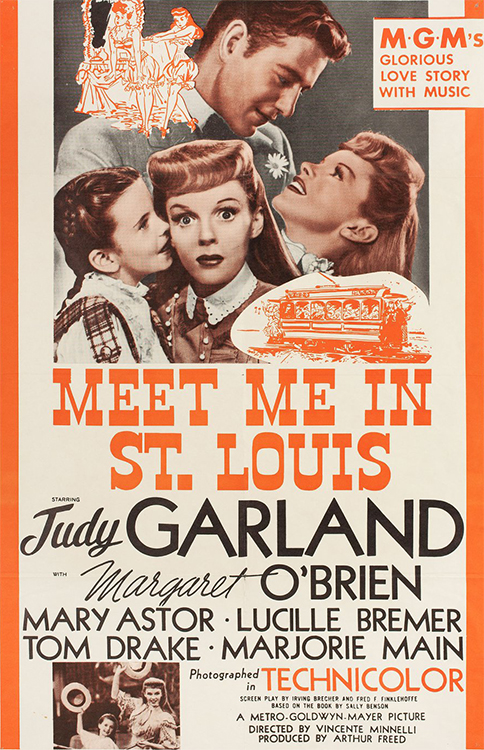 MEET ME IN ST. LOUIS (1944) DIR Vincente Minnelli PROD Arthur Freed SCR Fred F. Finklehoffe, Irving Brecher (novel “Meet Me in St. Louis” [1942] by Sally Benson) CAM George J. Folsey ED Albert Akst MUS Roger Edens, Conrad Salinger CAST Judy Garland (Esther Smith), Margaret O’Brien, Mary Astor, Lucille Bremer, Tom Drake, Marjorie Main, Harry Davenport, June Lockhart, Hugh Marlowe, Chill Wills, Darryl Hickman
THE CLOCK (1945) DIR Vincente Minnelli, [uncredited] Fred Zinnemann PROD Arthur Freed SCR Robert Nathan, Joseph Schrank (story by Paul Gallico, Pauline Gallico) CAM George J. Folsey ED George White MUS George Bassman CAST Judy Garland (Alice Mayberry), Robert Walker, James Gleason, Keenan Wynn, Marshall Thompson, Lucille Gleason, Ruth Brady, Steve Brodie, Arthur Freed, Terry Moore
ZIEGFELD FOLLIES (1945) DIR Vincente Minnelli, Roy Del Ruth, Robert Lewis, Lemuel Ayers, George Sidney, Charles Walters, Merrill Pye PROD Arthur Freed SCR David Freedman, Hugh Martin, Ralph Blane, Peter Barr, Irving Brecher, Al Lewis, Red Skelton, Edna Skelton, Harry Tugend, George White, Billy K. Wells CAM George J. Folsey, Charles Rosher ED Albert Akst MUS Lennie Hayton, Conrad Salinger, Roger Edens CAST Fred Astaire, Lucille Ball, Lucille Bremer, Fanny Brice, Judy Garland (The Star), Kathryn Grayson, Lena Horne, Gene Kelly, Victor Moore, Red Skelton, Esther Williams, William Powell, Cyd Charisse, Hume Cronyn, Virginia O’Brien, Keenan Wynn, Peter Lawford
THE HARVEY GIRLS (1946) DIR George Sidney PROD Arthur Freed SCR Edmund Beloin, Nathaniel Curtis, Harry Crane, James O’Hanlon, Samson Raphaelson (book “The Harvey Girls” [1942] by Samuel Hopkins Adams; story by Eleanore Griffin, William Rankin) CAM George J. Folsey ED Albert Akst MUS Lennie Hayton, Conrad Salinger CAST Judy Garland (Susan Bradley), John Hodiak, Ray Bolger, Angela Lansbury, Preston Foster, Virginia O’Brien, Kenny Baker, Marjorie Main, Chill Wills, Cyd Charisse, Rand Brooks, Bess Flowers, Virginia Gumm
TILL THE CLOUDS ROLL BY (1946) DIR Richard Whorf PROD Arthur Freed SCR Jean Holloway, Myles Connolly (story by Guy Bolton) CAM George J. Folsey ED Albert Akst MUS Conrad Salinger CAST June Allyson, Lucille Bremer, Judy Garland (Marilyn Miller), Kathryn Grayson, Van Heflin, Lena Horne, Van Johnson, Angela Lansbury, Tony Martin, Virginia O’Brien, Dinah Shore, Frank Sinatra, Robert Walker, Gower Champion, Cyd Charisse
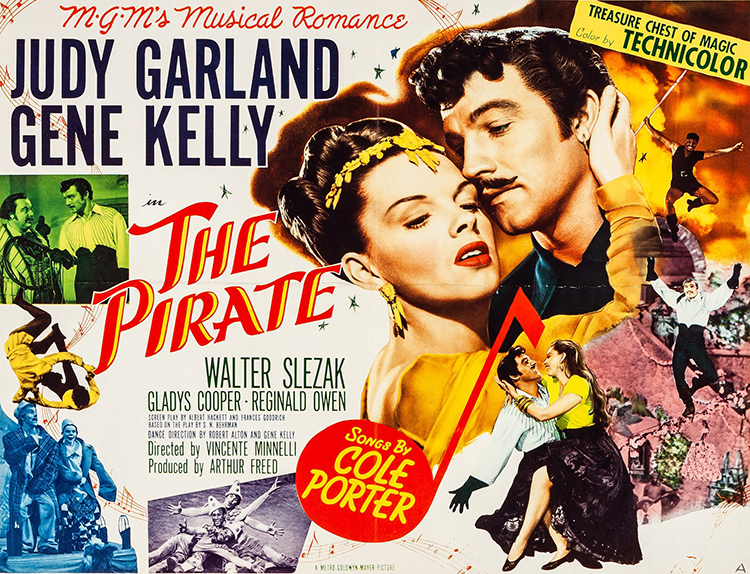
THE PIRATE (1948) DIR Vincente Minnelli PROD Arthur Freed SCR Frances Goodrich, Albert Hackett (play “The Pirate” [1942] by S. N. Behrman) CAM Harry Stradling Sr. ED Blanche Sewell MUS Conrad Salinger, Lennie Hayton CAST Judy Garland (Manuela), Gene Kelly, Walter Slezak, Gladys Cooper, Reginald Owen, George Zucco, Fayard Nicholas, Harold Nicholas, Lester Allen, Lola Albright, Ellen Ross, Anne Francis, Marie Windsor
EASTER PARADE (1948) DIR Charles Walters PROD Arthur Freed SCR Frances Goodrich, Albert Hackett, Sidney Sheldon (story by Frances Goodrich, Albert Hackett) CAM Harry Stradling Sr. ED Albert Akst MUS Conrad Salinger CAST Judy Garland (Hannah Brown), Fred Astaire, Peter Lawford, Ann Miller, Jules Munshin, Clinton Sundberg, Richard Beavers, Lola Albright
WORDS AND MUSIC (1948) DIR Norman Taurog PROD Arthur Freed SCR Fred F. Finklehoffe (story by Jean Holloway, Guy Bolton; adaptation by Ben Feiner Jr.) CAM Charles Rosher, Harry Stradling Sr. ED Albert Akst, Ferris Webster MUS Conrad Salinger, Lennie Hayton CAST June Allyson, Perry Como, Judy Garland (Herself), Lena Horne, Gene Kelly, Mickey Rooney, Ann Sothern, Tom Drake, Cyd Charisse, Betty Garrett, Janet Leigh, Marshall Thompson, Mel Tormé, Vera-Ellen, Jeanette Nolan, Richard Quine, Gower Champion
IN THE GOOD OLD SUMMERTIME (1949) DIR Robert Z. Leonard PROD Joe Pasternak SCR Frances Godrich, Albert Hackett, Ivan Tors (play “Parfumerie” [1937] by Miklós László; screenplay THE SHOP AROUND THE CORNER [1940] by Miklós László) CAM Harry Stradling Sr. ED Adrienne Fazan MUS George Stoll, Robert Van Eps CAST Judy Garland (Veronica Fisher), Van Johnson, S.Z. Sakall, Spring Byington, Clinton Sundberg, Buster Keaton, Marcia Van Dyke, Lilian Bronson, Liza Minnelli, Anna Q. Nilsson
SUMMER STOCK (1950) DIR Charles Walters PROD Joe Pasternak SCR Sy Gomberg, George Wells (story by Sy Gomberg) CAM Robert H. Planck ED Albert Akst MUS Conrad Salinger CAST Judy Garland (Jane Falbury), Gene Kelly, Eddie Bracken, Gloria DeHaven, Marjorie Main, Phil Silvers, Ray Collins, Nita Bieber, Carleton Carpenter, Hans Conried
A STAR IS BORN (1954) DIR George Cukor PROD Sidney Luft SCR Moss Hart (screenplay A STAR IS BORN (1937) by William A. Wellman, Dorothy Parker, Robert Carson, Alan Campbell; story by Robert Carson) CAM Sam Leavitt ED Folmar Blangsted MUS Ray Heindorf CAST Judy Garland (Vicki Lester), James Mason, Jack Carson, Charles Bickford, Tommy Noonan, Lucy Marlow, Amanda Blake, Irving Bacon, Hazel Shermet, Gertrude Astor, Strother Martin, Mae Marsh, John Saxon
PEPE (1960) DIR – PROD George Sidney SCR Dorothy Kingsley, Claude Binyon (screen story by Sonya Levien, Leonard Spigelglass; play “Broadway Zauber a.k.a. Broadway Magic” by Leslie Bush-Fekete) CAM Joseph MacDonald ED Viola Lawrence, Al Clark MUS Johnny Green CAST Cantinflas, Dan Dailey, Shirley Jones, Maurice Chevalier, Bing Crosby, Michael Allan, Richard Conte, Tony Curtis, Bobby Darin, Sammy Davis Jr., Jimmy Durante, Zsa Zsa Gabor, Judy Garland (Vocalist on Radio, voice only), Greer Garson, Hedda Hopper, Joey Bishop, Ernie Kovacs, Peter Lawford, Janet Leigh, Jack Lemmon, Dean Martin, Carlos Montalbán, Jay North, Kim Novak, Andre Previn, Donna Reed, Debbie Reynolds, Edward G. Robinson, Cesar Romero, Suzanne Lloyd
 JUDGMENT AT NUREMBERG (1961) DIR – PROD Stanley Kramer SCR Abby Mann (also original story) CAM Ernest Laszlo ED Frederic Knudtson MUS Ernest Gold CAST Spencer Tracy, Burt Lancaster, Richard Widmark, Marlene Dietrich, Judy Garland (Irene Hoffman), Maximillian Schell, Montgomery Clift, William Shatner, Werner Klemperer, Kenneth McKenna, Edward Binns, Bess Flowers
GAY PURR-EE (1962, animation) DIR Abe Levitow SCR Dorothy Jones, Chuck Jones ED Earl Bennett, Sam Horta MUS Mort Lindsey CAST (voice only) Judy Garland (Mewsette), Robert Goulet, Red Buttons, Hermione Gingold, Paul Frees, Mel Blanc, Morey Amsterdam, Joan Gardner, Julie Bennett, Tony Randall
A CHILD IS WAITING (1963) DIR John Cassavetes PROD Stanley Kramer SCR Abby Mann (also story) CAM Joseph LaShelle ED Robert C. Jones, Gene Fowler Jr. MUS Ernest Gold CAST Burt Lancaster, Judy Garland (Jean Hansen), Gena Rowlands, Steven Hill, Paul Stewart, Gloria McGehee, Lawrence Tierney, Bruce Ritchey, John Marley, Bill Mumy, John Cassavetes, Juanita Moore
I COULD GO ON SINGING (1963) DIR Ronald Neame PROD Lawrence Turman, Stuart Millar SCR Mayo Simon (story by Robert Dozier) CAM Arthur Ibbetson ED John Shirley MUS Mort Lindsey CAST Judy Garland (Jenny Bowman), Dirk Bogarde, Jack Klugman, Aline MacMohan, Gregory Phillips, Russell Waters, Pauline Jameson, Jeremy Burnham, Eric Woodburn, Lorna Luft
 FILM TALK
You must be logged in to post a comment.