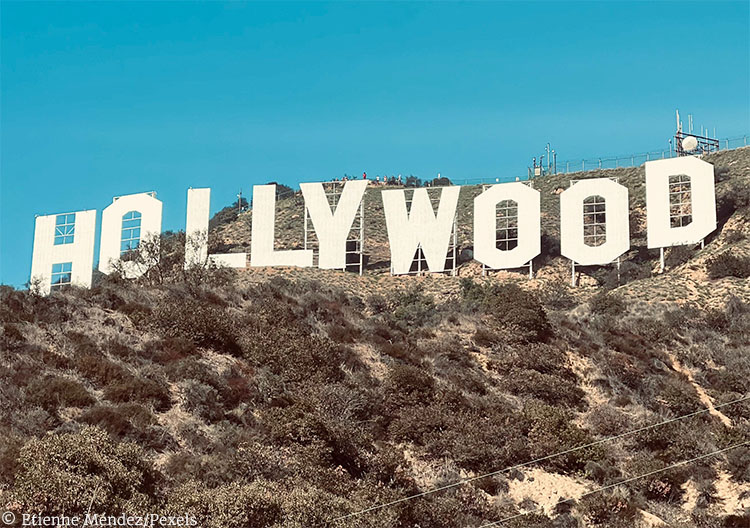
Hollywood, the film capital of the world and the city of dreams, celebrates a new centenarian: the Hollywood Sign celebrates its 100th anniversary this year. With its bold, uppercase, white letters, the beloved sign on Mount Lee, in the Beachwood Canyon area of the Santa Monica Mountains, represents those dreams, but also a place, an idea, stardom, and the magic of filmmaking. Over the years, the Hollywood Sign—originally a billboard—became a monument and a world-famous cultural landmark of the mythical kingdom where movies are made, magic is possible, stars are born, and dreams come true.
The original Hollywoodland Sign was built a century ago. It was completed by early December 1923, only as a temporary promotion and advertisement to sell real estate in a new, local and upscale Hollywoodland housing development—tucked between the Hollywood Reservoir and Griffith Park—by a company called Hollywoodland Property. Located at the top of Cahuenga Peak on Mount Lee, the sign wasn’t even meant to be a permanent structure; it was designed to last a maximum of eighteen months.
The original wood panels were not intended for the long term; except for the three L letters and the W, the other nine letters were only anchored flimsily by two sixty-foot telephone poles, which were sunk about eight feet into the ground. Each L was supported by one sixty-foot telephone pole and the W by three. None of the telephone poles, nor the vertical supports for the letters, were cemented into the ground; they only used dirt to fill in around the poles. Since the hillside terrain was uneven, the letters were not in a straight line.
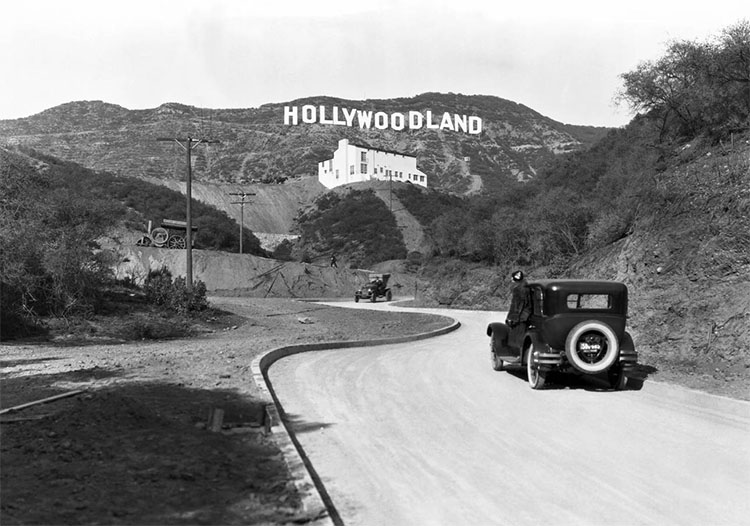
Only days after construction of the sign was completed, it was illuminated for the first time on December 8, 1923, with 3,700 ten-watt light bulbs; some sources say there were 4,000 twenty-watt light bulbs. A maintenance man was hired to replace non-working light bulbs. At night, the sign flashed HOLLY, WOOD, and LAND in sequence, and then HOLLYWOODLAND as one word. There was also a spot shining from under the Hollywoodland Sign.
By the late 1920s, the sign had become one of the symbols of movies, fame, and fortune. Ironically, it appeared in only a few films about Hollywood or the film industry. But on September 16, 1932, things changed for the worse. That evening, Welsh-born stage and screen actress Lillian Millicent ‘Peg’ Entwistle left her uncle’s home at 2428 North Beachwood Drive, where she resided. She walked a mile and a half up Beachwood Drive to the Hollywoodland Sign, climbed up the maintenance ladder of the letter H, and jumped to her death. A female hiker discovered her body in the ravine below Mount Lee two days later.
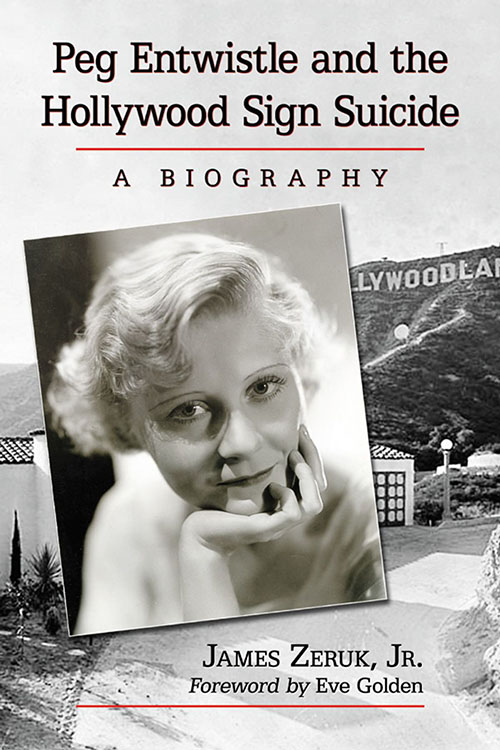
Entwistle’s death at age 24 resulted in wide and often sensationalized publicity. Even though Entwistle appeared in only one film, “Thirteen Women” (1932, released posthumously, one month after her death), her tragedy has been absorbed into Hollywood history. Hers is another tale of adoration and acclaim promised and devastation delivered, one that many young and aspiring actors have suffered at the mercy of Hollywood. Consequently, the Hollywoodland Sign became associated with broken dreams.
Getting rejected and dealing with it is something Academy Award-winning actress Louise Fletcher talked to me about in our 2016 interview. She said, ”Rejection is just something you eat every day, like it’s your breakfast. It’s just a part of it. You can’t take it too personally, that’s what I tell young people who ask my advice. I say, ‘Only do it if you really have to because you’re going to eat rejection every day, and you have to learn not to take it in a personal way. It’s not your dream; it’s whoever is making the movie or the play. It’s their idea. You’re just part of a team, and you might not be part of that team, you know. When I was very young, and I was told, ‘No, you are not going to get that part,’ it would hurt so bad, I took it too hard, and I suffered, while all that is unnecessary really. Today it just goes right out of my head; I never think of it again if I don’t get a part that I’d like. It’s a skill set; you have to learn that.’
Yet, after Entwistle’s death, the glamorous and charismatic image of Hollywood as the land of make-believe took a hit. On top of that, The Great Depression, which began with Wall Street’s stock market crash in October 1929 and lasted until the late 1930s, affected every industry, and real estate was no exception. Hollywoodland’s real estate development came to a standstill. By the time of Hollywood’s Golden Age, the Hollywood Sign was in bad shape.
In 1933, the owner of the sign reportedly decided to turn off the light as it was too costly to maintain the sign’s light bulbs; by 1939, all the light bulbs either burned out or were stolen, and maintenance of the sign was discontinued. The sign was vandalized and holes appeared in the letters; once it had attracted countless tourists and local residents, and even aircraft pilots regarded it as a navigational landmark. But even before the 1940s, time had taken a physical toll on the sign as it began to fall into disrepair. It had been neglected too long and simply deteriorated, as nobody was willing to pay for the sign’s maintenance and repair work. In 1945, the sign was donated to the Recreational and Park Department of the City of Los Angeles, and in 1949, the Hollywood Chamber of Commerce decided to take matters into its own hands.
When they replaced the H—which had fallen off during a storm in early 1944 and was missing all those years—the other letters were restored as well, primarily by paint jobs and patchwork repairs. The LAND suffix was removed from the Hollywoodland Sign so that the new sign, which simply read HOLLYWOOD, represented the Hollywood community and no longer the Hollywoodland housing development. The sign remained in good condition until 1964, when it began to show severe signs of weather damage and fell apart again. In 1973, the Los Angeles Cultural Heritage Board declared the sign Historic Cultural Monument No. 111; it gave the sign a kind of prestige, and some of the damage to the sign was restored. But later on, the wood kept rotting away, and termites caused further deterioration.
In 1977, the Hollywood Chamber of Commerce launched a ‘Save the Sign’ campaign to raise $250,000; that was the total amount of money needed to literally save the sign—almost $28,000 per letter. Rock band Fleetwood Mac, then at the peak of their fame, suggested doing a charity concert at the Hollywood Bowl to raise funds for the sign, but a number of local residents protested when the band planned to use their own amplifying system. Plans for the concert were cancelled.
NBCLA’s November 1978 report on the Hollywood Sign, before and after the storm
In 1978, a storm severely damaged the sign. None other than Playboy founder and publisher Hugh Hefner hosted a gala fundraiser for the Hollywood Sign at the Playboy Mansion in Holmby Hills, near Beverly Hills. He appealed to his famous friends and convinced nine celebrity donors and companies to each donate approximately $28,000—that was the cost, not to repair but to completely replace one letter—in an attempt to rebuild all nine letters of the Hollywood Sign and preserve them for future generations. Hefner bought the letter Y.
Rock musician Alice Cooper, long a Hollywood devotee, bought the first O in memory of his friend, the late comedian Groucho Marx. Other donors included Gene Autry, former cowboy star and owner of KTLA, the first commercial TV station in Los Angeles; he bought the second L. Andy Williams  and Warner Bros. Records (the third O) also stepped in and bought a letter. When all nine letters were ‘sold’ and $250,000 was raised, the old wooden sign was taken down and three months later, it was replaced by a new and highly endurable all-metal structure, flown in by helicopter, letter by letter, and cemented into the side of Mount Lee. In November 1978, the brand-new Hollywood Sign in its current form and shape was unveiled in the presence of silent screen star Gloria Swanson.
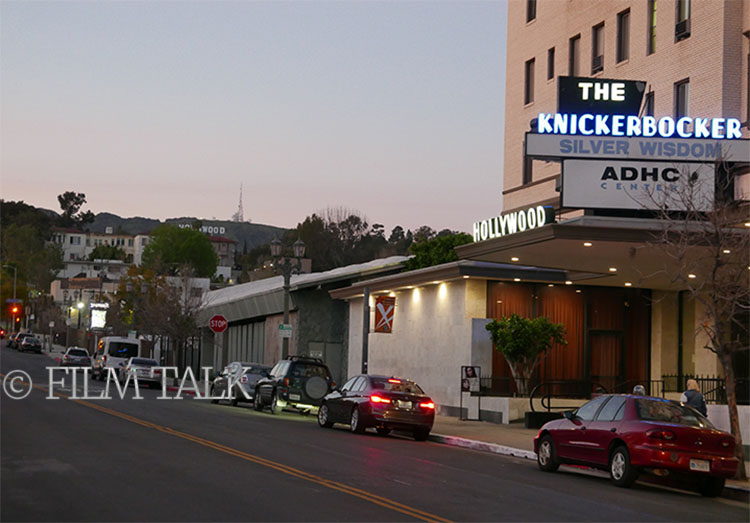
Since then, it remained intact and became iconic in popular culture. In the past decades, the influx of Hollywood Sign tourists clogging the narrow and curving hillside streets such as North Beachwood Drive and Mt. Hollywood Drive, among others, has been irritating local residents. Tourists all want the best view of the sign and its 45-foot-tall white uppercase letters, but residents claimed that traffic is creating safety issues. The narrow roads in the area were not designed for so many cars and pedestrians. Residents asked to keep roads clear for emergency vehicles.
The Hollywood Sign has become a major tourist attraction. It is the Eiffel Tower of Hollywood; the growing number of tourists wanting a glimpse of the famous Hollywood Sign and taking photographs and selfies had reached a tipping point several years ago already.
The Hollywood Sign Trust, a nonprofit founded in 1978, is now in charge of preserving, protecting, promoting, maintaining, and refurbishing the Hollywood Sign. It manages the website hollywoodsign.org which includes a 24/7 live webcam of the nine-letter sign. Just ahead of its 100th anniversary, all nine letters of the Hollywood Sign were cleaned and repainted late last year. The last time the sign was painted was in 2012, for its 90th anniversary.
Associated Press reported on January 26, 2015, on the escalating tourist traffic near the Hollywood Sign
The Hollywood Sign Trust also points out that there are three officially authorized hiking trails to get enthusiasts close to the sign: the Mt. Hollywood Trail, Brush Canyon Trail and Cahuenga Peak Trail. There are two official legal viewpoints to the sign: at Hollywood Boulevard and Highland Avenue, and at the Griffith Observatory.
Some sources indicate that Harry Chandler originally conceived the idea of the Hollywoodland Sign. He was the legendary publisher of The Los Angeles Times in the 1920s, after he first joined the paper as a clerck in 1883. He also was a large-scale real estate speculator. It’s uncertain though who came up with the idea, and if he did, it would be unclear to what extent he might have been involved. However, he did get involved with helping to found The Hollywood Bowl (officially opened in 1922), and in Los Angeles, other notable and historical landmarks such as The Ambassador Hotel (1921, demolished in 2005), and two that celebrate their centennial this year as well: The Biltmore Hotel (1923) and the Los Angeles Coliseum (1923).
CBS Evening News on the Hollywood Sign’s fresh paint job in September-October 2022
To this day, it is unclear when exactly construction of the original Hollywoodland Sign began, how long it took to construct it, or how many workmen were hired to work on building the sign.
For all events on the Hollywood Sign, check out hollywoodsign.org or its social media accounts (Facebook, Instagram, Twitter) for more information.


You must be logged in to post a comment.