It’s late October, and Halloween is just around the corner. This time of the year seems to be filled with ghosts—on the streets, the movies they show on television. But how many films truly capture the essence of haunting? That’s another question. The truth of the matter is that very few do it as quietly as David Lowery‘s “A Ghost Story” (2017).
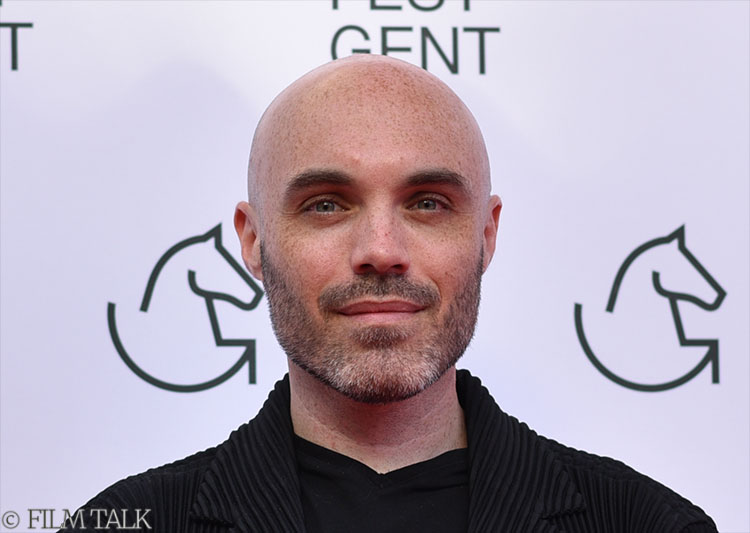
‘In terms of a movie from start to finish, I think “A Ghost Story” is probably my most personal film. When I was writing it, I only knew what I was trying to achieve on an emotional level,’ David Lowery told me in October 2022 at the Film Fest Gent. ‘I didn’t know if it would work, I didn’t know if it would be feature-length or not, I wasn’t even sure how what I had written would manifest. What I did know, is that I wanted to get as many friends as I could to help make it. Casey [Affleck] and Rooney [Mara] were two of the ones who came down to Texas, but it was a labor of love in the classic sense of the term. No one got paid, there was no sense of recompense; it was just an opportunity to make a movie for the sake of making something special.’
 “A Ghost Story” is a supernatural drama about a man who becomes a ghost and remains in the house he shared with his wife. It’s a haunting meditation on time, loss, and the lingering traces of human existence. The film follows a couple, played by Rooney Mara, credited as ‘M,’ and Casey Affleck, who plays ‘C,’ as her musician husband. They live a quiet life in a small house surrounded by undeveloped property somewhere in the vast flatness of Texas. When C dies unexpectedly in a car accident near their home, he returns as a ghost—depicted simply with a white sheet and black eyeholes—watching silently as life continues without him. What begins as a story of grief gradually transforms into an exploration of eternity and impermanence.
Lowery’s film is almost wordless, relying on long takes, ambient sound, and a deliberate pace to evoke the stillness of mourning. One of its most striking scenes shows Mara’s character M eating an entire pie in one continuous shot—a moment both mundane and devastating, capturing the raw, physical manifestation of sorrow. Meanwhile, the ghost becomes trapped in time, observing the house as it changes hands, deteriorates, and is eventually replaced by new structures. His presence—mute and powerless—reflects the futility of clinging to what once was.
“A Ghost Story” (2017) with Rooney Mara as M
Visually, “A Ghost Story” is minimalist but deeply poetic. Shot in a nearly square atypical 1.33:1 aspect ratio with rounded corners—David Lowery said that the film is about someone basically trapped in a box for eternity, and he felt the claustrophobia of that situation could be amplified by the boxiness of the aspect ratio—the film resembles an old photograph, emphasizing nostalgia and confinement. The score by Daniel Hart complements the mood with ethereal, melancholic tones that echo the ghost’s endless vigil.
Beyond its supernatural premise, “A Ghost Story” contemplates the meaning of existence in an indifferent universe. It suggests that human life, though fleeting, leaves faint echoes—songs, memories, and emotions that persist beyond death. Lowery turns the cliché of the ‘sheeted ghost’ into something profound and tender: a symbol of our desire to remain seen and remembered. In its quiet, meditative way, “A Ghost Story” becomes less about fear of death and more about the beauty and ache of being.
“A Ghost Story” (2017, trailer)
The film grossed nearly $2 million worldwide, and on Rotten Tomatoes, 91% of 286 critics’ reviews were positive, which is a big deal. After looking around on the internet, I found an interesting review on IMDB, published on March 6, 2018, from a reportedly seventeen-year-old reviewer who calls himself/herself ‘protectthealphawolf‘ and wrote a total of six reviews on IMDB. I don’t know who this person is, but his/her review is pretty remarkable. Considering that “A Ghost Story” is an outstanding film, here is the review as it appeared on IMDB:
I cried for forty-five minutes after the film.
Alright. I confess. I am an emotional person. After seeing the Plugged In review for this film, I cautiously threw this movie in on a slow Saturday night. I assumed that it was going to be much like the movie “Ghost,” and that it would be good, but not overly amazing. I was so wrong.
Not only did this movie make me cry for most of its duration, but it literally made me sob so hard that I was afraid of waking up the rest of my family. I cried in my bedroom at 11:45 at night. The film just hits so close to home. Time is the enemy of everyone. There’s no going back, and there’s no stopping it either. People pass, relationships end, romances form, and then break apart. Nothing, at least in our physical world, ever stays the same. This movie beautifully illustrates this in a way that most American audiences don’t seem to be understanding, which is why I am writing this review.
This movie deserves so much more recognition than it currently has, especially on this site. While this is by no means an action-packed or on-the-edge-of-your-seat film, the pure amount of artistry and raw, unadulterated emotion found in it makes it stand out in my mind as one of the best films I have ever seen.
It’s so simple. So astronomically simple, and that’s what makes it so magical. Whether it be the haunting image of a wrecked car or the heavily spoken about scene depicting a woman eating an entire pie for over five minutes, every single shot is filmed with so much emotion, it makes you want to pause the film and reflect on every minute the story has to offer. Everything has a purpose in this film. It all ties together in this beautiful, haunting tragedy mixed with a love song.
I know I’m just a kid. Yes, I may be only seventeen. But I beg you, if the reviews for this film on this site are making you think twice about seeing this, just listen to what I have to say and watch it. No, it’s not for everyone. If you’re looking for a horror movie or a blood-splattered motion pic, skip this one over. But if you’re deeper than that, and you actually want to experience something you won’t forget, throw yourself into this one.
It’s sad to see that this beautiful masterpiece of American cinema is being so overlooked.
 FILM TALK
You must be logged in to post a comment.