
Dominik Moll (b. 1962) is a French-German film director and screenwriter who first gained international attention with his debut film, “Harry, un ami qui vous veut du bien” (2000, a.k.a. “Harry, He’s Here to Help”). This psychological thriller combined Hitchcockian tension with an ironic sensibility. The film was a critical success, and earned two César Awards, including Best Director—Mr. Moll’s first of four Césars, since he also won three for the highly successful “La nuit du 12” (2022, a.k.a. “The Night of the 12th”).
“Harry, un ami qui vous veut du bien” established him as a filmmaker capable of delivering gripping narratives. His ability to create suspense—not through spectacle but through atmosphere and subtle character dynamics—became a hallmark of his films and the fil rouge throughout his entire body of work.
His list of film credits is quite limited because he takes a considerable amount of time to ensure that every new film is a valuable, character-driven project. And time and time again, it is. Mr. Moll is the best Hollywood filmmaker working in French cinema because his films appeal to a global audience. He consistently challenges his viewers to confront the shadows that lie beneath ordinary appearances. With a career defined by meticulous storytelling and an unflinching gaze into the psychological depths of his characters, his concept of world cinema shows there are no boundaries to the power of his films and filmmaking in general. He’s one of the best film ambassadors you can find to promote his craft.
After his latest films “Seules les bêtes” (2021, a.k.a. “Only the Animals”), an intriguing, engrossing, and suspense whodunit with a seemingly simple plot, followed by the absorbing investigative crime drama “La nuit du 12” (2022) where two hardened French detectives try to solve the murder of a young woman, it was worth the wait for Mr. Moll’s upcoming and highly recommended film, “Dossier 137” (a.k.a. “Case 137”), set in Paris during the 2018 gilets jaunes protests.
The leading character in the film is Stéphanie Bertrand (played by Léa Drucker); she’s an IGPN officer—IGPN is short for Inspection générale de la Police nationale, a.k.a. Internal Affairs—and investigates a young protester, Guillaume Girard (played by Côme Péronnet), who was severely injured by a flash-ball during a turbulent Paris demonstration. It looks like a routine case at first, but it turns personal when Stéphanie finds out the victim hails from her hometown, which encourages her even more to unravel the truth. The film doesn’t shy away from depicting violent demonstrators, but the story’s main topic is police brutality.
“Dossier 137” (2025, a.k.a. “Case 137”; trailer)
“Dossier 137,” shot from October till December 2024 in Paris and in the French Great East region, had its world premiere last May at the Cannes Film Festival, and since then, it became a film festival favorite in Europe and across the globe, from Indonesia and Thailand to Argentina and the U.S. where it was screened at the San Diego International Film Festival, and the AFI Fest, in the heart of Hollywood.
Mr. Moll was in Brussels last week to promote the release of “Dossier 137.” During his visit to the Belgian capital, I got to sit down with him—always a joy and a delight—to talk about the film that’s being released this month in various territories. In Belgium, “Dossier 137” will be in theaters from November 26 and is released through Cinéart.
Mr. Moll, in “La nuit du 12,” the police were doing a murder investigation, and now, in “Dossier 137,” the police are investigating the police. Is that film-wise a logical step for you?
Yes. In a sense, it’s a continuation because when I worked on “La nuit du 12,” I wanted to tell that story, that investigation, and how the investigator became obsessed by this case which he couldn’t solve. But at the same time, I was also fascinated by exploring how a police investigation really works, what it implies—also in terms of bureaucracy and everything that you usually don’t get to see in films. I’m a big fan of the documentaries by Frederick Wiseman because he explores all those institutions. He makes you understand how they work, what their internal structure is, how the hierarchy works inside, be it a hospital, the police force, a psychiatric hospital—whatever. It’s very fascinating to understand how such an institution works. Of course, he tells it in a documentary, and I try to build and weave that into a fictional story. So I think if you look at it from that angle, “Dossier 137” is a continuation of “La nuit du 12” because it also explores the police as an institution, and even more so because we’re really at the heart of this institution with the police investigating the police.
 You always do your homework thoroughly. What did you do to prepare for “Dossier 137”? Did you join the police during a demonstration to see how they work, for example?
Yes, there were several things I did. In the first four months, I read an awful lot about investigations written by journalists who had worked on cases of police violence. Those were very detailed. But maybe the most important thing was that I could spend a few days with the IGPN—the Internal Affairs bureaus—and be there with the investigators, observe how they worked, how they interrogated police officers, and also to be able to just talk with them and ask them questions. That was very important, but I also met other people, like lawyers who defend police officers, lawyers who defend victims of police violence, and a family whose son had been severely wounded by a shot. I also joined the police during a demonstration; I wore a helmet and everything, and stayed with them during the whole demonstration. That was also interesting, to see how it works on the other side, so I could get an idea what it was like for them. That gave me a lot of material to work with, and practically everything that is in the film comes from things that I observed, or that I had read, or that I had asked about. And sometimes it’s all in the little details, you know. Like the fact that at one point, one of the IGPN investigators told me that it was quite difficult to convince witnesses to tell them what they had seen because as soon as they knew that it involved the police or police violence, they were very reluctant to talk. They were afraid that they might get into trouble, and so it takes a lot of psychological skills to bring those witnesses to trust you. Or when they feel that a neighbor has seen something, and he doesn’t want to say it…
…like the chambermaid in the luxury hotel?
Exactly. She saw something, but she says, ‘No, I haven’t seen anything,’ and yet Stéphanie feels that she has seen something and then follows her. Videos and images are also important within that type of investigation. I noticed that when I was in the offices of the IGPN in Paris. For every investigation linked to police violence during demonstrations, they try to find videos. Those can be videos from cameras in the street, or stuff that demonstrators filmed with their smartphone, or journalists who filmed something—anything. So from the beginning, when I began writing the screenplay with Gilles Marchand, we knew that we had to build the whole investigation around those videos; they would allow Stéphanie to make progress in her investigation. All the time I invested in doing research and meeting people was very important, also because nothing was known about the way the IGPN works. They are quite secretive; there was never a film, nor a book or a novel about them. That’s why I had to do my own research.
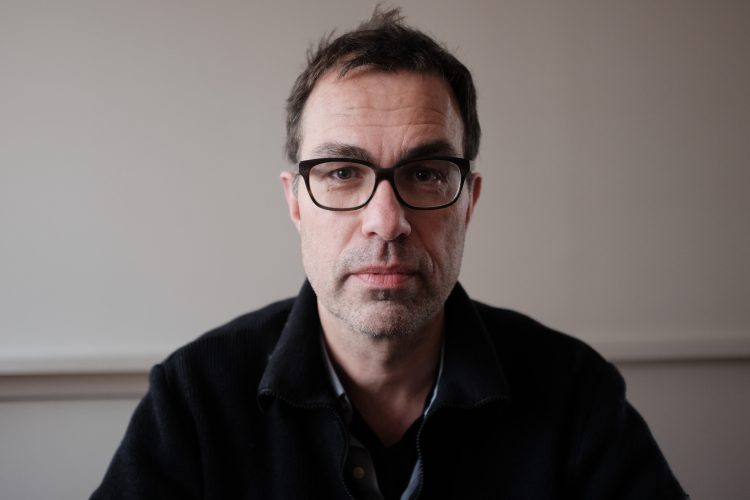
Did you have total autonomy, or were there things you needed authorization for?
No, it was quite easy, also because I had already done “La nuit du 12.” The Ministry of the Interior had seen the film, and they knew that I was not a dangerous anarchist [laughs], and that I was really talking about the work that the police do. And I was also lucky that there was a new head of the IGPN in France. For the first time, she was not a police woman, but a prosecutor. She wanted the IGPN to be less secretive and a bit more open. She thought it was important that people understood what they did, how they worked, and what they were doing. She thought it was a good idea that I should come and see how it worked. So there were no conditions. They never asked me to read the screenplay; they trusted me, and I could do whatever I wanted.
The film not only asks questions, but there’s also this topic of police violence, which is the backbone of the film. We condemn all kinds of violence, so what now?
In France—and pretty much everywhere now—things are very black and white. It’s like you’re pro-police or you’re anti-police, and there’s nothing in between. People try to categorize you very easily, and social media doesn’t help you to understand the complexity of it. I was interested in showing how police violence could happen, instead of pointing fingers and saying all police officers are violent and do bad things. The problem is that, for politicians, it seems impossible to acknowledge that police violence exists sometimes. It seems impossible to say something as simple as that; they’re afraid that the police unions will be scandalized. After all, the politicians need the police to protect them and to protect their government. And so they can’t afford to turn the police against them. They never dare to criticize anything, which is absurd because if you protect or find excuses for the police officers who commit violence, it doesn’t help all those police officers who do their job properly. So yes, I try to ask questions.
In all your films, you have this perfect balance between tension and moments of laughter and joy. There’s this scene, for example, where they’re all working on their computers and send each other emails, and then all of a sudden they’re out bowling and having fun. Humor is gold, isn’t it?
Yes, and I enjoy doing that. Even when the subject is serious, that doesn’t mean that you can’t laugh when you have a scene that is a bit lighter or even funny. Gilles and I like to build in moments like that, such as the bowling scene, or in the luxury hotel, when the investigator who works with Stéphanie asks, ‘How much does a room like that cost?’ When he finds out it costs two thousand euros, he tests the bed to see if it’s comfortable. Afterwards, you know that he has stolen a piece of soap; those are little moments that help you to build a character. You need to let off the steam once in a while. I enjoy doing that; Gilles and I do it quite naturally.
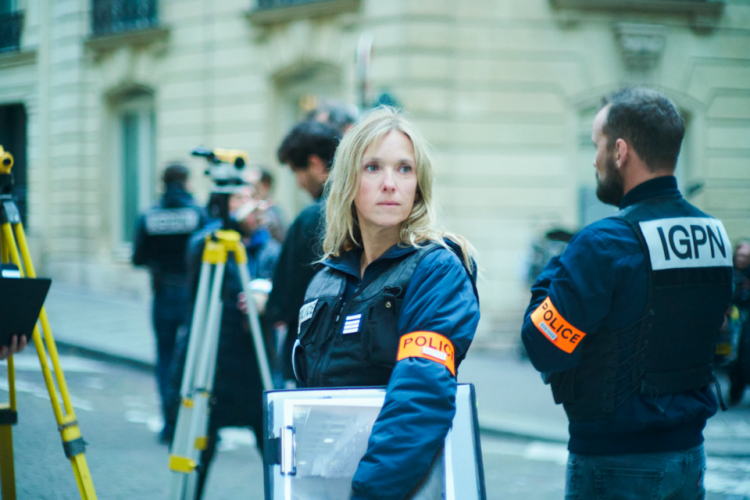
Did you have Léa Drucker in mind when you started writing the screenplay?
Not when I started writing. But during the writing process, I thought of her, and after a while, I imagined her playing that part. At the end, I could hear her voice when I was writing her dialogue. When I showed her the screenplay, she said yes immediately. That made me very happy; I couldn’t have imagined someone else playing that part. So it came progressively during the writing process.
How do you usually cast your leading actors? Do you call them, or do you need to get in touch with their agents?
It depends. I had worked with Léa on “Des nouvelles du planète Mars” [2016, a.k.a. “News From Planet Mars”]. We didn’t see each other that often since then, but I had her phone number, so I called her and we met to have a coffee, where I gave her the screenplay. Three hours later, she called me and said, ‘I really want to do it.’ She made it very simple.
You often work with the same people, like your co-screenwriter, your cameraman, editor, also your production designer Emmanuelle Duplay. I once read an interview with Robert F. Boyle, a production designer who worked for Alfred Hitchcock on three of his films. They asked him, ‘What does a production designer do?’ And he said, ’Well, the production designer is on the set, and if the director should drop dead suddenly, he steps over the dead body and finishes the film…’
…really? Wow! [Laughs.] Well, my production designers are very rarely on the set. They do all the work before the shooting, like building the sets, or finding the locations and refurbishing them, or whatever. There are two production designers I have worked with; we prepare everything, and we do location scouting. Emmanuelle Duplay was my production designer on “Dossier 137,” and she was rarely on the set because she was always preparing the next set. So I think if I drop dead, it wouldn’t have been necessarily her [laughs], but the assistant director could step in, or Gilles Marchand, who is also a director. But it’s an interesting story [laughs]; it’s funny that he said that.
Brussels
November 20, 2025
FILMS
INTIMITÉ, a.k.a. INTIMACY (1994) DIR Dominik Moll PROD Vincent Dietschy, Bénédicte Mellac SCR Dominik Moll (short story by Jean-Paul Sartre) CAM Pierre Milon ED Thomas Bardinet MUS Franck Ash, Philippe Razol, Philippe Ours CAST Christine Brücher, Nathalie Krebs, François Chattot, Christian Izard, Hélène Roussel, Laure Werckmann
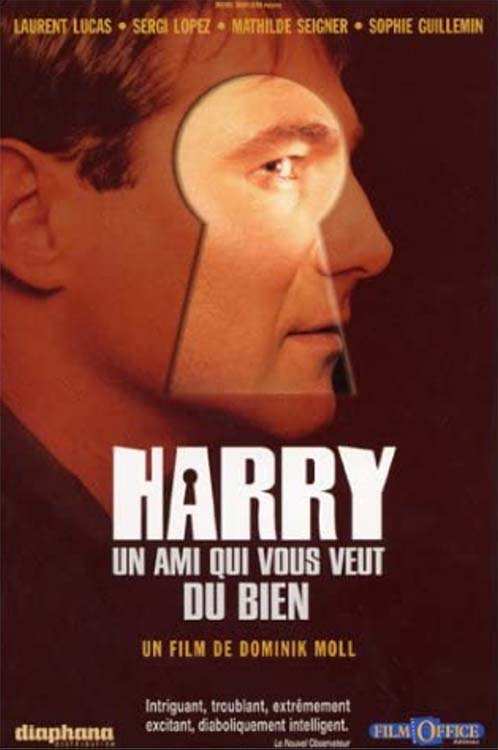 HARRY, UN AMI QUI VOUS VEUT DU BIEN, a.k.a. WITH A FRIEND LIKE HARRY… and HARRY, HE’S HERE TO HELP (2000) DIR Dominik Moll PROD Michel Saint-Jean SCR Dominik Moll, Gilles Marchand (poem by Francis Villain) CAM Matthieu Poirot-Delpech ED Yannick Kergoat MUS David Whitaker CAST Laurent Lucas, Sergi López, Mathilde Seigner, Sophie Cuillemin, Liliane Rovère, Dominique Rozan, Michel Fau, Victoire de Koster
LEMMING (2005) DIR Dominik MollPROD Michel Saint-Jean SCR Dominik Moll, Gilles Marchand CAM Jean-Marc Fabre ED Mike Fromentin MUS David Whitaker CAST Laurent Lucas, Charlotte Gainsbourg, Charlotte Rampling, André Dussollier, Jacques Bonnaffé, Véronique Affholder, Michel Cassagne
L’AUTRE MONDE, a.k.a. BLACK HEAVEN (2010) DIR Gilles Marchand PROD Carole Scotta, Barbara Letellier, Caroline Benjo, Simon Arnal SCR Dominik Moll, Gilles Marchand CAM Céline Bozon ED Nelly Quettier MUS Emmanuel D’Orlando, Anthony Gonzalez CAST Louise Bourgoin, Grégore Leprince-Ringuet, Melvil Poupaud, Swann Arlaud, Pauline Etienne, Pierre Niney, Patrick Deschamps
LA MOINE, a.k.a. THE MONK (2011) DIR Dominik Moll PROD Michel Saint-Jean SCR Dominik Moll, Anne-Louise Trividic (novel by Matthew Lewis) CAM Patrick Blossier ED Sylvie Lager, François Gédigier MUS Alberto Iglesias CAST Vincent Cassel, Déborah François, Joséphine Japy, Sergi López, Catherine Mouchet, Jordi Dauder, Geraldine Chaplin, Roxane Duran
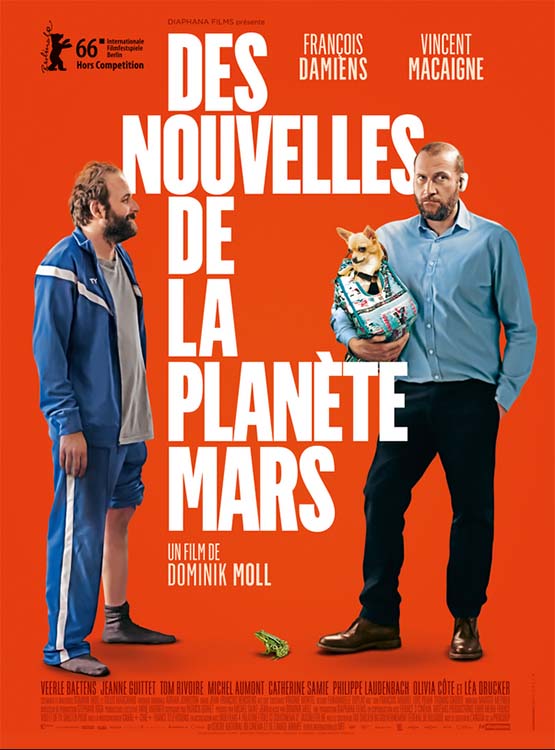 DES NOUVELLES DE LA PLANÈTE MARS, a.k.a. NEWS FROM PLANET MARS (2016) DIR Dominick Moll PROD Michel Saint-Jean SCR Dominick Moll, Gilles Marchand CAM Jean-François Hensgens ED Margot Meynier MUS Adrian Johnston CAST François Damiens, Vincent Macaigne, Veerle Baetens, Jeanne Guittet, Tom Rivoire, Michel Aumont, Catherine Samie, Léa Drucker
DANS LA FORÊT, a.k.a. INTO THE FOREST (2016) DIR Gilles Marchand PROD Jérémie Elkaïm, Valérie Donzelli SCR Dominik Moll, Gilles Marchand CAM Jeanne Lapoirie ED Yann Dedet MUS Philippe Schoeller CAST Jérémie Elkaïm, Timothé Vom Dorp, Théo Van de Voorde, Mika Zimmerman, Mireille Perrier, Sophie Quinton, Kristell Bizien, Marite Mibalo Johansson
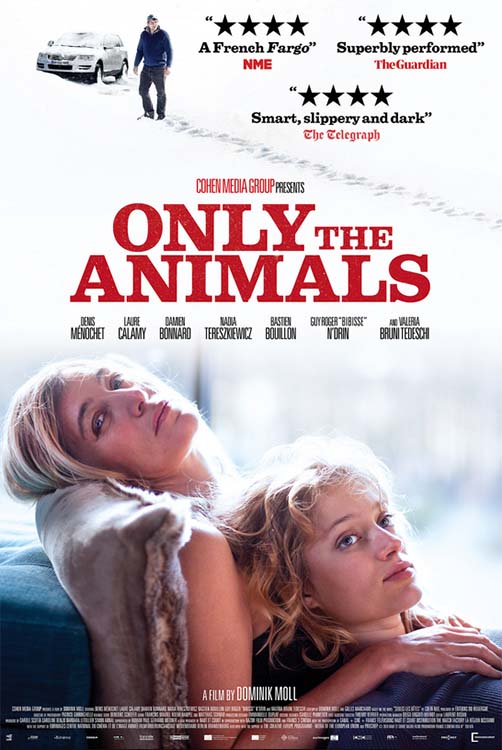 SEULES LES BÊTES, a.k.a. ONLY THE ANIMALS (2019) DIR Dominik MollPROD Carole Scotta, Barbara Letellier, Caroline Benjo, Simon Arnal SCR Dominik Moll, Gilles Marchand (novel by Colin Niel) CAM Patrick Ghiringhelli ED Laurent Rouan MUS Benedikt Schiefer CAST Denis Ménochet, Laure Calamy, Damien Bonnard, Nadia Tereszkiewicz, Bastien Bouillon, Valeria Bruni Tedeschi, Guy Roger ‘Bibisse’ N’Drim, Jenny Bellay
LA NUIT DU 12, a.k.a. THE NIGHT OF THE 12TH (2022) DIR Dominik Moll PROD Caroline Benjo, Carole Scotta, Barbara Leteiller SCR Dominik Moll, Gilles Marchand CAM Patrick Ghiringhelli ED Laurent Rouan MUS Olivier Marguerit CAST Bastien Bouillon, Bouli Lanners, Anouk Grinberg, Pauline Serleys, Charline Paul, Matthieu Rozé, Lula Cotton-Frapier, Thibaut Evrard, Théo Cholbi, Mouna Soualem, Baptiste Perais, Nathalaël Beausivoir, Jules Porier, Benjamin Blanchy
DOSSIER 137 (2025) DIR Dominik Moll PROD Caroline Benjo, Barbara Letellier, Simon Arnal SCR Dominik Moll, Gilles Marchand CAM Patrick Ghiringhelli ED Laurent Rouan MUS Olivier Marguerit CAST Léa Drucker, Jonathan Thurnbull, Mathilde Roehrich, Stanislas Mehrar, Pascal Sangla, Claire Bodson, Julien Lilti, Florence Viala de la Comédie Française, Hélène Alexandridis, Solàn Machando-Graner
 FILM TALK
You must be logged in to post a comment.