In 2007, French actress and Academy Award winner Juliette Binoche (b. 1964) and British dancer-choreographer Akram Khan (b. 1974) stepped away from their established careers to embark on a bold, artistic experiment. Over a period of seven months, they created “In-I,” an intense performance that they would stage over a hundred times around the world.
Now, almost two decades later, Juliette Binoche returns to that journey and their intense stage collaboration with the documentary “In-I in Motion,” which focuses on their boundary-pushing performances, and is assembled from studio rehearsal footage and a live recording of the finished stage production.
When they embarked on this journey, she was not a professional dancer, and Akram Khan had zero acting experience. Here, the challenge for the actress was to move, and for the dancer to speak.
In the past months, “In-I in Motion” was screened at several film festivals, and now, at 127 minutes—reduced from a 156-minute cut that was screened at a handful of festivals—it’s being released in various territories.
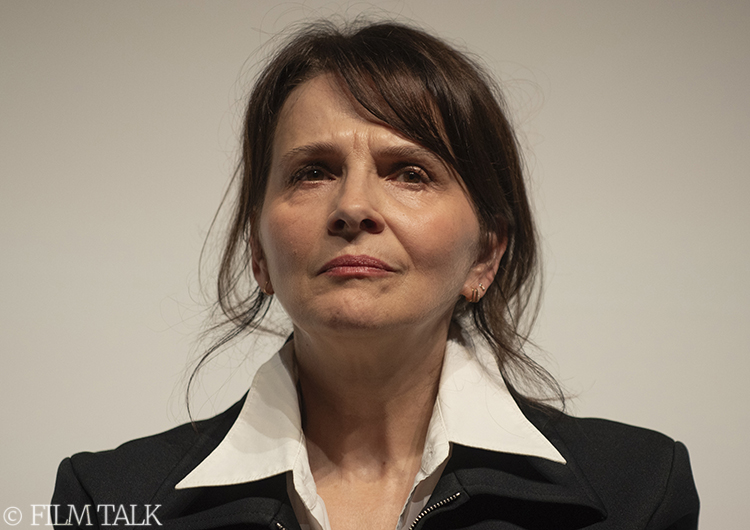
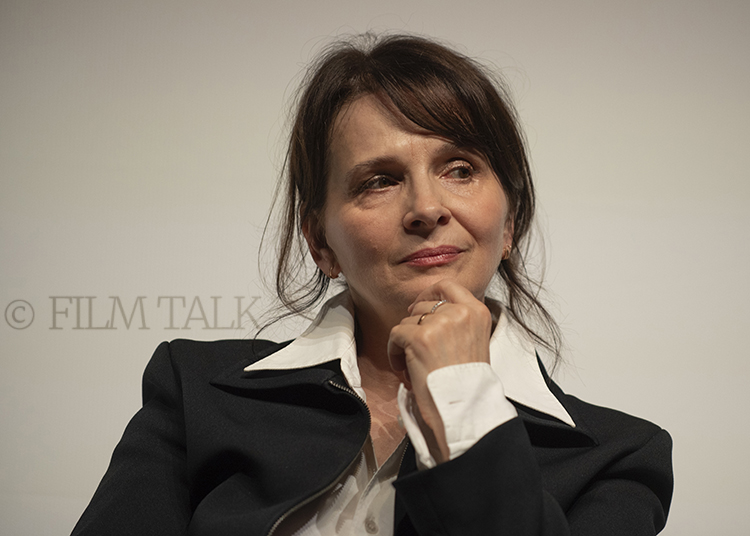
On June 17, Juliette Binoche introduced the film at BOZAR in Brussels, Belgium, during a Q&A, after a screening of “In-I in Motion.” Although originally announced as an English-language event, the Q&A was conducted in French. A few of her quotes from the Q&A are included in this post.
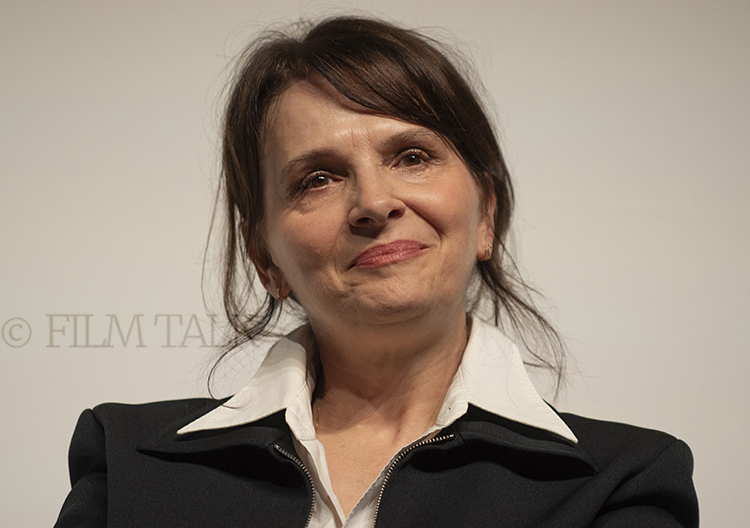
Robert Redford was the first; he pushed her to make this film after seeing “In-I” in New York. After the show, when she was about to go to her dressing room, he told her, ‘You have to make a film out of this.’ After about 120 shows around the world, she asked her sister Marion Staelens, who is also an actress, director and photographer, if she would be interested in shooting the last seven shows in Paris. She had also filmed them when they were rehearsing, so there was a lot of footage which was very helpful to understand and show what they had been through.
Officially, “In-I in Motion” is Juliette Binoche’s directorial debut, and it arrives as something unexpected—an intimate vérité documentary that peels back layers not just of performance, but of self-revelation. The film traces Binoche’s late-2000s plunge into an unfamiliar physical language. At a point in her career when critics had already canonized her performances, she chose vulnerability instead of triumph when she partnered with Akram Khan to create “In-I,” a dance-theater performance composed of vignettes exploring love in all its forms: infatuation, lust, banality, longing. Then she set aside her materials and waited nearly twenty years before returning to them through the lens.
A central theme of “In-I in Motion” is the relationship between body and emotion. Throughout the documentary, movement becomes a language through which the performers express desire, conflict, vulnerability, and reconciliation.
The documentary balances intimacy with scope as scenes alternate between sweat-soaked rehearsal rooms and empty stages, and quiet moments reflecting alone against public appearances carrying audiences across various continents.
It is very unusual for established performers to document themselves this way—mid-collision with new art forms. Most films featuring dancers capture polish; “In-I in Motion” honors friction—all the stumbling, failure, and exhaustion that precedes mastery.
Perhaps most poignantly, the documentary reframes what legacy means: those long hours spent falling down, learning rhythm, trusting another body enough to let them lead. For Binoche, artistry proved iterative rather than fixed—always becoming, never finished.
After seeing “In-I in Motion,” I’m sure audiences will understand motion itself differently. Movement isn’t merely displacement through space but continuous reinvention. And Binoche’s journey reminds us that sometimes the boldest act possible is simply showing up somewhere where you’ve never stood before, trembling openly, and willing to start over again.
“In-I in Motion” captures the intense rehearsal process as Binoche, best known for her acclaimed performances in cinema, enters the physically demanding world of contemporary dance. Unlike professional dancers, she must rely on emotional honesty rather than technical perfection. Khan guides her through movement exercises that allow her to communicate feelings that words alone cannot express. Their collaboration demonstrates that artistic expression is not limited by discipline, but flourishes through experimentation and mutual respect.
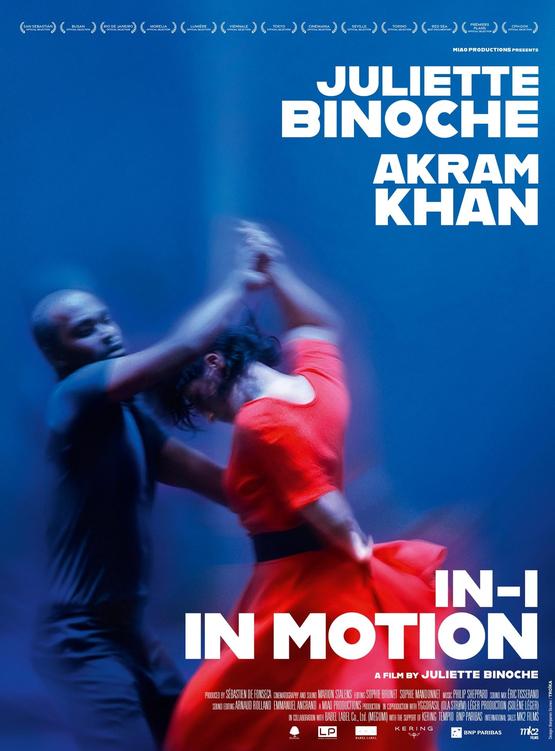 Visually, “In-I in Motion” reflects the elegance and intimacy of its subject. The cinematography alternates between close-up rehearsal footage and carefully composed performance sequences, creating a sense of immediacy while maintaining artistic beauty. Minimalistic staging directs attention to the performers’ bodies and emotions, reinforcing the idea that movement itself is the primary narrative force.
Ultimately, “In-I in Motion” is more than a documentary about a dance production. It is an insightful examination that reveals the emotional and physical challenges behind its creative process. The film encourages viewers to appreciate art as an ongoing journey rather than a finished product.
The film’s release will be restricted to the arthouse circuit, which has widely regarded Juliette Binoche as one of its defining actresses of the past four decades. After all, she built her reputation by working with many of the world’s most celebrated auteur directors such as Claire Denis, André Téchiné, and Leos Carax in independent cinema, rather than focusing on mainstream commercial cinema. Her career combines French, European, and international independent films with occasional Hollywood productions, even though she was—and remained—highly in demand in the U.S.
Some of her English-language films are “The Unforgettable Lightness of Being” (1988), “The English Patient” (1996, which earned her an Academy Award), “Chocolat” (2000), and “Dan in Real Life” (2007). But she also turned down multiple prestigious projects, including Steven Spielberg’s “Indiana Jones and the Last Crusade” (1989, the third installment in the Indiana Jones film series), “Schindler’s List” (1993), and “Jurassic Park” (1993).
In 2023, Binoche met two financiers and a producer who asked her, ‘Is there a project that you would like to do?’ She said, ‘Yes, I have this thing, and if you’re interested, here it is.’
‘As an artist, you have to put yourself into places where you have never been before,’ she said in Brussels. ‘That means you have to go out of your comfort zone. You can reinvent yourself, but you also need to go into the unknown; it takes a lot of courage. A project like this is not a journey with a lot of red carpets and awards.’
‘We are creatures, but we are also creators,’ she concluded. ‘And if I can do it, then everybody can.’
“In-I In Motion” (2025, trailer)


You must be logged in to post a comment.